
@Fogo Official The first time I encountered Fogo, it did not feel like a project trying to announce itself loudly. There was no sense of urgency in its presence, no attempt to present itself as a complete reinvention of blockchain infrastructure. Instead, it gave the impression of something shaped by observation rather than ambition. It seemed less concerned with making promises and more focused on adjusting small but important assumptions that had quietly shaped the limitations of existing systems. It felt like a project born from noticing friction rather than chasing attention.
The context into which Fogo enters is already dense with competition. Layer-1 blockchains have spent years attempting to balance speed, reliability, and openness, often framing their progress in terms of abstract numbers. Many networks speak in terms of throughput or efficiency, as if performance exists entirely within software. But over time, it has become clear that these systems are constrained not only by code but by the physical world itself. Distance, coordination, and timing create subtle inefficiencies that cannot be solved purely through programming. Fogo appears to begin from an acknowledgment of this reality, accepting that infrastructure must reflect the physical environment it operates within rather than pretending it can ignore it. 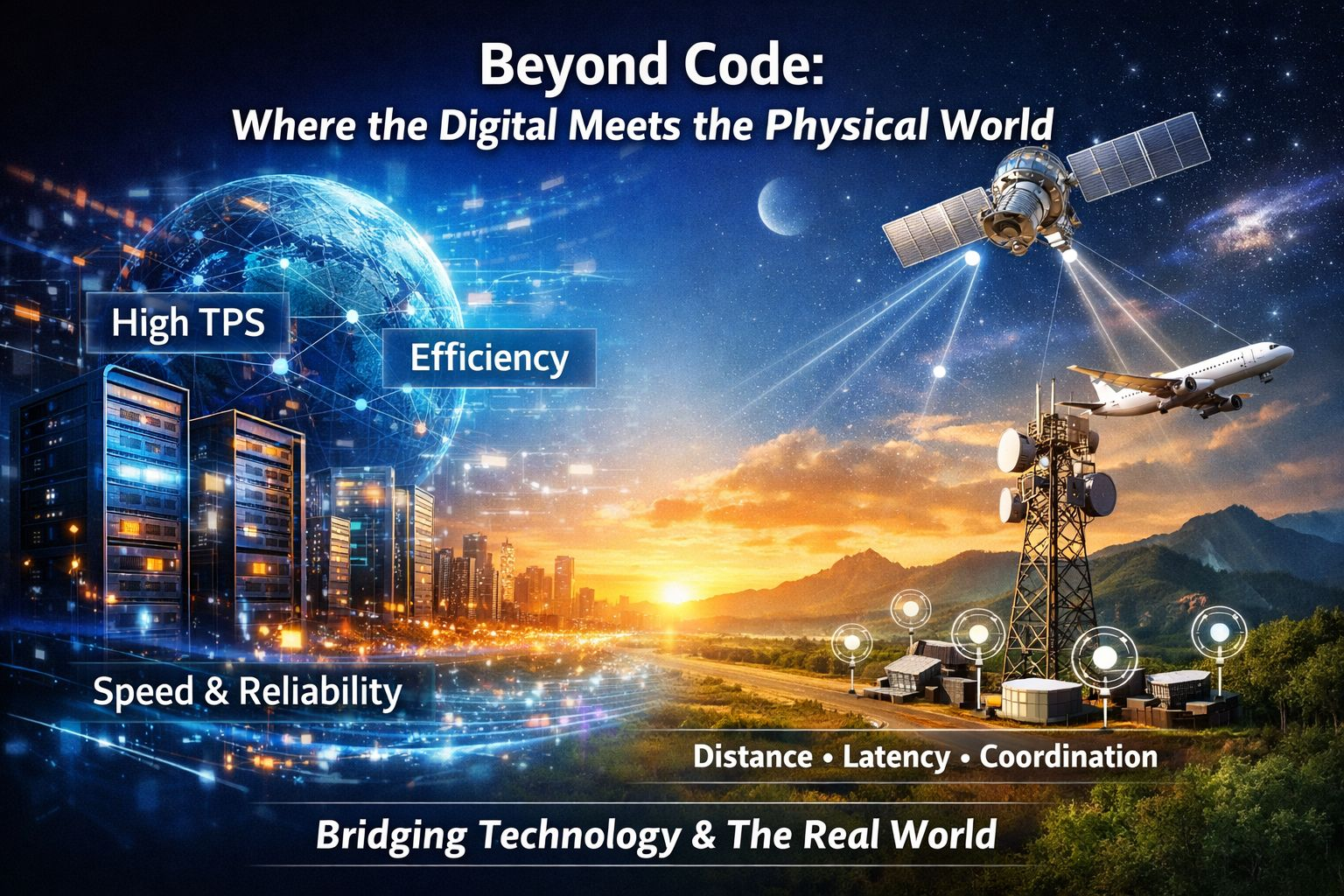
There is also something deliberate in its decision to build on the Solana Virtual Machine rather than inventing its own execution environment. This choice may appear unremarkable at first, but it reveals a particular mindset. Many projects attempt to differentiate themselves by replacing everything that came before, often at the cost of compatibility and familiarity. Fogo does the opposite. It accepts an existing foundation and reshapes the conditions around it. This approach quietly reduces the burden on developers and allows the system to evolve from something already understood rather than forcing people into unfamiliar territory. It suggests a preference for continuity over disruption, and refinement over invention.
What becomes more interesting over time is the specific problem Fogo seems to notice. Blockchain networks often promise openness and autonomy, but when it comes to practical use, especially financial activity, they can feel inconsistent. Transactions do not always settle when expected. Execution timing varies. Users are exposed to uncertainty that traditional financial systems learned to minimize decades ago. Fogo appears to approach this not by adding complexity, but by reducing unpredictability. Its architecture quietly centers around making execution more consistent, more stable, and more aligned with the expectations of systems that depend on precise timing.
There is an implicit admission in this design that not every blockchain needs to serve every possible use case equally. Instead of presenting itself as universal infrastructure, Fogo narrows its focus. It seems comfortable accepting the trade-off that specialization can bring clarity. By optimizing itself around financial interactions and trading environments, it avoids the broader ambition that often dilutes other networks. This narrowing of purpose can feel limiting, but it also creates coherence. The system begins to feel less like a general platform and more like a tool shaped for a particular environment.
This sense of intentional constraint appears again in the way its validator structure is organized. Rather than distributing activity evenly across the entire network at every moment, Fogo rotates responsibility across defined groups. This is not a dramatic change, but it reflects a willingness to acknowledge the cost of coordination across distance. It accepts that efficiency sometimes requires structure, and that decentralization does not need to mean constant simultaneous participation from every node. This is a subtle but meaningful shift in perspective, recognizing that decentralization can exist within cycles rather than constant uniformity.
Even the pace at which Fogo has entered the ecosystem reflects a measured approach. Its mainnet launch did not attempt to redefine the entire landscape overnight. Instead, it introduced its infrastructure and allowed early activity to emerge gradually. Adoption has begun in predictable areas where responsiveness and timing matter most, particularly in financial applications and trading environments. This progression does not feel forced. It resembles the slow alignment of infrastructure with the needs of those who find value in it, rather than an attempt to manufacture immediate relevance.
At the same time, there are unanswered questions that remain difficult to ignore. The long-term resilience of any specialized infrastructure depends not only on performance but on its ability to maintain trust under unpredictable conditions. Fogo’s design choices, including curated validators and geographic optimization, introduce efficiency but also raise questions about balance. Every system that prioritizes precision must eventually demonstrate that it can also endure disruption. This is not a flaw unique to Fogo, but it is a reality that every emerging infrastructure must confront..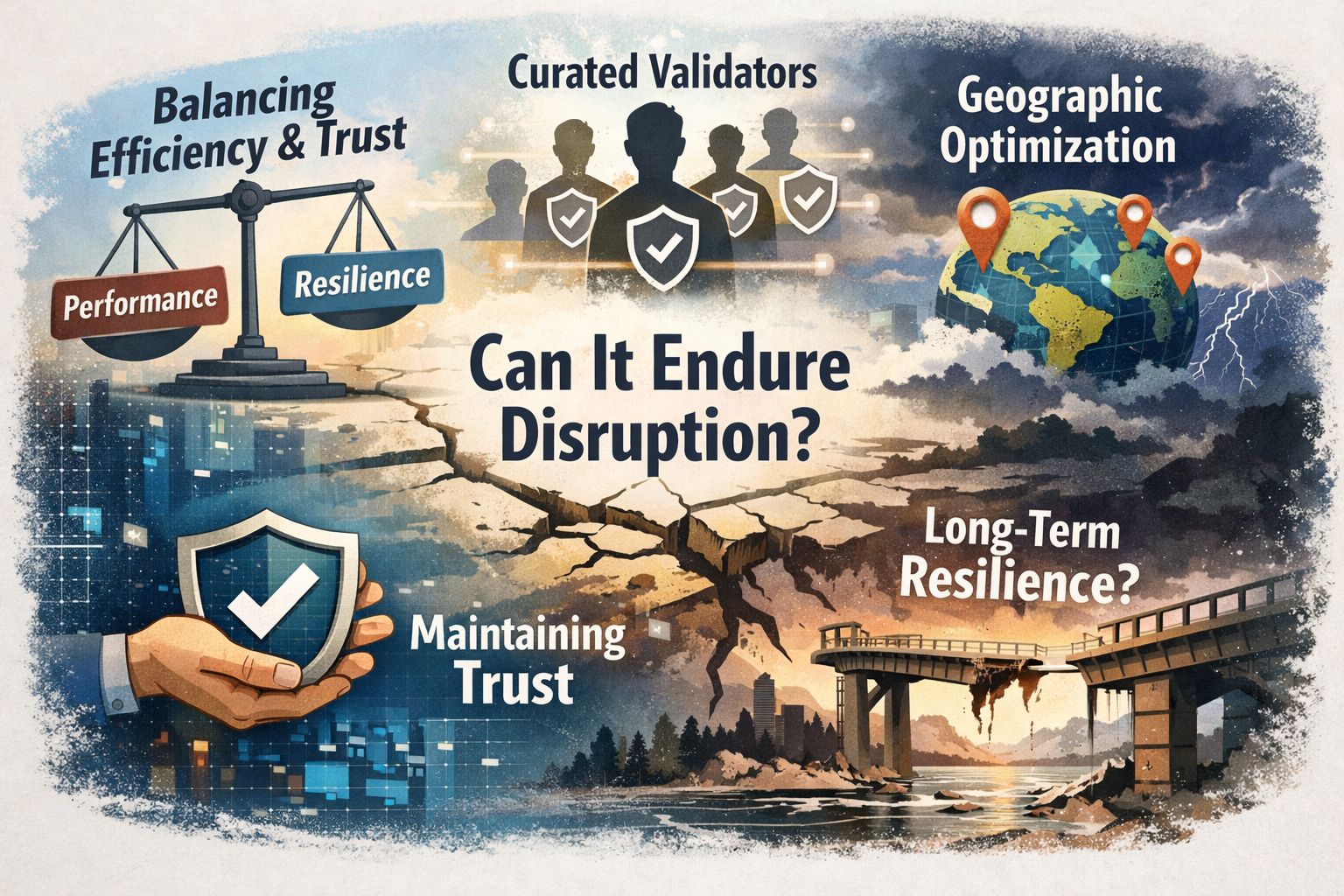
There is also uncertainty in how its identity will evolve. Many blockchain projects begin with clear technical focus but gradually expand into broader ecosystems. Whether Fogo remains specialized or slowly becomes more generalized will depend on how its community and developers interact with its capabilities. Sometimes systems designed for specific environments eventually become platforms for entirely different forms of activity. Other times they remain quietly effective within their original purpose.
What makes Fogo feel relevant is not its performance claims, but its restraint. It does not attempt to frame itself as the final answer to blockchain scalability or infrastructure. Instead, it feels like a project shaped by practical observation, refining the conditions under which decentralized systems operate rather than replacing them entirely. It exists as an adjustment rather than a declaration.
From a distance, Fogo does not appear as a turning point. It appears more like a correction. It reflects a growing awareness that infrastructure evolves not through dramatic breakthroughs, but through gradual alignment with the realities it exists within. Its direction suggests a system learning to coexist with physical and economic constraints rather than trying to escape them.
Whether this path leads to broader influence or quiet specialization is still unclear. But what can already be observed is its posture. It is not attempting to outrun the industry. It is attempting to stabilize itself within it. And sometimes, in an environment defined by constant acceleration, stability itself becomes the most meaningful change.
