Fogo is not trying to be louder than the market; it is trying to be faster than it.
That distinction matters. In a cycle where narratives have exhausted themselves and liquidity has become selective, infrastructure that alters execution physics has more impact than branding ever will. Fogo, a high performance Layer 1 built around the Solana Virtual Machine, is not interesting because it borrows a proven execution environment. It is interesting because it attempts to reshape how time, coordination, and capital interact on chain.
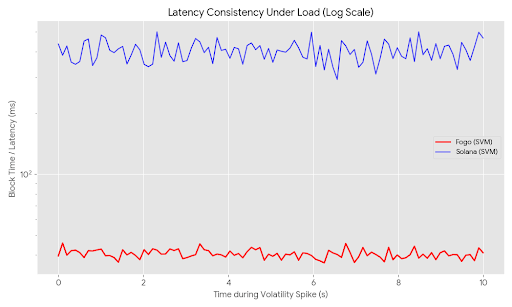
Speed in crypto has been misunderstood for years. Most traders equate it with throughput numbers or headline block times. What actually matters is latency consistency under load. Fogo’s architecture, reportedly capable of extremely low block times, only becomes meaningful when viewed through the lens of liquidity behavior. The real question is not how fast a block is produced, but how predictable finality is during volatility. When spreads widen and liquidations cascade, inconsistent confirmation times introduce hidden settlement risk. Capital withdraws not because of ideology, but because time becomes uncertain. If Fogo can maintain tight latency bands during stress, it does something more important than scale it reduces temporal risk.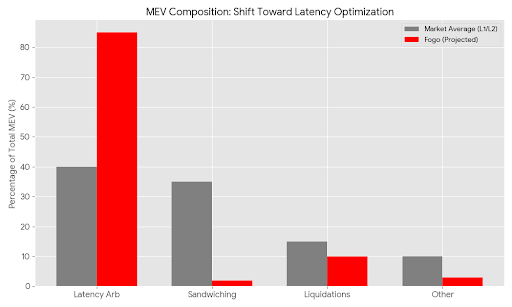
That reduction directly changes capital efficiency. On slower or less deterministic networks, professional liquidity providers must overcollateralize positions to account for execution delays and failed transactions. This dead capital is invisible in marketing decks, but it shows up in depth charts. When a chain lowers confirmation uncertainty, market makers can tighten spreads and recycle collateral faster. That increases real liquidity without new inflows. If Fogo’s execution model delivers consistent sub-second finality, it effectively increases the velocity of capital inside its ecosystem. In market structure terms, velocity often matters more than raw liquidity.
The decision to build around the Solana Virtual Machine is less about compatibility and more about order book culture. The SVM was designed for parallel execution, which structurally favors high frequency environments. This is not a philosophical choice; it is a market one. Order books require deterministic execution ordering. Automated market makers tolerate randomness better because they internalize slippage. Order books punish it. By inheriting an execution environment optimized for concurrency, Fogo implicitly positions itself as infrastructure for traders rather than passive liquidity.
But there is a hidden tradeoff in high performance validator design. Ultra fast block production compresses the window for participation. Validator economics become more capital intensive because hardware requirements rise as latency expectations fall. This can centralize validation around well capitalized operators. The question serious participants should ask is not whether Fogo is decentralized today, but whether its validator incentive model remains attractive when token emissions decline and fee revenue becomes the primary reward. If hardware costs outpace fee growth, smaller validators disappear. That shifts governance and potentially increases regulatory attack surface.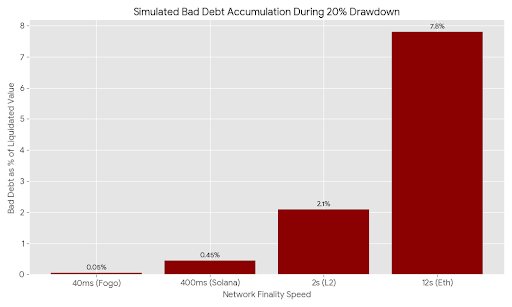
Regulatory pressure is not theoretical anymore. The market has moved past speculative token flows and into an era where stablecoins and real world assets dominate on chain settlement. Infrastructure that wants durable liquidity must anticipate compliance friction. High performance chains face an additional challenge: their speed amplifies systemic errors. If a sanctioned wallet interacts with a protocol, enforcement windows shrink. Fogo’s long term viability will depend on how it balances neutral execution with compliance adaptability. Institutional capital does not require censorship, but it does require predictability around enforcement risk.
In current market conditions, capital is rotating toward environments that minimize operational friction. We are seeing a quiet migration from fragmented Layer 2 ecosystems back to cohesive Layer 1 environments where composability is intact. Fragmentation introduced bridging risk and liquidity silos. Fogo enters this landscape offering performance without the cross domain complexity of multi layer stacks. That matters for institutional desks managing basis trades or delta neutral strategies. Cross chain latency introduces basis instability. A unified high speed environment simplifies risk modeling.
Settlement design also affects liquidation dynamics. In volatile markets, liquidation engines rely on rapid state updates to avoid bad debt. On slower chains, price oracles and execution lag can create gaps between mark price and executable price. If Fogo maintains synchronized execution and state propagation, it reduces the window where bad debt accumulates. That is not just a protocol level benefit; it influences how much leverage platforms are willing to offer. Leverage depth correlates with settlement reliability. Infrastructure that supports faster liquidation resolution can sustain more aggressive margin frameworks without destabilizing the system.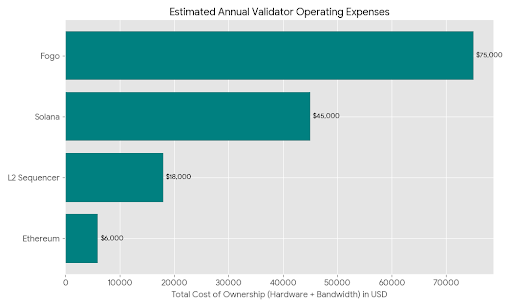
There is also a behavioral component to speed. Traders adapt strategies based on execution constraints. On slower chains, strategies lean toward swing positioning and liquidity farming. On faster chains, microstructure strategies emerge. Scalping, arbitrage, latency sensitive strategies these behaviors increase transaction density. Transaction density, when organic, strengthens fee markets and validator revenue. But it also creates bursty demand. Fogo’s sustainability depends on whether its fee model can absorb bursts without pricing out consistent users. Fee volatility has destroyed more ecosystems than hacks ever did.
The Solana Virtual Machine brings another structural advantage: developer familiarity in performance oriented design. Yet the assumption that developer migration automatically brings liquidity is flawed. Liquidity follows opportunity, not code compatibility. Fogo must create conditions where deployed applications generate genuine yield or trading edge. Otherwise, it becomes a faster ghost town. Infrastructure alone does not attract durable capital; profitable primitives do. What infrastructure can do is lower the friction for those primitives to emerge.
Institutional adoption constraints often revolve around operational clarity. Custody, auditability, and predictable validator sets matter more than retail enthusiasm. High performance chains sometimes struggle here because rapid iteration can compromise audit cycles. If Fogo evolves quickly at the protocol level, it must balance innovation with stability. Institutions prefer environments where protocol changes are deliberate and transparent. Governance pacing becomes a competitive advantage.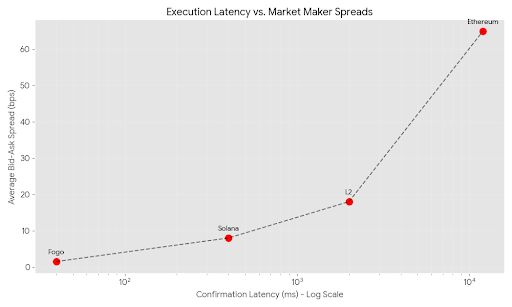
One overlooked mechanism in high speed environments is MEV distribution. Faster block times compress the arbitrage window, but they do not eliminate extractable value. They shift who captures it. If block production is tightly controlled or validator sets are small, MEV concentration increases. That can distort fee markets and discourage independent validators. Fogo’s long term health will depend on whether it democratizes value capture or allows it to centralize quietly. The market eventually prices in invisible extraction.
On chain data would reveal early signals. I would watch validator concentration ratios, median confirmation time variance during volatility spikes, and the proportion of transactions originating from arbitrage bots versus organic users. If bot dominance exceeds sustainable thresholds, retail users experience degraded execution despite fast blocks. Speed without fairness becomes cosmetic.
Capital flow patterns in this cycle show that liquidity is no longer impressed by theoretical scalability. It demands reliability under stress. Chains that performed well during calm markets but failed during volatility have lost institutional credibility. Fogo’s true test will not be throughput benchmarks; it will be its behavior during a broad market drawdown. Does it maintain liveness? Do fees remain rational? Do liquidation engines clear debt efficiently? Infrastructure earns trust during stress, not expansion.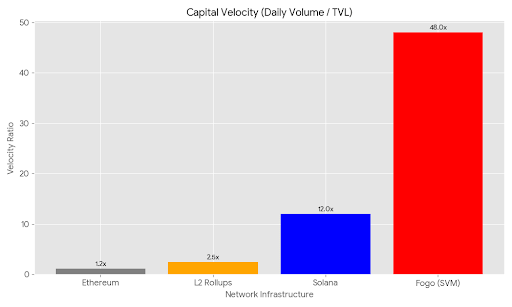
There is also the macro layer. As tokenized treasuries and stablecoin settlement volumes grow, infrastructure that can handle high value transfers with minimal settlement lag gains strategic importance. Traditional finance operates on deterministic timeframes. If Fogo positions itself as a settlement rail for high value digital assets, its latency advantages become economically meaningful. But that requires integration with compliance frameworks and custodial partners, which introduces governance complexity.
Validator incentive alignment becomes critical as emissions taper. If transaction fees become the dominant reward, network activity must remain robust. Artificially stimulated activity through incentives creates temporary illusions. Sustainable fee markets arise from genuine economic activity. Fogo must foster applications that generate recurring transactional demand rather than speculative spikes. Otherwise, validator attrition becomes inevitable.
There is a structural weakness in many competing designs: overreliance on rollups to achieve scalability. Rollups fragment liquidity and introduce sequencer trust assumptions. Fogo’s single-layer high-performance approach avoids that complexity, but it inherits a different risk hardware centralization. The tradeoff is clear. The market will decide which risk profile it prefers. My sense, based on current capital flows, is that simplicity with performance is gaining favor over modular complexity.
From a trader’s perspective, what matters is execution integrity. If I place a large order during volatility, I care about slippage, confirmation reliability, and liquidation responsiveness. Marketing does not protect capital; infrastructure does. If Fogo consistently delivers low latency finality under load, spreads tighten organically. Tight spreads attract volume. Volume sustains validators. Validators secure the chain. That feedback loop is the real product.
The final point most participants miss is that speed changes governance psychology. Faster systems create expectations of immediate resolution. When disputes, forks, or governance votes arise, stakeholders accustomed to rapid execution demand rapid coordination. Social consensus does not scale as cleanly as transaction throughput. Fogo’s community and validator set must be able to deliberate at the pace its infrastructure implies. Otherwise, technical speed outpaces human alignment.
Fogo is ultimately a bet on execution determinism in a market tired of fragmentation. It is not revolutionary because it is new. It is consequential if it proves that ultra fast Layer 1 design can remain economically decentralized, regulatorily adaptable, and institutionally credible at the same time. That combination is rare.
If it succeeds, the impact will not be visible in headlines. It will be visible in depth charts that hold firm during volatility, in liquidation engines that clear without socialized losses, and in validators who remain profitable without hidden extraction. Infrastructure maturity is quiet. But when it works, the market feels different.
And seasoned traders notice when the physics change.