
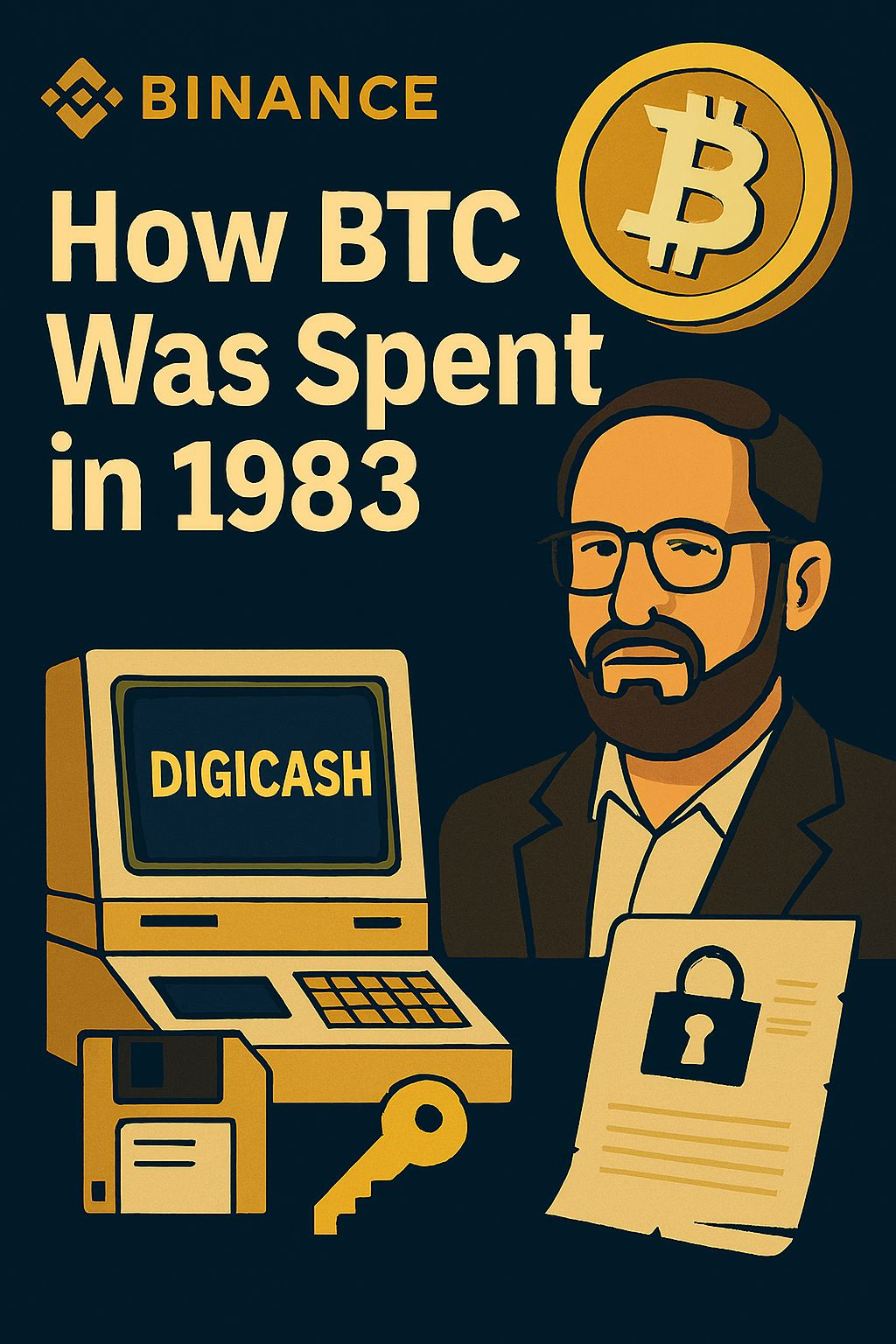
#Write2Earn In 1983, cryptographer David Chaum created the e‑cash protocol based on blind signatures. This allowed users to anonymously spend their digital money issued by his company DigiCash, which was then stored locally on the user’s computer without revealing their identity. However, the system was centralized, because the money was cryptographically signed by Mark Twain Bank USA to verify authenticity. (Later, a few European banks received licenses, but the project never went mainstream.)
In the 1990s, the cypherpunk movement emerged — a group of cryptographers and activists who discussed anonymity, freedom from government control, and the possibility of creating decentralized currencies. This is where the ideas behind blockchain were born.
Adam Back, a supporter of the movement, embraced the blockchain concept and in 1997 developed Hashcash — a Proof‑of‑Work mechanism to fight spam. (This principle later became the foundation of BTC mining.)
Wei Dai appreciated the Proof‑of‑Work idea and in 1998 created B‑Money, a decentralized digital currency. Nick Szabo added his concept of Bit Gold, using computational puzzles to generate value. These projects essentially became the blueprint for Bit‑coin. And just like that — Bitcoin was born! But unexpected events followed…
Knowing about these inventions, Satoshi Nakamoto appeared. In October 2008, he borrowed the idea of decentralized digital currency from Bit‑Money and, with no competition yet, quickly published his paper:
“Bitcoin: A Peer‑to‑Peer Electronic Cash System”, describing a supposedly new decentralized network, blockchain, and Proof‑of‑Work mechanism.
On January 3, 2009, Satoshi boldly launched the first block — the Genesis Block — and began the history of Bit‑coin (BTC), claiming he invented the system. That same day, he mined the first block (50 BTC), but there was no exchange or trading infrastructure yet, so BTC had no market price at launch.
Until October 2009, BTC was worth $0 — it couldn’t be exchanged for money. The first public price appeared on October 5, 2009, when an enthusiast named New Liberty Standard calculated the value based on electricity costs for mining:
- $1 = 1309.03 BTC
- So 1 BTC ≈ $0.000764
Later, in May 2010, Laszlo Hanyecz (famous for the pizza deal) exchanged 10,000 BTC for two pizzas (~$25), setting a new rate:
≈ $0.0025 per BTC — considered the first real commercial transaction.
By the way, Laszlo Hanyecz was a friend of Satoshi and wrote the GPU mining node. His contribution was critical: he proved BTC could be mined much faster, triggering the tech race from CPU to GPU and eventually to ASIC. Yet, history remembers him as the guy who traded 10,000 BTC for two pizzas.
Then in July 2010, the Mt.Gox exchange launched. Prices ranged from $0.05 to $0.08 per BTC, marking the start of real USD trading. By the end of 2010, BTC hit $0.50, and in 2011 — $1 and beyond. The rest of the story, you probably already know.
So don’t believe everything the globalists write online to promote their next financial project 🤭
---
In My Next Article…
I’ll reveal how cryptographer David Chaum stole the idea of B‑Money from the cashless Euro prototype issued in 1956 for interbank settlements.

1998 Bit-Money vs. Bit-Coin 2009