


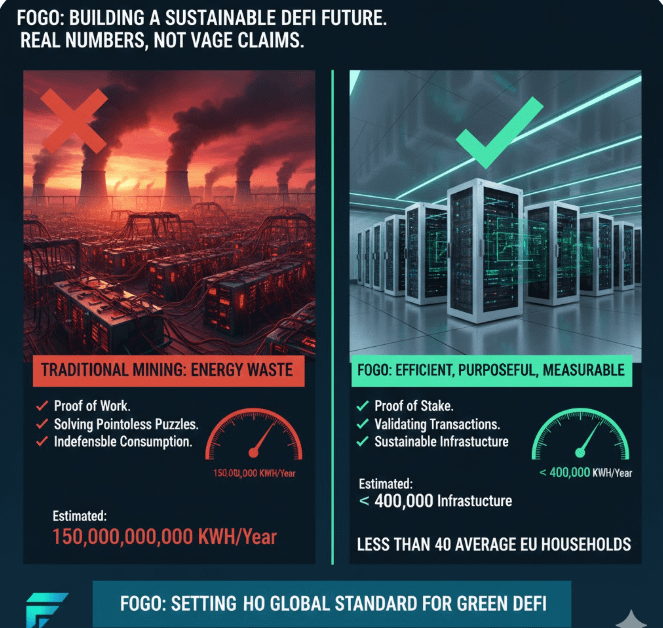
Crypto has a reputation problem with energy. It's earned in some cases particularly with proof-of-work networks that run massive arrays of specialized hardware, consuming electricity at rates comparable to small countries, all to solve mathematical puzzles that serve no purpose other than establishing who gets to add the next block to the chain.
But that reputation has become something of a blunt instrument, applied broadly to all crypto without distinction. Not all blockchains are the same. The energy profile of a proof-of-stake network is fundamentally different from a proof-of-work network. And the specific design choices within proof-of-stake networks create large variations in energy consumption.
Fogo takes the energy question seriously and the numbers in the whitepaper tell a specific, auditable story.
How Fogo Handles Consensus
Fogo uses Proof of Stake (PoS). This matters enormously for energy consumption. In PoS, the right to produce the next block is allocated based on how much token is staked essentially, a proportional economic lottery. There's no computational arms race to solve a puzzle. Validators don't need to run massive arrays of graphics cards or specialized ASICs. They run standard server hardware the same kinds of machines that power web servers, databases, and cloud computing.
The energy cost of a PoS validator is roughly proportional to the energy cost of running a server. It's orders of magnitude less than the energy cost of running a proof-of-work mining operation of comparable economic value.
This is why Ethereum's energy consumption dropped by approximately 99.95% when it switched from proof-of-work to proof-of-stake in 2022. The mechanism matters that much.
Fogo's Specific Numbers
The Fogo whitepaper goes beyond "we're PoS, therefore we're green" to provide specific estimates. The estimated total energy consumption for operation and validation of the Protocol in its first year is anticipated to be less than 400,000 kWh.
To put that in perspective: the average US household consumes approximately 10,500 kWh per year. Fogo's entire network, for a full year of operation, is expected to consume the equivalent of fewer than 40 households' annual electricity use.
These are preliminary estimates, and the whitepaper is appropriately cautious about the certainty of these numbers actual consumption may differ based on hardware configuration, validator participation, software optimizations, and other factors. But the order of magnitude is meaningful. This is not a network that will appear in headlines about environmental impact.
The Methodology
The energy estimates are based on the methodology recommended by the Crypto Carbon Ratings Institute in their December 2024 paper on MiCA sustainability indicators. This is an independent, methodologically rigorous approach not a number the project came up with itself.
The calculation starts from hardware specifications. Fogo's validators currently run on AMD EPYC 9275F processors, which have a thermal design power (TDP) of 320W meaning they're designed to dissipate up to 320 watts under full load. At this TDP, running continuously for a full year, one validator machine consumes approximately 1 kWh per year... wait, let me recalculate: 320W × 8760 hours = 2,803 kWh per year, so roughly 2.8 MWh per validator annually.
With fewer than 40 initial validators, the total comes to under 112 MWh well under the 400,000 kWh threshold stated.
The whitepaper also commits to updating if the network's energy consumption exceeds 500,000 kWh annually, providing a clear accountability mechanism. If the network grows more validators, more transactions, more activity and energy use crosses the threshold, the disclosure will be updated.
The Climate Commitment in MiCA
The Fogo whitepaper's sustainability section exists because MiCA requires it. Part J of the whitepaper template specifically asks for information on adverse impacts on climate and other environment-related adverse impacts. This requirement is a meaningful innovation in crypto regulation it forces projects to put specific numbers on their environmental footprint rather than making vague claims about efficiency.
Requiring MiCA whitepaper issuers to disclose energy consumption means that this information is standardized and comparable across projects. Investors, users, and regulators can look at these numbers and make informed comparisons. Over time, this kind of transparency creates market incentives for efficiency: projects with high energy consumption face scrutiny, while efficient projects like Fogo can point to their numbers as a genuine differentiator.
Zone Architecture and Energy Efficiency
There's an interesting interaction between Fogo's multi-local consensus architecture and its energy profile.
Because validators within a zone are geographically clustered and communicating with each other very efficiently, the network achieves high throughput with a smaller validator set than a more globally distributed network might require. Fewer validators means less total energy consumption, while the zone structure ensures the network remains fast and secure.
Additionally, the priority fee mechanism creates efficient use of block space validators are incentivized to fill their blocks with the most valuable transactions, which means processing capacity isn't wasted on low-value spam. This economic efficiency indirectly supports energy efficiency: the network does useful work with its energy consumption rather than burning compute on transactions that add little value.
The Bigger Picture
The sustainability story for Fogo isn't just about compliance with MiCA or having favorable numbers compared to Bitcoin. It's about recognizing that the applications the Protocol is designed to enable high-frequency DeFi, real-time gaming, enterprise data applications will run on infrastructure that needs to scale. A network that starts with sound energy economics, built on an architecture that doesn't require computational waste, is better positioned to grow sustainably.
The transition from "crypto is an environmental disaster" to "some crypto is exceptionally energy efficient" is already underway in how sophisticated observers think about the space. Fogo's position on the efficient end of that spectrum isn't incidental it's the natural result of building on PoS with a lean, performance-optimized validator set.
The 400,000 kWh number is specific and verifiable. That's how energy transparency should work.