Most infrastructure conversations in crypto still revolve around peak TPS and benchmark bursts. I’m not interested in bursts. I care about time discipline — because in production systems, especially in trading-heavy environments, latency variance is risk.
That’s where Fogo’s design philosophy stands apart.
Fogo is not positioning itself as another high-throughput chain. It is architecting an execution environment where predictability is engineered, not assumed. And that distinction matters more than most builders realize.
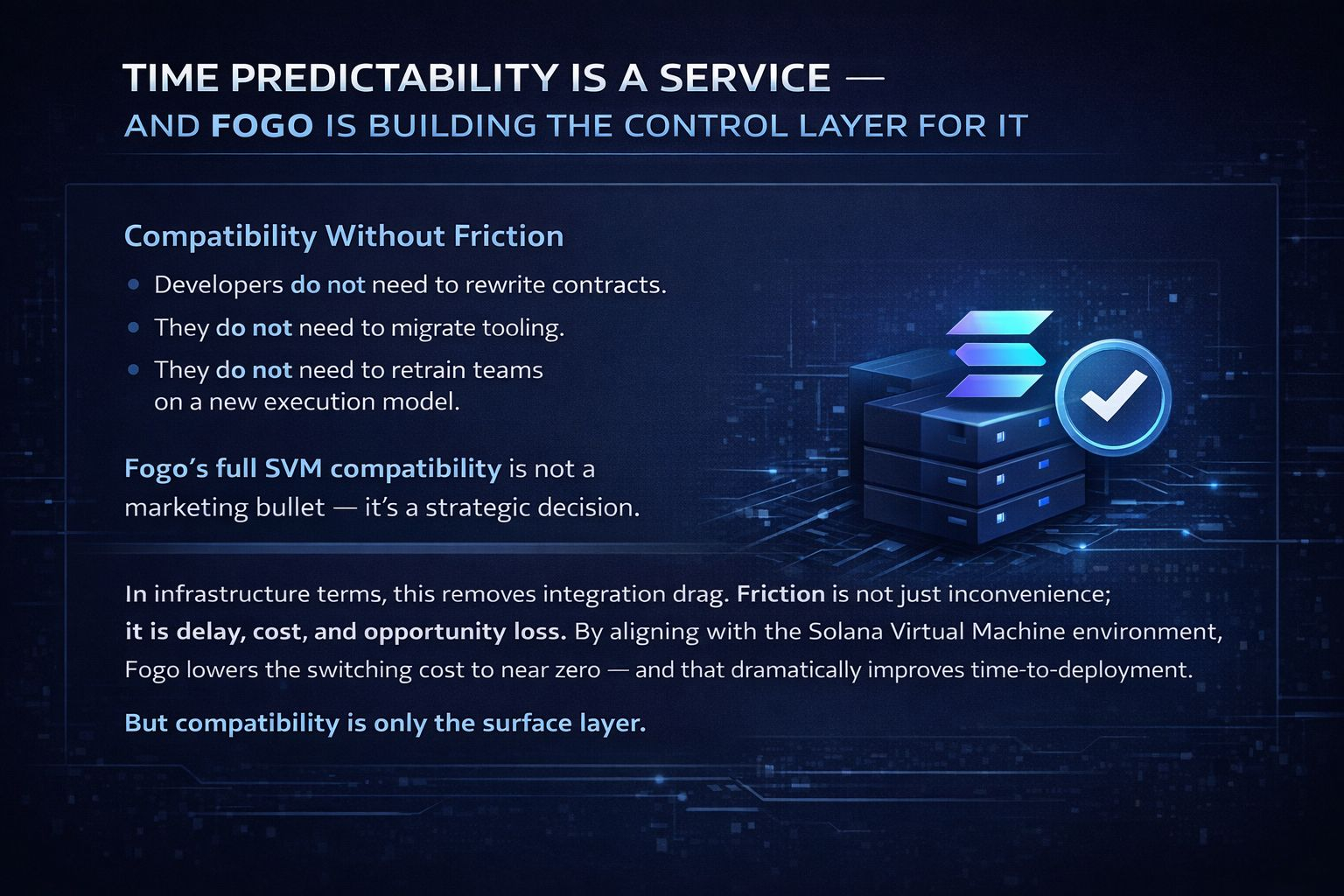
Compatibility Without Friction
Fogo’s full SVM compatibility is not a marketing bullet — it’s a strategic decision.
Developers do not need to rewrite contracts.
They do not need to migrate tooling.
They do not need to retrain teams on a new execution model.
In infrastructure terms, this removes integration drag. Friction is not just inconvenience; it is delay, cost, and opportunity loss. By aligning with the Solana Virtual Machine environment, Fogo lowers the switching cost to near zero — and that dramatically improves time-to-deployment.
But compatibility is only the surface layer.
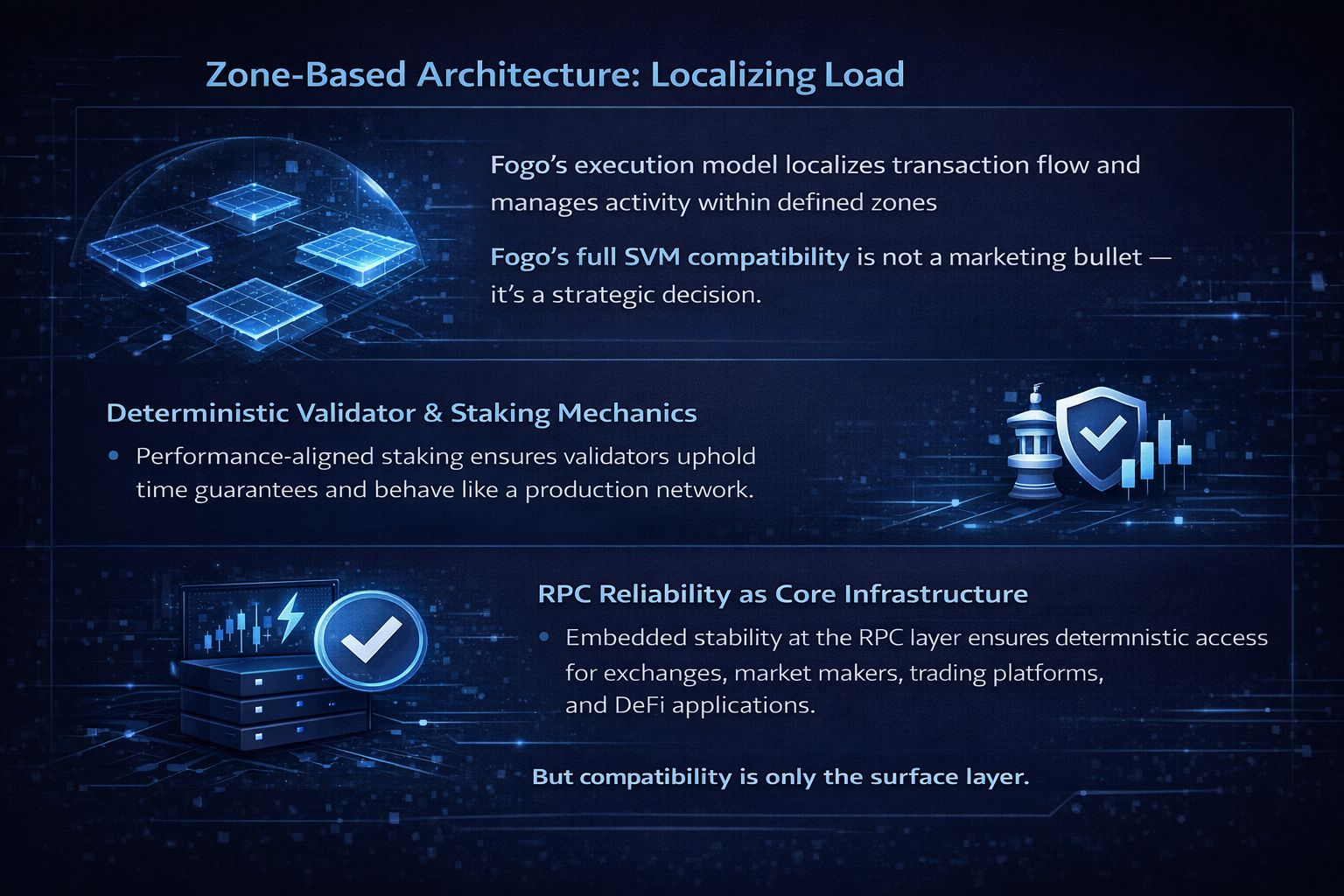
Zone-Based Architecture: Localizing Load
Where most networks struggle is not average throughput — it’s load distribution under stress.
Fogo’s zone-based execution model localizes transaction flow. Instead of allowing congestion to propagate system-wide, execution domains are structured to contain and manage activity within defined boundaries.
From a systems engineering perspective, this reduces cascading latency spikes. It improves determinism. It allows performance isolation.
In trading and real-time DeFi, containment is resilience.
Deterministic Validator & Staking Mechanics
Validator incentives are often discussed purely in economic terms. Fogo approaches them operationally.
The staking structure is aligned around performance consistency, not just liveness. Validators are expected to uphold time guarantees as part of their role in the system.
This reframes staking from passive yield participation to service-level accountability.
When validator design aligns with execution discipline, you begin to see infrastructure behaving less like an experiment and more like a production network.
RPC Reliability as Core Infrastructure
Most chains treat RPC reliability as an external problem. Fogo treats it as first-order architecture.
For serious builders — exchanges, market makers, on-chain trading desks — RPC stability is not optional. It determines whether systems can operate with deterministic latency expectations.
By embedding reliability into the network’s operational design, Fogo signals that it understands where institutional friction actually exists.
This is not about flashy features.
It is about reducing operational uncertainty.
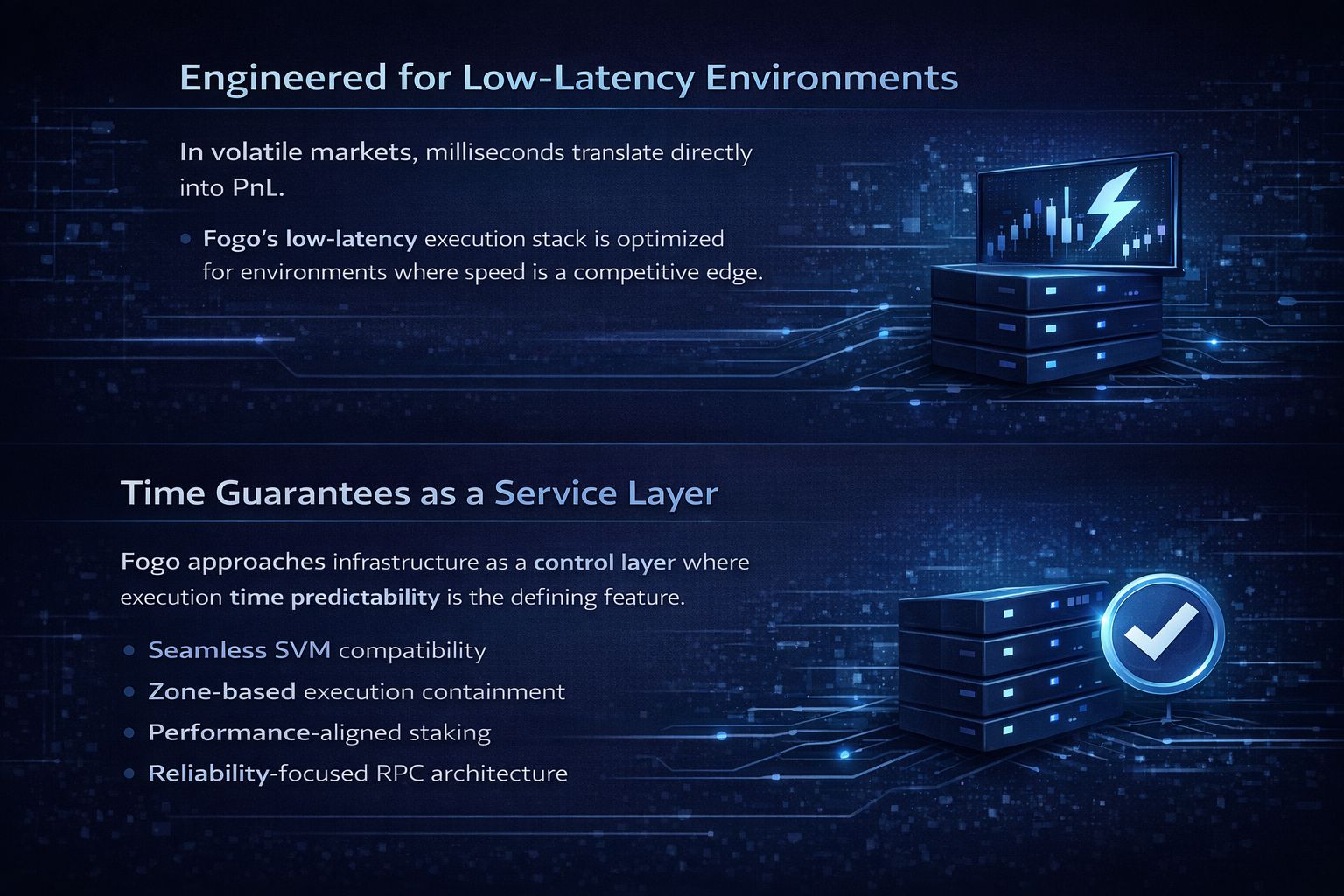
Engineered for Low-Latency Environments
In volatile markets, milliseconds translate directly into PnL.
If your infrastructure produces unpredictable confirmation timing, slippage risk increases. Execution strategies degrade. Arbitrage windows close. Liquidations misalign.
Fogo’s emphasis on low-latency execution, combined with zone isolation and validator alignment, creates a system optimized for environments where timing precision is a competitive edge.
That is not a retail narrative. That is an infrastructure thesis.
Time Guarantees as a Service Layer
When I evaluate infrastructure, I ask a simple question:
Does this system treat time as a variable — or as a constraint?
Fogo treats time as a constraint to be engineered around.
By combining:
Seamless SVM compatibility
Zone-based execution containment
Performance-aligned staking
Reliability-focused RPC architecture
Fogo is building what I consider a control layer for predictable on-chain execution.
Not hype.
Not theoretical throughput.
But measurable, operational discipline.
And in a market that increasingly rewards serious infrastructure over speculative noise, predictability may be the most undervalued product of all.
Fogo is not competing to be the loudest network.
It is competing to be the one you can rely on when timing matters most.