
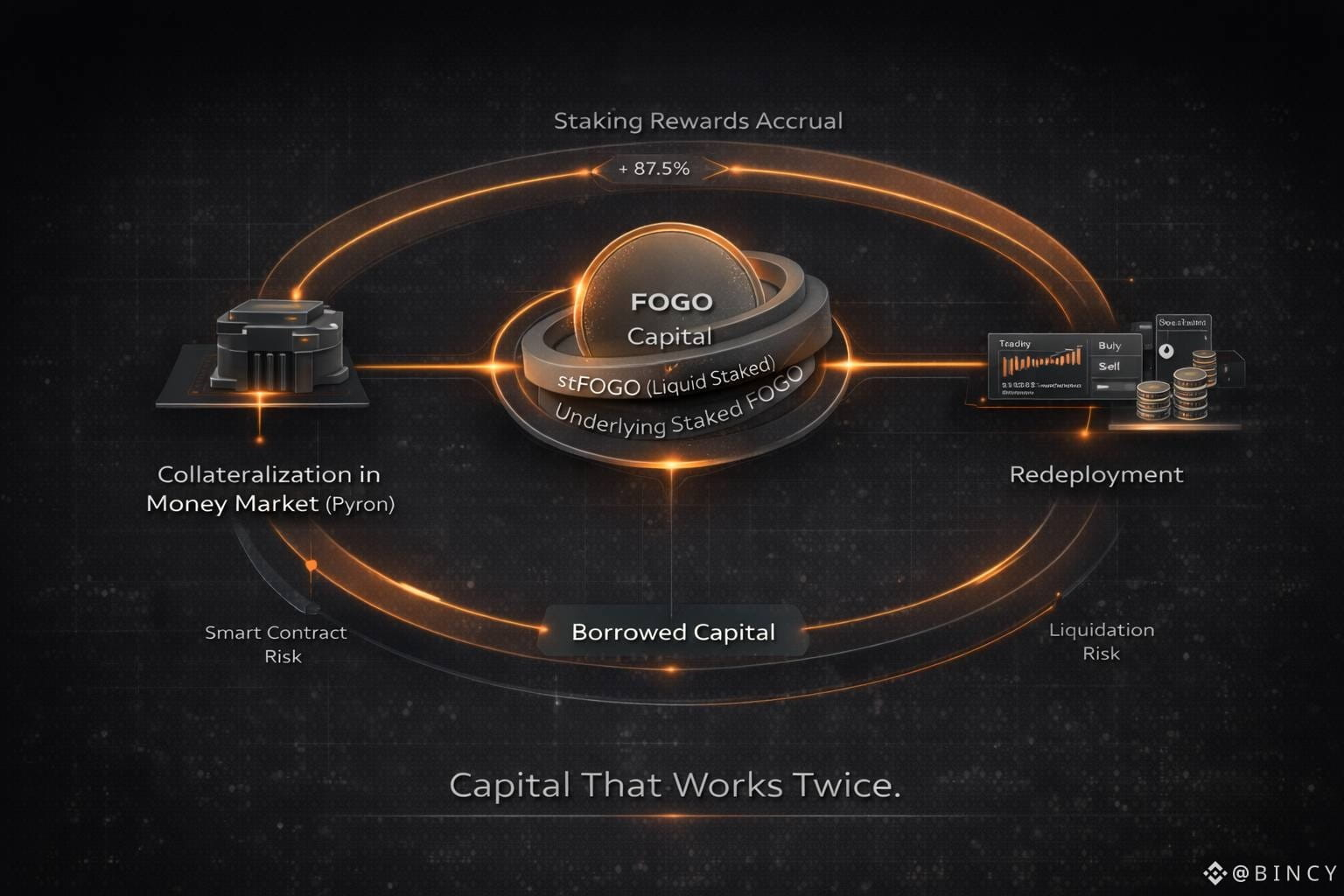
A majority of the folks view FOGO as a quick chain among buyers. So, that is so but the most interesting thing is that FOGO takes advantage of that speed to create a stack that saves money: you can stake, lend, and trade together without the common challenges. In simple terms, FOGO desires to leave the so-called idle capital wasted.
Such a design is important in actual markets. Professional traders are not only interested in the speed of execution, but in the number of ways my capital can be deployed simultaneously, and the speed at which I can handle risk in the event that the market changes. The ecosystem of FOGO begins to reply to that with liquid staking and money markets which convert staked exposure into collateral.
The reason Staking Isn’t Sufficient to be a Chain with a Trading Focus.
Classic staking is easy: you lock the tokens, get rewards, and get used to there being no more use of your capital. To hold and forget investors that is okay. For traders, it’s a penalty. Since you can no longer be flexible because the moment your capital is locked. You can’t redeploy quickly. You can’t hedge smoothly. When volatility goes to the moon you can not shift collateral.
That is the reason why there is liquid staking. It attempts to disrupt the trade off between earning yield and remaining liquid. Brasa is that liquid staking layer on FOGO, and it mints stFOGO as a liquid receipt token, earning staking rewards without capital being locked away in DeFi.
Brasa and stFOGO: Liquidizing Staking to a Building Block.
The main concept of Braza is simple: put in FOGO, earn stFOGO, and your FOGO under the ground is being staked by the validators as you hold on to the token that you can actually utilize. This is important since stFOGO is a working asset and not an idle demonstration of the fact that you staked.
The nature of the ecosystem around it makes this a uniquely FOGO-shaped narrative. The airdrop blog provided by FOGO did not position the staking as an additional feature. It literally implied a direction: appropriate FOGO, liquid stake with Brasa, and then work stFOGO to earn more in Pyron. It is no chance expression. It is the chain that within first days tries to put users into a loop of efficiency in capital.
Pyron: Where the Capital Efficiency Reality Lies: Money Markets.
In case liquid staking can be used to generate an asset, which can be used, it is a money market that transforms that asset into leverage, liquidity and choice. In the community documents of FOGO, one of the money markets in the ecosystem is introduced as Pyron, along with FogoLend. It is an important issue because lending markets are the cornerstone of serious DeFi since they enable borrowing without selling collateral.
After stFOGO can be collateralized it ceases to be yield only. It is transformed into yield plus optionality. There the whole risk / probability profile modifies. As soon as a user is able to lend stFOGO, borrow stFOGO, or recycle positions, the chain should begin to seem more of a financial venue rather than a staking playground.
The Staking Loop Risk Managers Hate and Traders Adore.
And there is a reason why the market continues to recreate the same methodology within the chains: stake, mint an LST, borrow against it, and deploy. The reason why people do it is capital productivity. However it introduces levels of risk.
Even Binance Square community posts that discuss FOGO have begun describing this loop in simple terms: stake Pyron with stFOGO, borrow money, may purchase additional FOGO to repeat the stake, and increase returns. That is principally leveraged staking. It may be effective, but it will bring about liquidation risk in case the collateral value decreases or the cost of borrowings changes.
That is why the FOGO angle is interesting. An environment that allows the liquidation engines and risk controls to act more predictably is precisely a chain that has to be designed to perform low latency and fast responsiveness.
Leveraged loops are chaos in slow environments when making volatility due to the fact that when liquidations actually occur, the market has shifted once more. The ecosystem of FOGO is fundamentally enhancing capital efficiency where it also asserts to establish the speed with which risk is resolved.
Incentives: FOGO Is Prospectively Driving users to stFOGO Behavior.
The existence of a capital efficiency stack is ineffective without real life use. That is the reason incentives are important and the location of Brasa mentions an incentives campaign to incentives campaign which is based on staking behavior such as time based staking boosts. The message is unmistakable even without the need to copy the specific numbers into a hype narrative: the ecosystem is signaling the desire of the ecosystem to encourage longer-term staking behavior, using explicit multipliers and campaign mechanics.
This is a statement, in itself, since it demonstrates that FOGO is not merely speaking of the tools. It is influencing the culture of the way capital is supposed to act on the network. That is precisely the manner in which actual financial spaces are developing: regulations and incentives generate customs, and customs generate liquidity.
The reason why this Stack is Sticky with More Than One App.
This is the strategic point I believe people are missing. Chains do not become tough due to the gripping of one DEX. Interconnecting assets and positions in more than one app makes them durable such that leaving is expensive.
StFOGO is not only a Brasa token in the ecosystem framing of FOGO. It is made something one can lend, borrow against and even use in other venues. Community docs outline a more comprehensive DeFi offering at launch such as spot/liquidity venues and perps, as well as money markets and liquid staking. Once the portfolio of a user turns into a web of positions, rather than a one-TOKEN balance, the chain starts to actually get retention.
The Risk Side: What Will Fail in a Capital Efficiency Stack.
This is the part I always want people to understand before they "optimize." Capital efficiency is not free. It is layered exposure.
Liquid staking introduces smart contract risk and depeg dynamics. A money market introduces interest rate risk, liquidation mechanics, and oracle reliance. When you stack them, you stack risk too. If stFOGO is used as collateral, a sharp market move can liquidate positions fast. If liquidity dries up, exits can become expensive. If the staking layer or lending layer has an issue, the effects can cascade.
The reason I'm comfortable discussing this in a FOGO context is because even third-party sources like DeFiLlama label Brasa as a liquid staking protocol on Fogo, and they describe TVL methodology tied to FOGO staked in the Brasa pool. That kind of transparency matters because it anchors the ecosystem in measurable activity rather than vibes.
The New Thesis: FOGO Is Trying to Make "Yield" a Network Primitive
If I had to summarize the new narrative in one line, it's this: FOGO is trying to make yield and collateral mobility feel native to the chain's identity.
The airdrop blog literally pointed users into a sequence of actions that creates "earning stack" behavior. The community docs position liquid staking and money markets as core parts of the ecosystem suite, not peripheral experiments. Brasa's docs frame stFOGO as a way to keep staking rewards while participating in DeFi. And the market has already started discussing the leveraged loop patterns that emerge when stFOGO becomes usable collateral.
That combination is what makes FOGO worth studying beyond the speed narrative. Because speed is a feature. Capital behavior is the business model.
What I'd Watch Next to Judge Whether This Becomes Real Infrastructure
The real test is whether stFOGO becomes a trusted base asset across the ecosystem, and whether money markets like Pyron maintain healthy risk parameters as usage grows.
I would also watch whether liquidity venues deepen around stFOGO pairs, because that's how LSTs become truly usable under stress. And I would watch whether incentives evolve from short-term boosts into long-term behavior shaping without turning into mercenary farming.
If FOGO can keep this balance, it won't just be "fast." It will be something rarer: a trading chain where capital naturally wants to stay because it stays productive.