
The first time I really paid attention to @Fogo Official , it wasn’t because of a price spike. It was because of a fill.
I placed a trade on a volatile pair during a rotation week. Bitcoin dominance was hovering around 54 percent, which tells you something important right away. More than half of the market’s value was concentrated in one asset. That means altcoins were competing for thinner slices of liquidity. Spreads widen quietly in those conditions. Slippage becomes texture rather than exception.
That day, I was thinking about direction. I wasn’t thinking about structure. But structure was thinking about me.
$FOGO ’s design leans into a simple but uncomfortable truth. Most traders don’t lose because they are always wrong about direction. They lose because the market extracts small percentages consistently underneath their decision making. A 0.3 or 0.5 percent execution gap feels harmless. Over time, it compounds.
Let’s do the math slowly. Imagine an active trader rotating $15,000 positions three times a week. That’s $45,000 in notional volume weekly. If average slippage and execution cost sits at 0.5 percent, that’s $225 lost per week to structure. Over a year, that’s around $11,700. Not from bad ideas. From friction.
When I first looked at it’s batch auction mechanism, what struck me wasn’t the complexity. It was the intention. On the surface, orders are grouped and cleared in short intervals rather than matched strictly by speed. That means participants within a time window receive a common clearing price.
Underneath, this reduces the edge of hyper-optimized latency traders. In traditional order books, the fastest systems see price shifts first and capture favorable entries. Slower participants get filled after the micro-adjustment. That micro gap is invisible on a chart, but it’s real in execution.
Batching compresses that advantage. It doesn’t eliminate skill or strategy. It shifts competition away from who reacts first and toward who prices best within the window. That change in mechanics subtly redistributes value.
That redistribution creates another effect. It stabilizes expectations. When traders know they’re less likely to be front-run by speed alone, participation feels steadier. Liquidity providers may quote tighter spreads because the risk of being picked off instantly is reduced.
Of course, this only works if there’s enough participation inside each batch interval. Thin liquidity remains a risk. If only a handful of orders enter a clearing window, price discovery can distort. Efficiency mechanisms depend on activity. Early-stage ecosystems always face that tension.
Meanwhile, the broader market backdrop makes this experiment more relevant. Daily crypto spot volumes have cooled compared to peak bull phases. That cooling doesn’t mean inactivity. It means selectivity. Traders are more careful. Capital rotates faster between narratives. In this kind of environment, structural edge matters more than hype cycles.
#fogo ’s gas abstraction layer adds another dimension. On the surface, gasless or sponsored transactions reduce friction. Users don’t manage separate fee tokens. They click and execute. Underneath, this reduces cognitive load. It lowers hesitation.
Hesitation is rarely discussed, but it shapes liquidity. If traders need to bridge assets or top up gas before acting, that delay changes behavior. Removing that delay changes order flow patterns. It makes participation smoother, which in turn can deepen liquidity pools over time.
There’s a philosophical tension here. Performance-focused validator sets often mean higher hardware requirements and tighter coordination. That can raise centralization concerns. Some will argue that optimizing for execution speed compromises decentralization purity.
That concern is fair. It remains to be seen how it balances performance with resilience over time. But markets historically reward systems that make participation cheaper and more predictable. Ideals matter. So does function.
Right now, with Bitcoin ETFs normalizing institutional flows and stablecoin supply remaining elevated relative to pre-2023 levels, there is capital in the system. But that capital is cautious. It seeks efficiency. It measures cost.
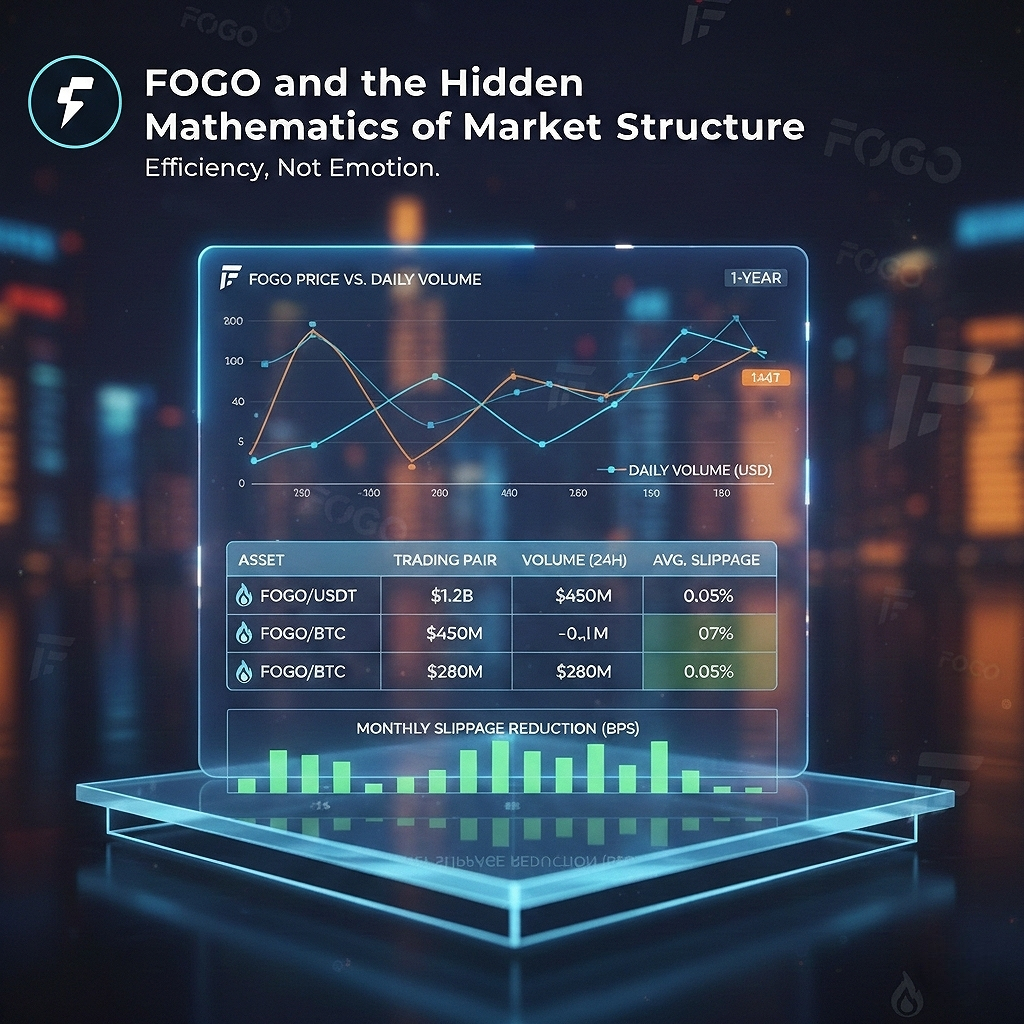
Understanding that helps explain why execution-layer innovation feels more relevant than another narrative token. If volatility compresses, spreads tighten. When spreads tighten, slippage becomes the main variable. That is where structure competes.
What I find interesting is that it is not positioning itself as an emotional trade. It is embedding itself in the mechanics. It is changing how orders meet rather than what people believe.
That distinction matters. Belief-driven cycles are explosive but unstable. Structure-driven cycles are quieter but steadier. If this holds, tokens tied to execution quality may see valuation tied less to hype and more to usage metrics. Volume processed. Average slippage reduced. Participation growth inside batch intervals.
Still, there are risks beyond liquidity depth. Competitors can replicate batch mechanisms. Exchanges can adjust matching logic internally. Incentive programs can inflate short-term metrics. Efficiency does not guarantee adoption.
And yet, early signs suggest that traders are becoming more aware of hidden costs. Conversations are shifting from pure price targets to fill quality and order flow fairness. That shift in dialogue reflects a maturing market.
Zoom out and you see the pattern. Crypto began with ideological foundations. It moved into speculative mania. It survived a contraction. Now it feels like it’s entering an optimization phase. Quiet improvements in infrastructure are shaping the next cycle underneath the noise.
It sits in that layer. It is not promising spectacle. It is tightening screws. It is adjusting timing. It is reducing leakage that most traders don’t notice until they calculate it honestly.
And maybe that is the real story here.