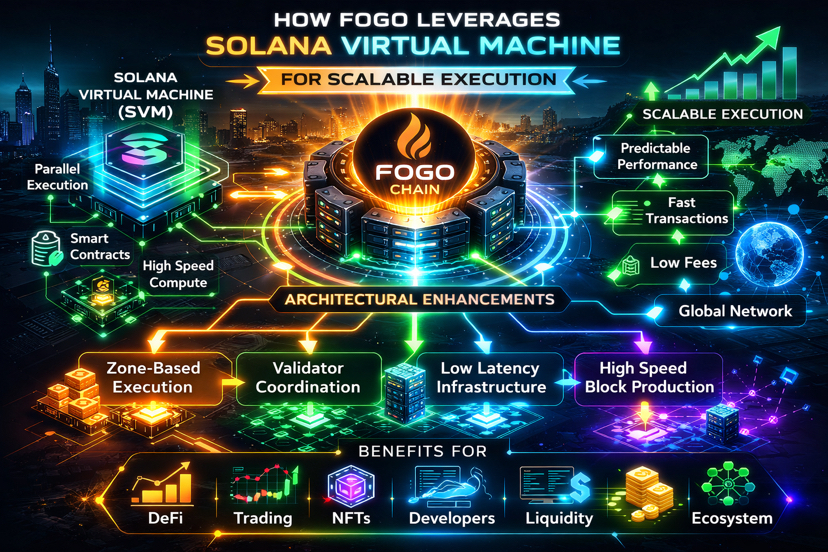
Fogo uses the Solana Virtual Machine as its foundation, but the chain does not stop at simple compatibility. The SVM gives a strong starting point for parallel execution and high performance, yet real world systems need more than just a fast virtual machine. They need predictable timing, stable coordination, and infrastructure that does not collapse during volatility. This is where Fogo begins to introduce its own architectural identity. The chain builds additional layers on top of the SVM to create a more disciplined and controlled execution environment that behaves consistently even when the network becomes busy.
One of the most important enhancements is the zone based execution design. Rather than letting every transaction compete for the same global resources, Fogo organizes execution into localized zones that can handle their own load. This keeps congestion from spreading across the network. When activity spikes in one area, the rest of the system continues to operate smoothly without inheriting the slowdown. This model is helpful for applications that rely on steady performance such as trading systems, liquidity protocols, or high frequency bots that cannot tolerate unpredictable delays. The chain directs execution flow intelligently so the network remains balanced and stable even when certain parts experience pressure.
Another key improvement comes from the way Fogo aligns validator coordination. Many chains assume that larger numbers of validators automatically improve decentralization and security, but this often introduces unnecessary latency and inconsistency. Fogo focuses instead on selecting validators that are positioned well, operate with high performance standards, and maintain strict timing behavior. By aligning validators with a deterministic coordination pattern, the chain reduces the timing drift that usually affects block production and transaction ordering. When validators operate in sync, the resulting execution becomes more predictable and the finality process becomes smoother.
Physical infrastructure placement also plays a significant role. Fogo positions its performance critical infrastructure near major financial and connectivity hubs where latency is naturally lower. This reduces propagation delays and improves the stability of block production. For users who interact with markets or build latency sensitive systems, a few milliseconds of improvement can meaningfully change execution outcomes. By engineering hardware locations rather than treating them as an afterthought, Fogo creates an environment where timing is less fragile and operations behave closer to how developers expect.
Block production is another area where Fogo pushes beyond the default SVM experience. Instead of relying on standard block intervals, the chain is optimized for extremely low block times paired with consistent scheduling. The goal is not just to be fast in ideal conditions but to stay fast even when the network is under pressure. Many chains can achieve high throughput during quiet periods but fall apart during spikes. Fogo aims to avoid this pattern by engineering block production processes that stay stable across different levels of activity. This gives builders confidence that their applications will behave the same way regardless of market conditions.
These architectural choices create a layered effect. The Solana Virtual Machine offers the raw execution engine, while Fogo adds structural discipline around it. The virtual machine processes transactions efficiently, the zone based model prevents congestion from spreading, the validator alignment stabilizes timing, and the infrastructure placement minimizes latency. Together these layers create a system where performance is not treated as an occasional feature but as a continuous property of the network. This is what allows the chain to scale execution reliably instead of only in controlled test conditions.
The result is an environment that feels less like a typical blockchain and more like an engineered execution layer designed for production workloads. Developers do not just benefit from a fast virtual machine. They benefit from predictable behavior, consistent timing, and a network that reduces the risk of unexpected slowdowns. For teams building serious systems, this type of stability is often more valuable than raw speed because it turns execution into something they can trust. Fogo uses the SVM as its base, but the chain becomes distinct through the structural discipline layered on top of it. These enhancements transform compatibility into a performance strategy and create a pathway for scalable execution that supports real world usage.