CoW Protocol (best known through CoW Swap) is an “intent-based” trading system on Ethereum that aims to get you better execution than a single DEX route. Instead of immediately swapping on one exchange, you sign an order intent (what you want to trade and your limits), and the protocol batches many users’ intents together. Those batches are then settled via an auction where competing “solvers” try to find the best way to fill all orders.
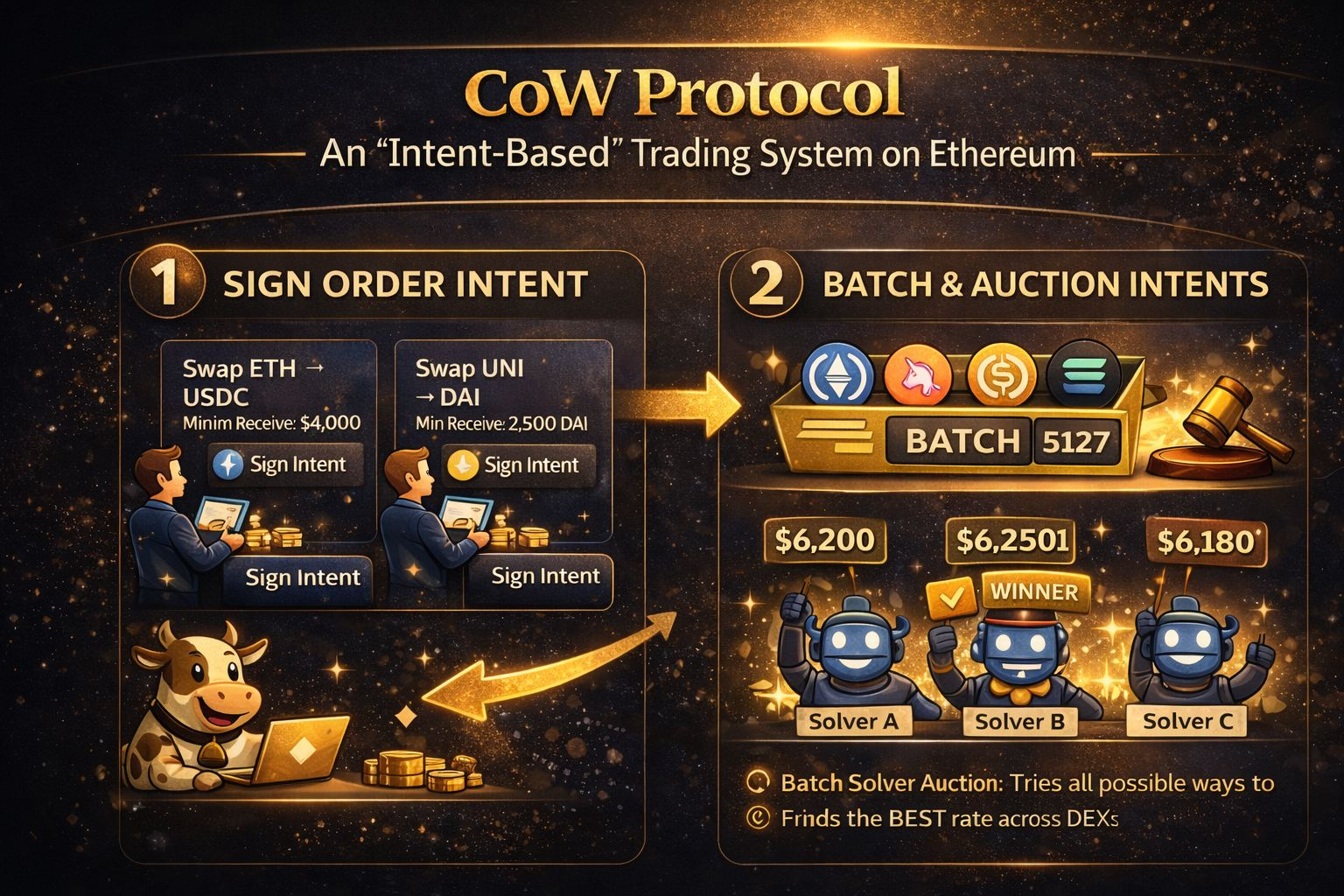
The distinct mechanism: “best rate” via solver competition
This is the core difference from a typical swap:
Solvers can source liquidity from multiple DEXs and aggregators, and they can also match traders peer-to-peer when possible (a “CoW” or coincidence of wants).
Because solvers compete in a batch auction, they’re incentivized to produce the settlement with the best overall outcome (often meaning better effective price and less slippage for users), rather than you manually picking a venue.
In practice, CoW Swap markets itself as finding low prices across DEXs/aggregators and adding MEV protection as part of the execution approach.
Vitalik using CoW Protocol (confirmed)
Yes, there are public on-chain transactions showing Vitalik’s labeled address interacting with CoW Protocol’s settlement contract. For example, Etherscan shows a transaction where “Vb” sends tokens to “CoW Protocol: GPv2Settlement” (the main settlement contract used for CoW Protocol trades).
Why traders use it
If you care about execution quality, CoW’s batch-auction + solver model is designed to:
reduce getting picked off in the mempool (MEV/frontrunning dynamics),
access broader liquidity than a single DEX,
and turn “best route” into a competition, not a guess.
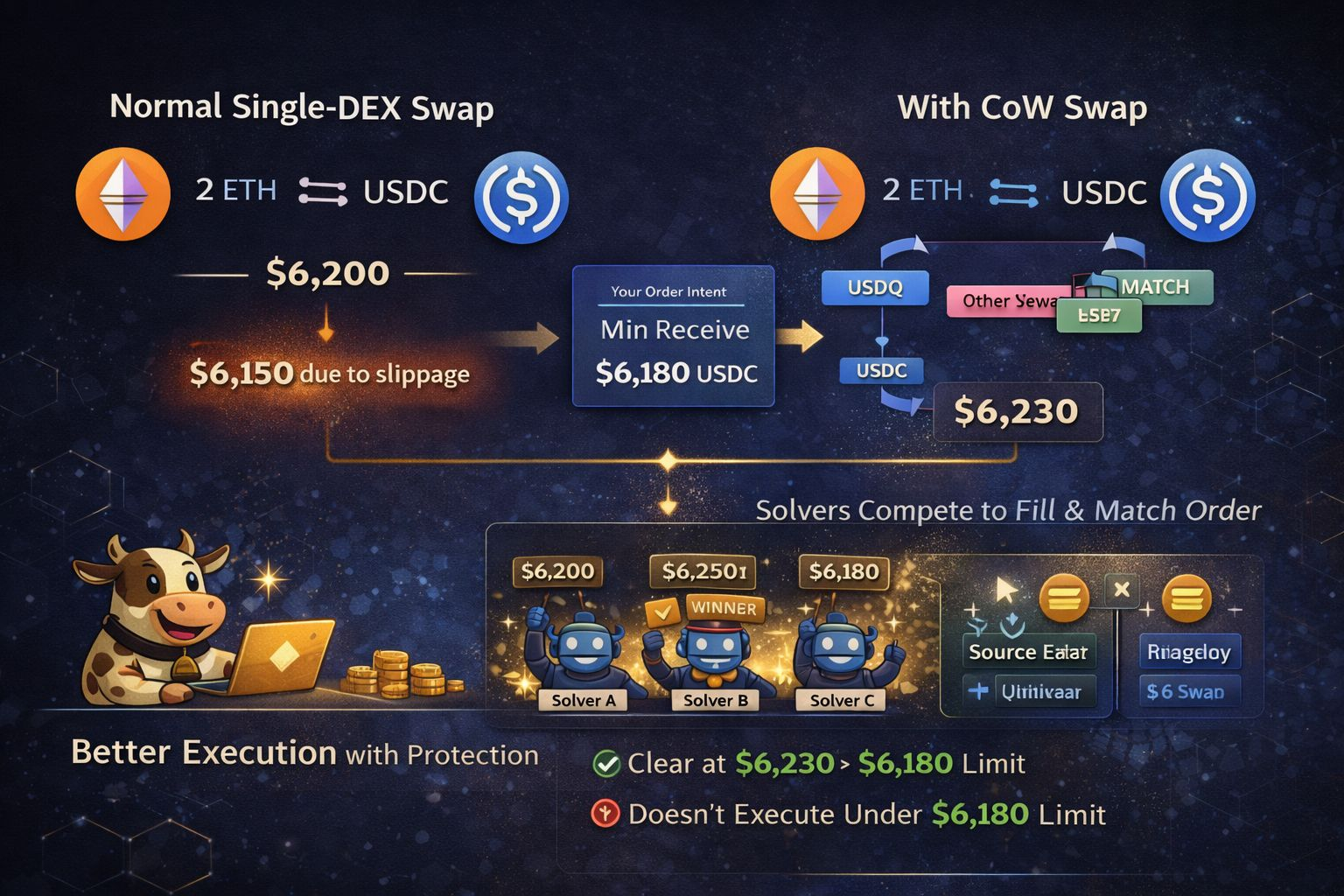
Example: imagine you want to swap 2 ETH into USDC with a minimum receive of $6,180 USDC (your limit). On a normal single-DEX swap at that moment, the best visible route might show $6,200, but by the time your trade lands you could get clipped by slippage and end up with $6,150. With CoW Swap, you sign the intent once, and your order joins a batch. Solvers then compete to fill it, maybe sourcing liquidity across Uniswap plus another venue, and matching part of your order directly with someone swapping USDC back into ETH. If the winning solver can clear your trade at $6,230 USDC with lower price impact, you get the better execution while still being protected by your $6,180 minimum, and if the batch cannot meet your limit, the trade simply does not execute.
1) Your swap request
You sell: 2 ETH
You want: USDC
You set a safety floor: Minimum receive = $6,180 USDC
That minimum means: “If I can’t get at least $6,180, don’t execute.”
2) What a normal single-DEX swap might do
At the moment you click swap, the DEX shows:
Expected output = $6,200 USDC
But price moves while your transaction is waiting and executing (this is slippage), so you actually receive:
Final output = $6,150 USDC
Calculation (loss from slippage):
Shown: $6,200
Received: $6,150
Difference: $6,200 − $6,150 = $50 USDC
So you lost $50 vs what you first saw.
3) How CoW Swap changes it
With CoW Swap, you do one thing:
You sign an intent: “Swap 2 ETH, but only if I get ≥ $6,180.”
Then your order goes into a batch, and solvers compete to fill it using:
multiple DEXs (like Uniswap + others), and/or
matching with other traders (peer-to-peer)
Let’s say the winning solver finds a better fill:
Final output = $6,230 USDC
Calculation (better execution):
CoW result: $6,230
Your minimum: $6,180
Extra above your minimum: $6,230 − $6,180 = $50 USDC
So you not only meet your limit, you beat it by $50.
4) The key safety rule (very important)
If solvers can’t find ≥ $6,180, then:
Trade does not execute (no bad fill).
That’s the “protected outcome” idea.