
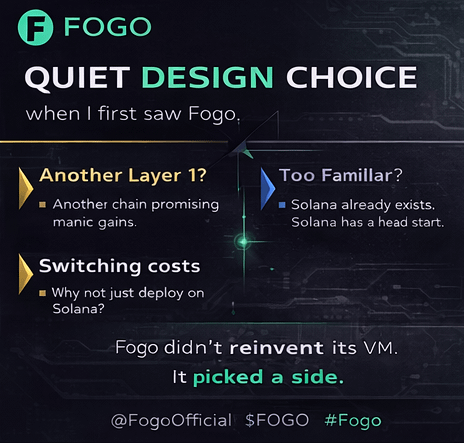
Another Layer 1. That was my first reaction. Another chain promising to be faster, cleaner, more efficient. I’ve heard that story before. Everyone says they’ve fixed something fundamental. Everyone says they’ve learned from the past.
So I assumed $FOGO would be the same.
Then I noticed something small but important. It runs on the Solana Virtual Machine.
That’s not a loud decision. It’s not flashy. It doesn’t try to reinvent how programs execute. It just… picks a side.
And that choice quietly shapes everything.
Using the Solana Virtual Machine (SVM) means Fogo isn’t starting from scratch in terms of execution logic. The SVM is built for parallel processing. It assumes transactions can be separated and run at the same time, instead of lining up in a single file. That design matters more than most people realize. It changes how applications are written. It changes how state is managed. It changes what kinds of bottlenecks show up under pressure.
At first, I thought: okay, so it’s basically borrowing Solana’s engine.
But the more I sat with that, the more I realized it’s less about borrowing and more about aligning.
Fogo is saying: the execution model itself is not the problem. The SVM works. Let’s build around it.
That’s a different posture from chains that try to tweak virtual machines or introduce entirely new execution environments. Fogo is not arguing with the model. It’s committing to it.
There’s something practical about that.
Developers who already understand Solana’s programming model don’t have to relearn everything. Tooling patterns carry over. Mental models carry over. Even mistakes carry over. That familiarity reduces friction. And friction, more than technology, is often what slows adoption.
Still, I’m not fully convinced that compatibility alone creates gravity.
Liquidity has its own inertia. So do users.
Solana already exists. It already has developers, infrastructure providers, validators, wallets, habits. Moving from Solana to Fogo — or even deploying on both — introduces coordination costs. Teams have limited time. Users don’t like managing multiple networks unless there’s a clear benefit.
So the question becomes: what motivates someone to move?
Performance might. Lower latency might. More predictable execution under load might. But those are technical advantages. Users don’t feel “parallelization.” They feel whether a trade goes through or fails. They feel fees. They feel downtime.
Developers, on the other hand, feel execution details deeply — especially when things break under pressure.
And pressure is where behavior becomes honest.
When markets are volatile, developers don’t care about ideology. They care about throughput. They care about whether their app stays online. They care about whether users blame them for something that was actually a network-level constraint.
If Fogo can provide a more stable execution environment under stress, that matters. But that’s a conditional statement. It depends on real-world performance, not theoretical benchmarks.
There’s also a structural assumption underneath all of this: that the SVM will remain a relevant and dominant execution model long enough for building around it to be worthwhile.
That feels decisive.
If the broader ecosystem shifts toward different execution environments — or if Solana itself evolves in ways that make parallel SVM-based chains less differentiated — then @Fogo Official alignment could become a constraint instead of an advantage.
It’s a bet.
A focused one.
Another layer to this is incentives. Incentives shape behavior more than architecture diagrams ever will.
Why would validators support Fogo? Because it’s profitable. Why would developers deploy there? Because they see users or funding. Why would users bridge assets? Because there’s something they can’t get elsewhere — better liquidity, unique apps, lower costs, or simply opportunity.
Without that pull, technical strength sits unused.
I’ve seen networks with impressive design struggle because they underestimated migration friction. Developers are creatures of habit. Once they learn one stack, they tend to stay there. Under pressure — deadlines, funding cycles, market downturns — they default to what feels safe and familiar.
Even if Fogo feels familiar due to the SVM, there’s still a psychological hurdle. “Why not just stay on Solana?” That question will quietly sit in the background.
And yet, there’s another possibility.
By using the same execution model, Fogo doesn’t position itself as an enemy to Solana. It positions itself as adjacent. That could reduce competitive hostility and increase cooperative patterns — shared tooling, shared developer communities, maybe even shared liquidity strategies.
In ecosystems, similarity can create bridges instead of walls.
But similarity can also blur identity.
If everything feels the same, differentiation becomes subtle. And subtle differences are harder to communicate and harder for users to understand.
I keep circling back to liquidity gravity. Liquidity attracts more liquidity. Once capital pools in one place, it becomes rational to build there. Breaking that cycle requires either a shock or a strong counter-incentive.
Fogo’s use of the SVM lowers technical switching costs. But economic switching costs remain.
Time will tell whether reduced friction is enough.
There’s also a behavioral pattern I’ve noticed in developers under stress: they improve for predictability over theoretical peak performance. That matters because it influences the broader outcome. Looking ahead, the direction appears constructive, though it still depends on wider conditions. It’s better to have a system that behaves consistently at 70% of maximum throughput than one that sometimes hits 100% but occasionally collapses.
If Fogo’s infrastructure prioritizes steady execution over dramatic scaling spikes, that might quietly earn trust. Trust builds slowly. It doesn’t announce itself.
Still, I’m aware that I’m assuming stability will be the selling point. That might not even be the narrative that forms.
Sometimes adoption isn’t about technical merit at all. It’s about timing. A wave of new projects might decide to start somewhere fresh simply because it feels less crowded. Early contributors often value visibility and influence over raw scale.
In that sense, #Fogo could attract builders who want to shape something earlier in its lifecycle, without abandoning the execution model they already understand.
But this too depends on momentum. Early ecosystems can feel energizing. They can also feel empty.
There’s a fragile balance between being early and being isolated.
What I find interesting is that Fogo doesn’t attempt to redefine how blockchains should execute code. It accepts an existing answer — the SVM — and tries to optimize around it. That humility is unusual in a space that often equates novelty with progress.
Whether that’s wisdom or limitation isn’t clear yet.
I’m not sure performance alone will move people. I’m not sure compatibility alone will either. But I can see how the combination reduces excuses. If a developer already knows the SVM and sees tangible benefits in deploying on Fogo, the mental resistance shrinks.
Adoption rarely happens in dramatic shifts. It happens in small decisions. One team experiments. One app launches. A few users follow incentives. Liquidity edges slightly outward.
Or it doesn’t.
For now, #fogo feels less like a bold proclamation and more like a quiet structural choice. Use the Solana Virtual Machine. Optimize around it. See what grows from that foundation.
Maybe that’s enough.
Or maybe the gravitational pull of existing ecosystems will prove stronger.
I’m still watching.