

There’s a private moment that happens in most blockchain gaming studios around eighteen months after launch. The team gathers for a retrospective or strategy session. Someone finally says what everyone has been thinking but nobody wanted to admit out loud: “Our game isn’t actually fun and blockchain made it worse.”
This confession usually comes after the team has exhausted every other explanation for why players aren’t sticking around. They blamed marketing. They blamed the bear market. They blamed player education. They blamed competitors. They blamed everything except the obvious truth that the game itself just isn’t good and blockchain features actively detract from whatever enjoyment might have existed.
I’ve been in these rooms enough times to recognize the pattern. Let me describe what this moment of honesty actually looks like and why it happens so consistently across blockchain gaming projects.
The journey usually starts with genuine belief. The team thinks blockchain will enable innovative gameplay that’s impossible in traditional games. They design systems around ownership and trading and player-driven economies. They convince themselves these features will create engagement that makes up for whatever traditional game design elements they’re sacrificing to accommodate blockchain.
Development proceeds with this belief intact. Every technical challenge gets framed as temporary obstacle to overcome rather than sign that fundamental approach might be wrong. Integration difficulties are just engineering problems. Performance issues will be solved with optimization. User experience friction will improve with better interfaces. The team maintains faith that everything will come together.
Alpha testing with friendly audiences provides first warning signs but they get dismissed. The testers are confused by blockchain elements but the team assumes this is education problem. Testers find core gameplay loops unsatisfying but the team believes the economic systems will compensate. Negative feedback gets filtered through confirmation bias that interprets everything as fixable rather than fundamentally flawed.
Beta launch brings larger audience and clearer signals. Retention numbers are terrible. Players drop off after first session at alarming rates. The ones who stick around are predominantly farmers and speculators not actual gamers enjoying the experience. Feedback is consistently negative about game feel, pacing, and satisfaction independent of blockchain confusion.
The team tries to fix obvious issues. They improve tutorials. They adjust economic balance. They polish rough edges. Nothing moves the needle significantly. Players keep leaving because the core experience isn’t compelling regardless of incremental improvements.
This is when the defensive explanations begin. Market conditions aren’t right. Competing games launched and fragmented the audience. Marketing didn’t reach the right people. The blockchain infrastructure had performance issues. Every explanation deflects from the possibility that the game itself is the problem.
More months pass with similar results. The team ships updates and new content. Some metrics improve slightly but retention and engagement remain far below what successful games achieve. Revenue is nowhere near sustainable levels. The runway gets shorter while the product gets marginally better but never actually good.
Eventually someone breaks. Usually it’s a team member who worked on traditional games before and recognizes that no amount of polish will fix fundamental design problems. They’re tired of pretending that blockchain features compensate for the game being mediocre at best.
The confession comes out carefully at first. “Maybe we focused too much on blockchain and not enough on making the core gameplay great.” The room goes quiet because everyone knows this is true but saying it out loud means admitting months or years of work went in the wrong direction.
Once someone says it, others pile on with observations they’ve been suppressing. The combat feels unsatisfying because it’s simplistic and repetitive. The progression system doesn’t create meaningful sense of achievement. The social features are shallow. The content is sparse because resources went into blockchain integration instead of content creation.
Most devastatingly, the blockchain features that were supposed to be revolutionary don’t actually make the game more fun. Ownership sounds good theoretically but players don’t care about owning items in a game they don’t enjoy playing. Trading is irrelevant when items have no value because nobody wants them. Player-driven economy is empty when there aren’t enough engaged players to create real economic activity.
The team realizes they built everything backwards. They started with blockchain and worked backward to game design. They made blockchain the foundation and tried to build enjoyable gameplay on top of it. This is opposite of how successful games get made where fun gameplay is foundation and everything else enhances it.
The blockchain integration forced design compromises at every level. Certain game mechanics were avoided because they didn’t fit blockchain architecture. Features that would have improved gameplay were cut because they complicated smart contract design. Performance was sacrificed to accommodate on-chain requirements. Every decision prioritized blockchain over player experience.
The results are games that showcase blockchain capability while failing at basic game design. They demonstrate ownership and scarcity and trading but they’re not fun to play. Players can verify that items are rare but they don’t care because collecting them isn’t satisfying. Markets work efficiently but there’s no reason to participate because the underlying game isn’t engaging.
This realization is devastating for teams that spent years building toward this moment. They believed blockchain would enable something special. They convinced investors and partners and themselves that this approach would create breakthrough gaming experiences. Now they’re confronting that they built elaborate technical systems for games nobody wants to play.
The question becomes what to do with this knowledge. Teams have limited options and all of them are bad.
They can admit failure publicly, shut down, and return remaining funds to investors. This is honest but career-destroying for founders. Nobody wants to be known for the blockchain game that failed after admitting it was never fun. Future fundraising becomes nearly impossible.
They can pivot to stripping out blockchain and rebuilding as traditional game. This might produce better game eventually but requires explaining to blockchain investors why the blockchain they funded is being removed. It also requires more capital and time than most teams have remaining.
They can continue operating while privately acknowledging the game won’t succeed but maintaining public optimism. This is most common choice because it delays consequences. Keep shipping updates, maintain appearances, hope something changes before running out of money. Slow death instead of quick acknowledgment.
They can try radical redesign keeping blockchain but completely rebuilding gameplay. This rarely works because it requires admitting current design is fundamentally flawed while maintaining that blockchain approach is still correct. The cognitive dissonance is hard to sustain and the redesign usually fails for same reasons original design did.
What’s particularly painful is recognizing how much of this was predictable. Game design principles exist for reasons. Fun comes from moment-to-moment gameplay not from economic systems. Retention comes from satisfying core loops not from ownership features. Engagement comes from content and progression not from trading mechanics.
Experienced game designers could have told these teams that blockchain-first approach would produce unsatisfying games. Many did tell them and were ignored because blockchain enthusiasm overrode game design wisdom. Teams convinced themselves that blockchain changed fundamental truths about what makes games enjoyable.
Reality is that blockchain doesn’t change player psychology. People still want responsive controls, satisfying progression, meaningful achievements, social connection, and compelling content. Blockchain provides none of these things. At best it’s neutral. At worst it detracts by adding complexity and performance overhead.
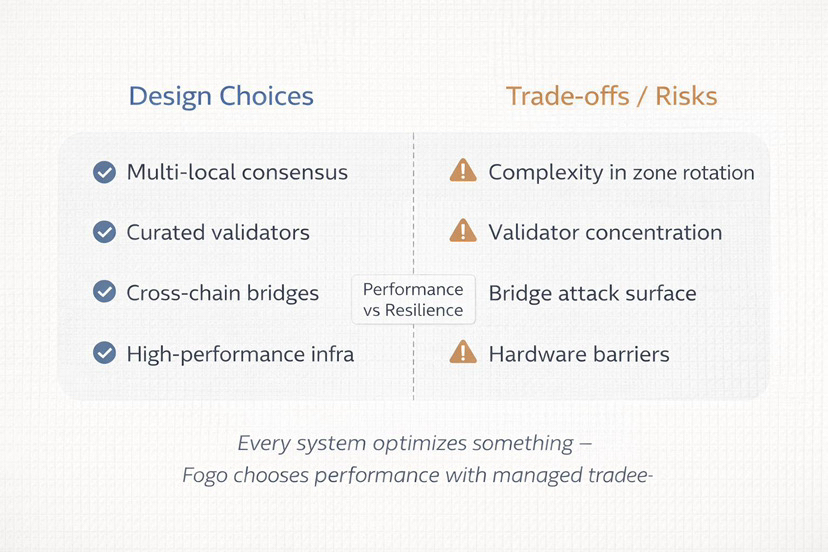
Fogo and infrastructure improvements don’t solve this because the problem isn’t technical. The problem is strategic and philosophical. Teams building blockchain-first games will consistently produce unsatisfying experiences regardless of how good the infrastructure becomes because they’re optimizing for wrong goals.
The games that might succeed are ones built by designers who understand what makes games great and use blockchain only where it genuinely enhances already-solid gameplay. This means starting with fun and adding blockchain selectively rather than starting with blockchain and trying to make it fun.
Most blockchain gaming teams haven’t learned this lesson yet. They’re still building blockchain-first and wondering why games aren’t succeeding. The ones who have learned it are often too deep into current projects to pivot effectively. They’re stuck executing on flawed strategies while knowing they’re flawed because the alternative is starting over.
This creates the quiet crisis in blockchain gaming where many teams privately know their games aren’t good enough but can’t admit it publicly without destroying their businesses. They keep operating on fumes hoping for miracles while the evidence accumulates that they built the wrong things for the wrong reasons.
The moment of honest admission when it comes is both liberating and crushing. Liberating because pretending stops. Crushing because it means accepting that years of work produced something that fundamentally doesn’t work. What teams do with that knowledge determines whether they eventually build something worthwhile or just slowly fade into the growing pile of failed blockchain gaming projects nobody wants to talk about.