Why I Think FOGO’s Story Is More About Market Structure Than Marketing
When I look at FOGO, I don’t really see a project trying to win attention with the usual crypto playbook. I see a chain that is making a very specific bet: if on-chain markets are going to feel usable for serious traders, the infrastructure has to be designed around execution first, not patched later.
That’s what makes FOGO interesting to me.
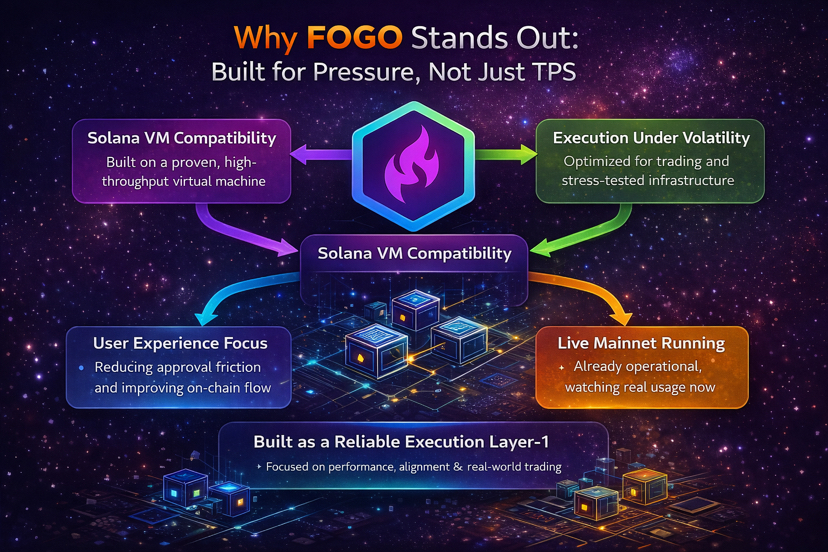
A lot of Layer-1 projects start broad. They want to serve everything at once — gaming, social, identity, finance, creators, enterprise, all in one narrative. FOGO feels more focused. The docs and architecture direction are clearly built around performance-sensitive activity, especially trading and applications where timing matters. It’s also built on the Solana Virtual Machine, which immediately tells you the team is prioritizing a proven high-throughput execution environment rather than reinventing the VM layer from scratch. 
Built on SVM, But the Real Focus Is What Happens Under Stress
FOGO using the Solana Virtual Machine matters, but not just because of speed buzzwords.
SVM is strong for parallel execution, and that gives developers a familiar model if they already understand Solana-style app design. That lowers friction for builders and makes migration more realistic. But what I find more important is why FOGO chose this path. It suggests the team wants to spend less energy on inventing a new execution model and more energy on tuning the network behavior around latency, coordination, and real trading conditions.
That’s a mature approach. In infrastructure, the hardest problems are often not “Can it run fast in theory?” They’re “Can it stay predictable when the network gets crowded?” and “Can builders trust what happens during volatile periods?”
$FOGO architecture docs lean directly into those questions. The network is designed around multi-local validator zones and a structure that aims to minimize communication delays between validators. In simple terms, it’s trying to reduce the physical and network-level friction that makes execution messy in real markets. The docs also describe a latency-first setup and geographic zoning logic, which is a very different tone from generic TPS marketing.
FOGO’s Best Signal Is That It Treats Friction as a Product Problem
One of the most underrated parts of any chain is not raw throughput — it’s user flow.
FOGO Sessions is a great example of that mindset. The docs describe Sessions as a way to reduce signature spam and improve UX by allowing scoped permissions, so users don’t have to keep approving every action like they’re filling out forms. That sounds small until you remember how much on-chain activity dies because the experience feels like paperwork.
This is where I think FOGO shows good instincts. It’s not just saying “we’re fast.” It’s saying “what is making users leave, and how do we remove that friction without breaking control?” That’s a builder mindset, not just a token narrative.
If $FOGO can keep improving this side of the stack, it can become attractive not only for traders, but for any app team that needs performance and smoother onboarding in the same package.
Mainnet Being Live Matters More Than Most People Admit
Another thing I pay attention to: is the project still selling a future, or can people actually use it now?
FOGO’s docs confirm mainnet is live, with public RPC details and current network setup information available for users and developers. That may sound basic, but in crypto, a lot of projects still operate in “coming soon” mode while narratives run ahead of product reality. FOGO at least gives builders and users something concrete to work with.
That changes how I evaluate it. Once a chain is live, the conversation shifts from branding to behavior. You can start watching whether developers build, whether users stay, and whether the network handles stress the way the architecture suggests it should.
That’s the point where projects stop being stories and start becoming systems.
The Real Long-Term Question for FOGO
I don’t think FOGO’s future depends on whether it can post one more impressive benchmark.
I think it depends on whether it can preserve alignment across the stack: validators, developers, users, and liquidity. Speed gets attention, but alignment is what creates durability. If the network stays predictable, builders will commit deeper. If UX keeps improving, users will come back. If the chain performs well during volatile windows, trust compounds.
And that’s the part I like most about $FOGO direction. It doesn’t feel like a chain trying to be everything. It feels like a chain trying to be reliable for a very demanding category of use case.
In this market, that kind of focus is rare.
If @Fogo Official keeps building with that discipline, it may not just be another fast chain in the conversation — it could become one of the few infrastructure plays that traders and builders actually rely on when conditions get messy.