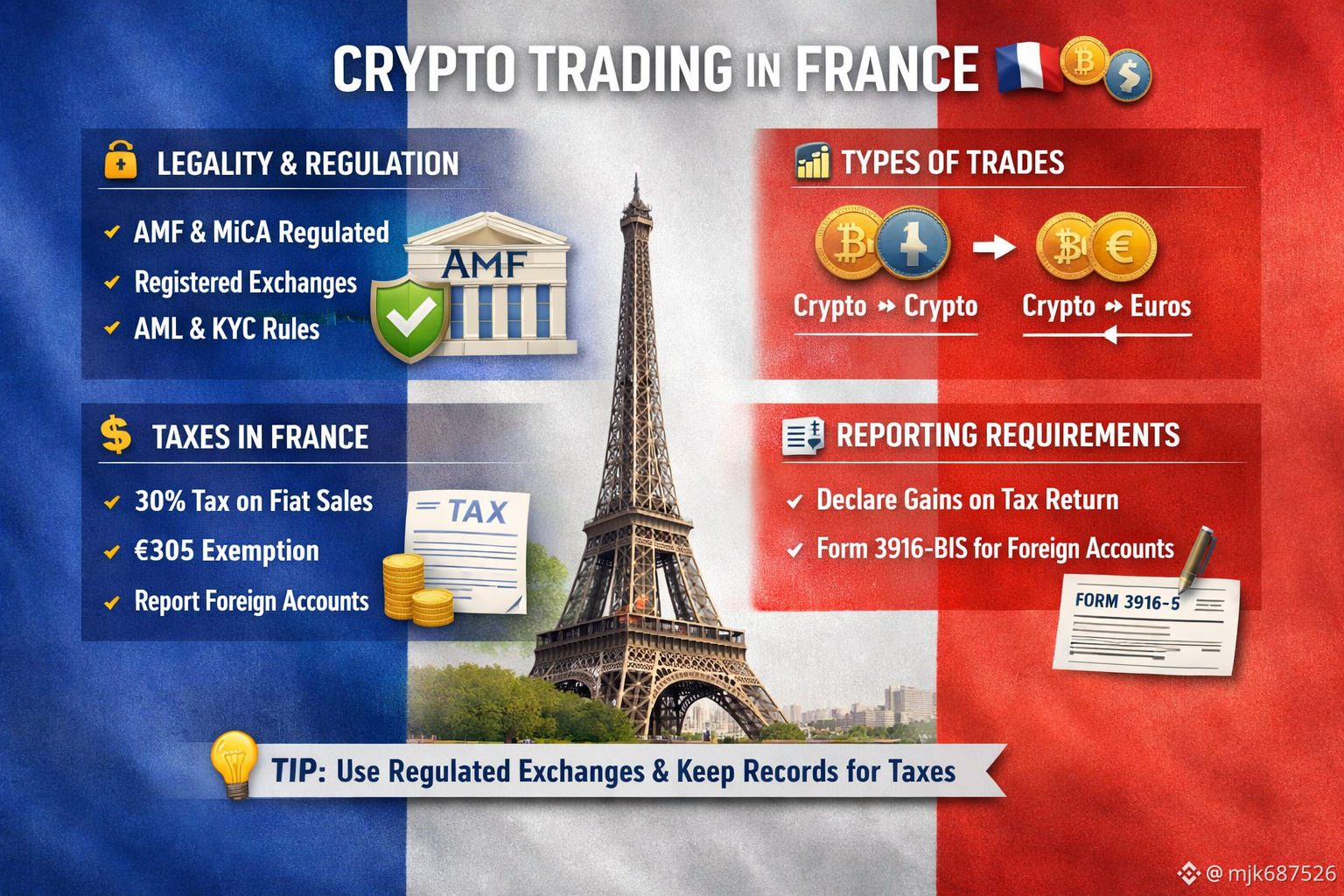
Here’s a clear overview of crypto trading in France — covering legality, rules, taxes, and how it works if you want to trade crypto there in 2026:
🇫🇷 1. Is Crypto Trading Legal in France?
Yes — cryptocurrency trading is legal in France. You can buy, sell, and trade digital assets like Bitcoin, Ethereum, and others through regulated platforms. The French financial markets regulator (Autorité des Marchés Financiers — AMF) oversees crypto trading and requires exchanges and service providers to be registered and compliant with anti-money-laundering (AML) and know-your-customer (KYC) rules. �
Datawallet +1
Since EU-wide MiCA regulation took effect, all crypto firms must obtain EU licenses (MiCA CASP) to operate legally across France and the EU, with a transition deadline around June 30, 2026. Firms not complying may have to exit the market or wind down operations. �
Reuters
📊 2. How Crypto Trading Works
Exchanges & Platforms: You can use regulated exchanges (like Coinbase, Binance, and others that comply with AMF/MiCA standards) to trade crypto for crypto or crypto for fiat (e.g., euros). �
Types of Trades:
Crypto-to-crypto trades: Trading one crypto for another (e.g., BTC ↔ ETH).
Crypto-to-fiat trades: Selling crypto to euros — this is considered a disposal and is taxable (see taxes below).
Safety: Always choose platforms with strong security (2FA, cold storage) and ones registered in France/EU. �
Traders Union
💰 3. Taxes on Crypto Trading
Taxes are one of the most important aspects of crypto trading in France:
🧾 Capital Gains & Taxable Events
Crypto-to-crypto trades generally not taxable — swapping crypto isn’t a taxable event as long as you stay within digital assets. �
summ.com
Selling to fiat (e.g., EUR) is taxable.
Using crypto to buy goods/services is also treated as a disposal for tax purposes. �
summ.com
📊 Tax Rates
Occasional traders: Flat 30% tax (called Prélèvement Forfaitaire Unique — PFU), which includes:
~12.8% income tax
~17.2% social charges
Professional traders/miners: If trading/staking/mining is considered your main activity, profits can be taxed as business income — up to ~45%. �
MEXC
💶 Exemptions & Thresholds
€305 annual exemption: If your total capital gains from crypto sales are under €305 per year, they’re tax-free — but you must still report them. �
summ.com
📝 Reporting & Obligations
You must include crypto gains and accounts on your French tax return.
Foreign crypto accounts (e.g., on Binance, Kraken) must be declared using Form 3916-BIS, even if unused — penalties for non-declaration can be significant. �
Crypternon +1
📈 4. Regulation & Oversight
MiCA Regulation: The EU’s Markets in Crypto-Assets law now governs crypto firms, requiring licensing, consumer protection, and reporting standards. �
Reuters
French AMF: Acts as the national regulator and enforces compliance with AML/KYC rules.
France has been vocal about enforcing stringent crypto supervision and may push for centralized EU oversight to strengthen investor protections. �
Reuters
🧠 5. Tips for Crypto Traders in France
✅ Use regulated exchanges that comply with AMF/MiCA rules.
✅ Keep detailed records of all trades — dates, amounts, values in euros, and platforms used.
✅ Always declare foreign exchange accounts to avoid fines.
✅ Consider consulting a tax professional for accurate filing — especially if trading frequently or professionally.
📌 Summary
Crypto trading is legal in France and covered by EU crypto law (MiCA). �
Datawallet
Taxes apply primarily when you convert to fiat or use crypto for purchases; crypto-to-crypto is usually not taxable. �
summ.com
Regulation is strict, with required licenses for platforms and reporting obligations for traders. �
Reuters
If you want, I can also list the top crypto exchanges available in France and compare their fees and features.$BTC