

Walrus (WAL) is not a hype-driven crypto project chasing fast pumps or social media noise. It is a purpose-built protocol focused on one of the most important problems in Web3 today: how to store and move massive amounts of data in a decentralized, efficient, and censorship-resistant way. Instead of trying to be everything at once, Walrus is doing one thing extremely well—redefining decentralized data storage for the next generation of blockchain applications.
At its core, Walrus is a decentralized storage protocol built on the Sui blockchain. Unlike traditional blockchains that struggle with large files, Walrus is designed specifically for “blob” data—large datasets such as AI training files, gaming assets, multimedia content, and application data. These are exactly the kinds of files modern decentralized applications need, yet most blockchains were never designed to handle them efficiently.
Walrus solves this problem by using advanced data distribution techniques. Instead of storing full copies of files on every node, Walrus breaks data into pieces using erasure coding. These pieces are spread across many nodes in the network. Even if some nodes go offline, the original data can still be reconstructed. This approach dramatically reduces storage costs while keeping data highly available and resistant to censorship or failure.
The choice to build on Sui is strategic. Sui is known for its high throughput, low latency, and object-based architecture, which makes it ideal for handling programmable data at scale. Walrus integrates deeply with Sui, meaning stored data is not just passive—it can be referenced, verified, and interacted with directly by smart contracts and decentralized applications. This opens the door to entirely new use cases where data and logic work together seamlessly on-chain.
The WAL token is the engine that powers the entire ecosystem. It has real utility, not just speculative value. Users pay with WAL to store and retrieve data on the network. Node operators earn WAL for providing storage and maintaining availability. Token holders can stake WAL to help secure the network and participate in governance, giving the community a voice in how the protocol evolves over time.
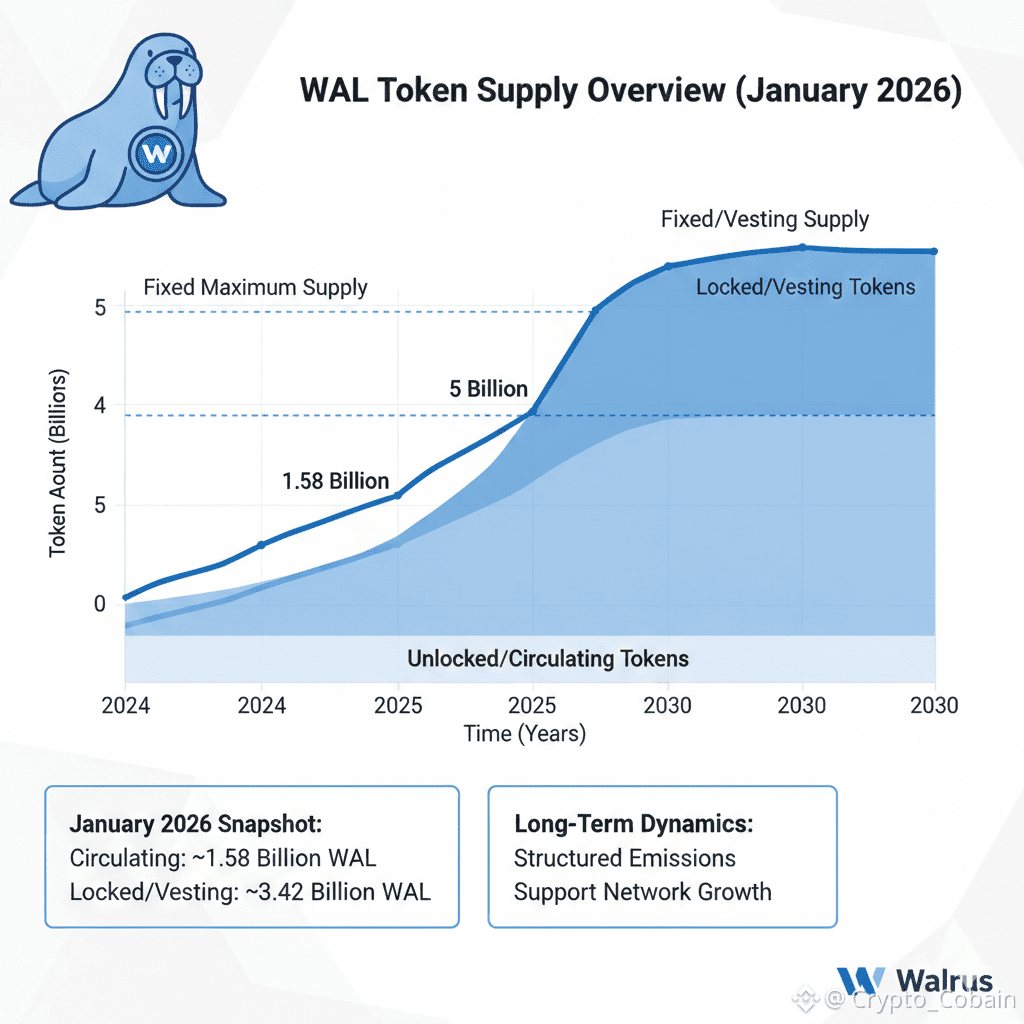
Walrus has a fixed maximum supply of 5 billion WAL tokens. As of January 2026, around 1.58 billion tokens are in circulation. This means a large portion of the supply is still locked or vesting, which is important for understanding long-term token dynamics. Emissions and unlocks are structured to support network growth without flooding the market all at once.
In terms of market performance, WAL has experienced the kind of volatility typical for a young infrastructure token. After reaching a much higher price during earlier market excitement, it has since corrected significantly. As of January 21, 2026, WAL is trading roughly between $0.13 and $0.16, giving it a market capitalization in the low hundreds of millions of dollars. While this represents a steep drop from its peak, it also reflects a period where speculation cooled and attention shifted back to fundamentals and real usage.
What makes Walrus particularly interesting is its focus on real-world demand. The protocol is positioned for sectors that genuinely need decentralized storage at scale. AI development is one of them. Training and serving AI models requires massive datasets that must be accessible, verifiable, and reliable. Gaming is another key area, where large assets need fast and frequent access without relying on centralized servers. Walrus is built with these exact requirements in mind.
Developer experience is another major priority. Walrus provides tools and interfaces that make it easier for builders to integrate decentralized storage into their applications without dealing with unnecessary complexity. This lowers the barrier to entry and increases the chances of real adoption beyond experimental use cases.
For users and investors, WAL is accessible through major exchanges, including Binance. This provides liquidity, easier access, and a familiar trading environment for those who want exposure to the project. As always, holding WAL on a compatible wallet allows users to interact directly with the protocol, stake tokens, and participate in governance rather than just trading price movements.
Like any emerging blockchain infrastructure, Walrus carries risks. Adoption is still growing, competition in decentralized storage is strong, and long-term success depends on developers choosing to build on it. Token unlocks, market conditions, and broader crypto sentiment also play a role in price behavior. Walrus is not a short-term gamble—it is a long-term infrastructure play.
In simple terms, Walrus is building the data backbone for Web3. It is not trying to replace cloud providers overnight, nor is it chasing trends. Instead, it is quietly laying down the foundations for a decentralized internet where data is owned by users, accessible to applications, and protected from censorship. If decentralized applications, AI, and on-chain gaming continue to grow, protocols like Walrus may end up being far more important than they look today.
