

Let me tell you about Walrus in a way that actually feels real—like I'm explaining it over chai in Karachi, not reading from some whitepaper.

Picture this: You're building something cool in Web3—an NFT collection with actual high-res art and videos, an AI app that needs massive datasets, or even just a decentralized social feed full of user-uploaded media. On most blockchains, you hit a wall fast. Storing even a few gigabytes? Forget it. Gas fees explode, transactions crawl, or you end up dumping everything on centralized servers like AWS... which kinda defeats the whole "decentralized" point, right? One company can censor you, go down, or snoop on your data.
Walrus fixes exactly that headache. It's a decentralized storage system built right on Sui (the fast, parallel-execution blockchain from Mysten Labs), but it's designed so other chains can plug in too. The core trick is clever: they don't store your file as one giant blob. Instead, they use this thing called Red Stuff—a 2D erasure coding setup that chops your data into tons of little slivers. Those slivers get spread across hundreds of independent storage nodes worldwide. No one node has your whole file. If some nodes drop offline or get shady, the math lets the system rebuild everything from what's left—super reliably, and way cheaper than copying the file ten times over.
The heavy lifting (the actual bytes) stays off-chain in this blob network, but Sui keeps everything honest: it tracks ownership as on-chain objects, runs availability proofs so nodes can't fake it, handles payments, and lets smart contracts talk directly to your stored data. Want a dynamic NFT that updates its media? Or an AI agent that pulls verifiable datasets? Walrus makes that smooth.
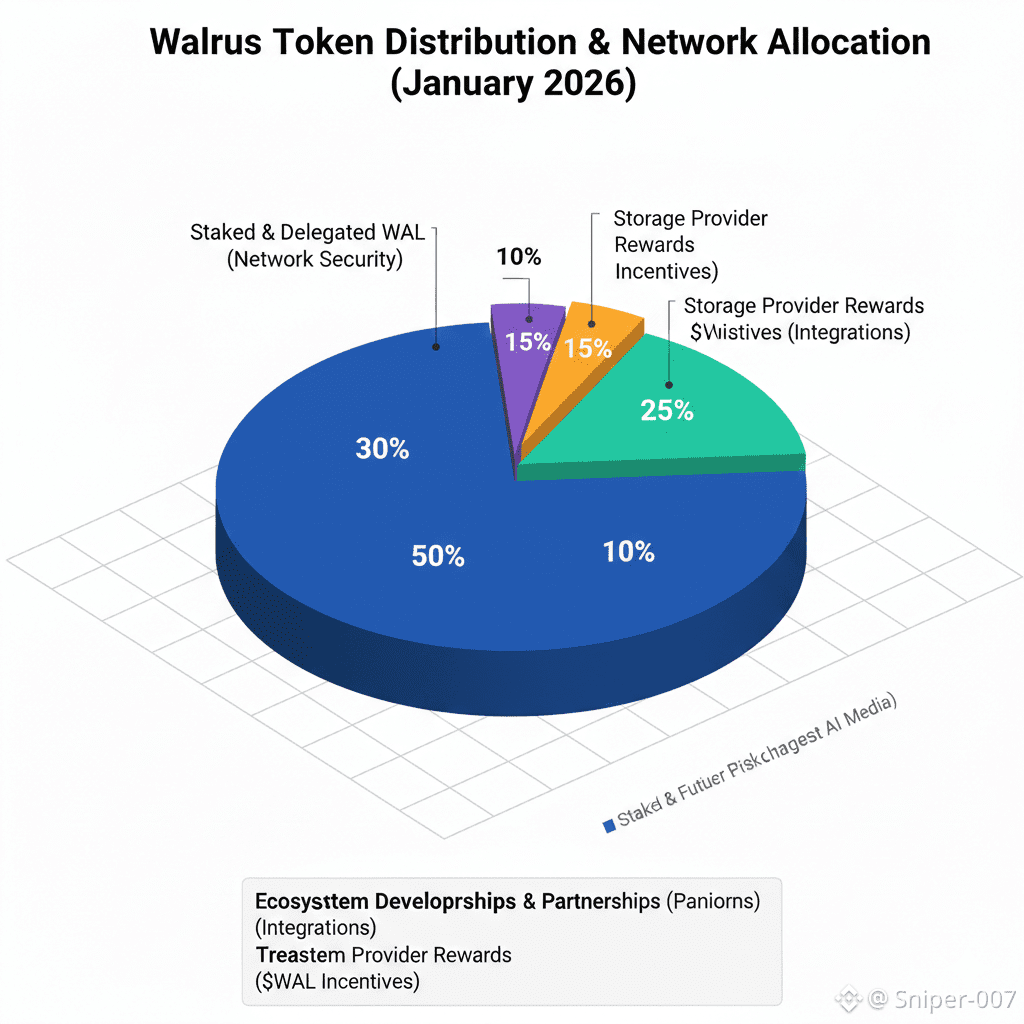
Then there's $WAL, the token that keeps the lights on. You pay in WAL to store stuff (prices are designed to feel stable in dollar terms, even if the token swings). Nodes earn WAL for reliably holding and serving those slivers. You can stake or delegate WAL to nodes you trust, earning rewards while helping secure the network—bad nodes get slashed, and some fees even burn tokens to keep things deflationary long-term. Governance? WAL holders vote on upgrades, pricing tweaks, penalties... real community control.
Fast-forward to right now (January 2026): Walrus mainnet has been live since March 2025, and it's picking up steam. Over a billion WAL staked already, integrations hitting 170+, partnerships with AI teams, media platforms, even big names like Pudgy Penguins using it for assets. Privacy features got a big boost with Seal (their access-control layer), turning Walrus into a go-to for confidential data in the AI era. Developers are building everything from decentralized websites (Walrus Sites) to full-on data markets where datasets become tradable and verifiable.
Sure, it's not without competition—Filecoin and Arweave have been around longer, and Walrus leans on Sui's ecosystem—but the cross-chain bridges and APIs mean Ethereum, Solana folks can use it too. Token's sitting around $0.13 with a market cap hovering ~$200M, which feels grounded for something that's quietly solving real infrastructure pain.
Walrus isn't the loudest project out there—no endless memes or hype trains. It's just solid, practical engineering: make big-data storage decentralized, verifiable, cheap, and actually usable. The kind of thing you don't notice... until you realize how much smoother everything runs with it in the background.
If Web3 is going to handle AI, gaming, media, and real-world data at scale, layers like this are what make it possible. Quietly becoming plumbing everyone depends on.
What do you think—does this solve a problem you've run into in crypto, or are you eyeing it for something specific? 🦭