

As crypto infrastructure matures, the industry is shifting away from speculative Layer-1 experiments toward networks that aim to power real financial activity. Stablecoins are now settling trillions of dollars annually, yet they still depend largely on legacy blockchains whose fee structures, congestion dynamics, and economic models were not purpose-built for global payment rails.
Plasma enters this landscape with a bold ambition: to build foundational infrastructure for a new financial system where money moves at internet speed, with near-zero fees and full transparency. At the heart of this design sits XPL, the native asset of the Plasma blockchain — a token engineered not merely for speculation, but for securing validators, incentivizing adoption, and underwriting the network’s long-term economic sustainability.
This article explores Plasma’s tokenomics architecture, XPL’s role in the validator network, emission design, supply distribution, burn mechanisms, and why these decisions matter for institutions, stablecoin issuers, and capital markets.
🌍 XPL as a Monetary Backbone for On-Chain Finance
Plasma frames XPL as a foundational reserve asset rather than a utility token with narrow scope. Just as sovereign currencies and central-bank reserves stabilize traditional payment systems, XPL is intended to secure Plasma’s settlement layer and align incentives across the ecosystem.
Its core functions include:
• paying transaction fees
• rewarding validators
• securing consensus through staking
• enabling future stake delegation
• supporting liquidity programs
• underwriting ecosystem growth
This multi-role positioning makes XPL analogous to BTC on Bitcoin or ETH on Ethereum — but tuned specifically for a world dominated by stablecoins and institutional payment flows.
Unlike speculative issuance models of early chains, Plasma explicitly links XPL’s design to adoption beyond crypto-native communities, focusing on banks, fintech platforms, payment providers, and capital-market infrastructure.
📊 Supply Architecture and Distribution Strategy
At Plasma mainnet beta launch, the initial supply is set at 10 billion XPL, with future programmatic increases tied to validator rewards.
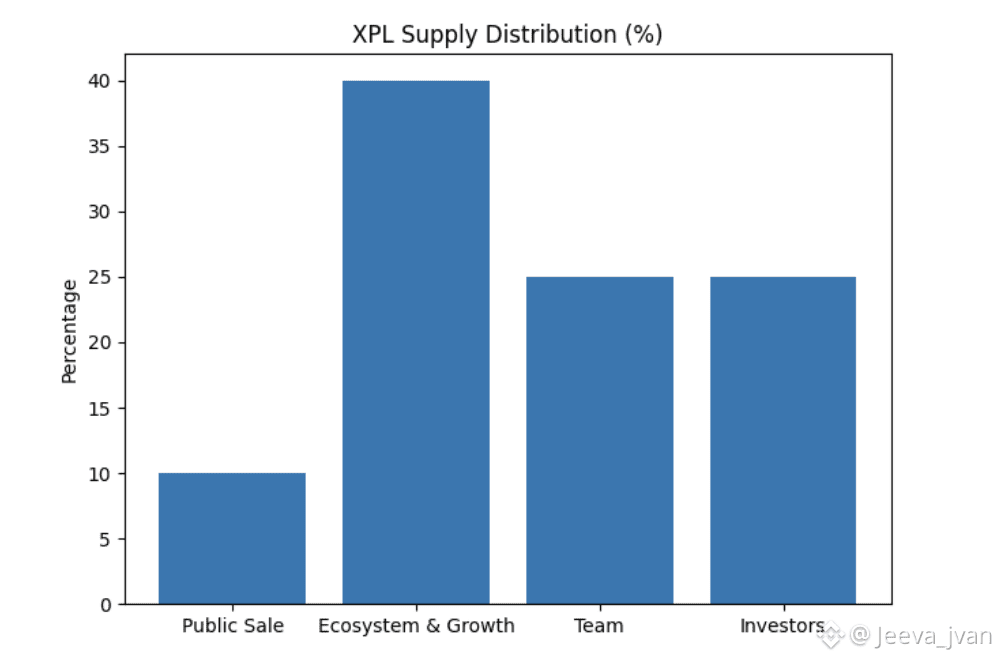
This supply is allocated across four major categories:
🟢 Public Sale — 10%
One billion XPL were distributed via Plasma’s public sale campaign. Non-U.S. participants receive full unlock at mainnet beta launch, while U.S. purchasers face a 12-month lockup ending July 2026.
This structure attempts to balance early community participation with regulatory constraints while avoiding immediate oversupply in the open market.
🔵 Ecosystem and Growth — 40%
The largest allocation reflects Plasma’s thesis that adoption must be funded aggressively.
Four billion XPL are dedicated to:
• DeFi liquidity incentives
• exchange integrations
• institutional partnerships
• ecosystem grants
• developer programs
• user-acquisition campaigns
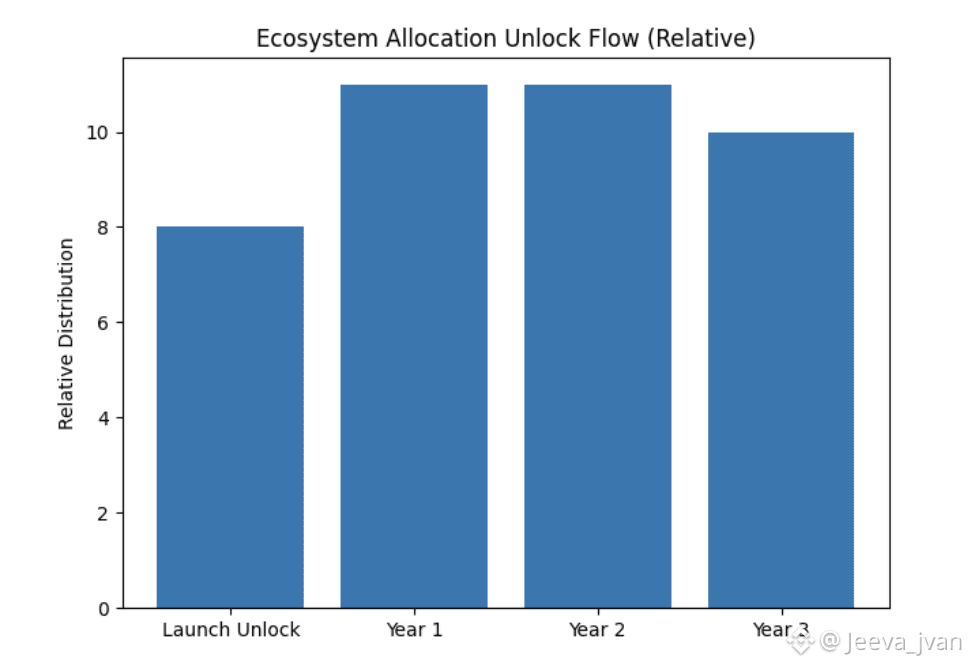
Eight hundred million XPL unlock immediately at launch for early liquidity and integrations, while the remaining 3.2 billion unlock gradually over three years — a design meant to smooth distribution and avoid supply shocks.
🟡 Team — 25%
Two and a half billion XPL are reserved for current and future contributors.
Vesting rules impose:
• a one-year cliff on one-third
• two additional years of monthly releases
• full unlock after three years
This long vesting horizon signals a commitment to sustained development rather than short-term extraction.
🟣 Investors — 25%
Another 2.5 billion XPL went to strategic investors such as Founders Fund, Framework, and Bitfinex.
Crucially, investor unlock schedules mirror the team’s — aligning venture capital with protocol longevity rather than rapid exits.
⚙️ Validator Network: Proof-of-Stake Economics
Plasma operates as a Proof-of-Stake blockchain optimized for stablecoin settlement.
Validators perform:
• block production
• transaction validation
• ledger updates
• censorship resistance
• network security
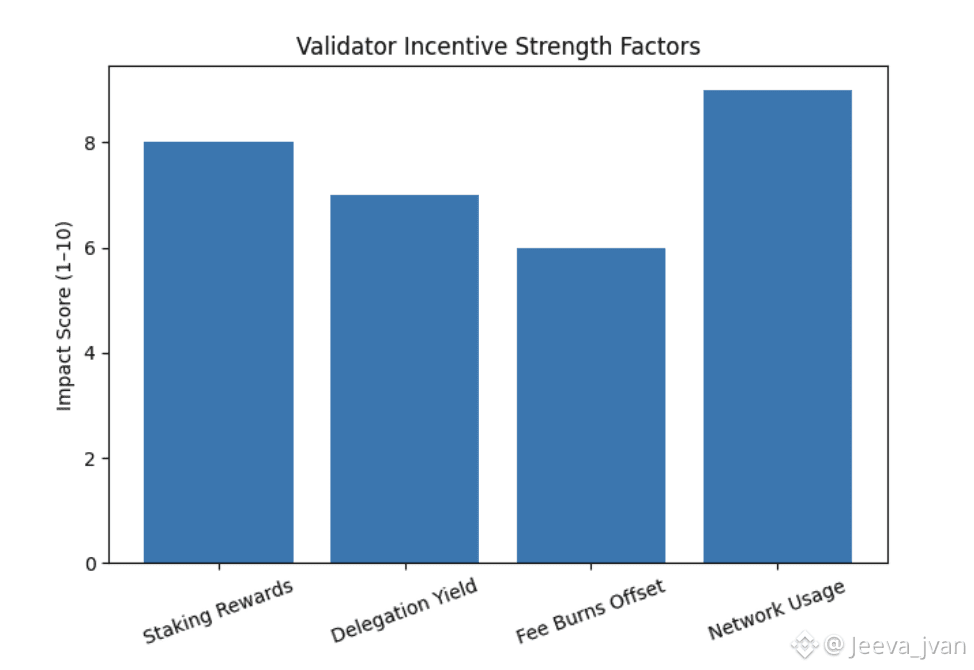
They stake XPL to participate and earn rewards for providing infrastructure.
Plasma also plans to introduce stake delegation, allowing everyday XPL holders to assign tokens to validators and share in rewards — expanding decentralization while lowering participation barriers.
This architecture ties economic security directly to XPL demand: as transaction volume grows and more value flows through Plasma, more XPL must be staked, tightening circulating supply.
📈 Inflation Schedule and Security Budget
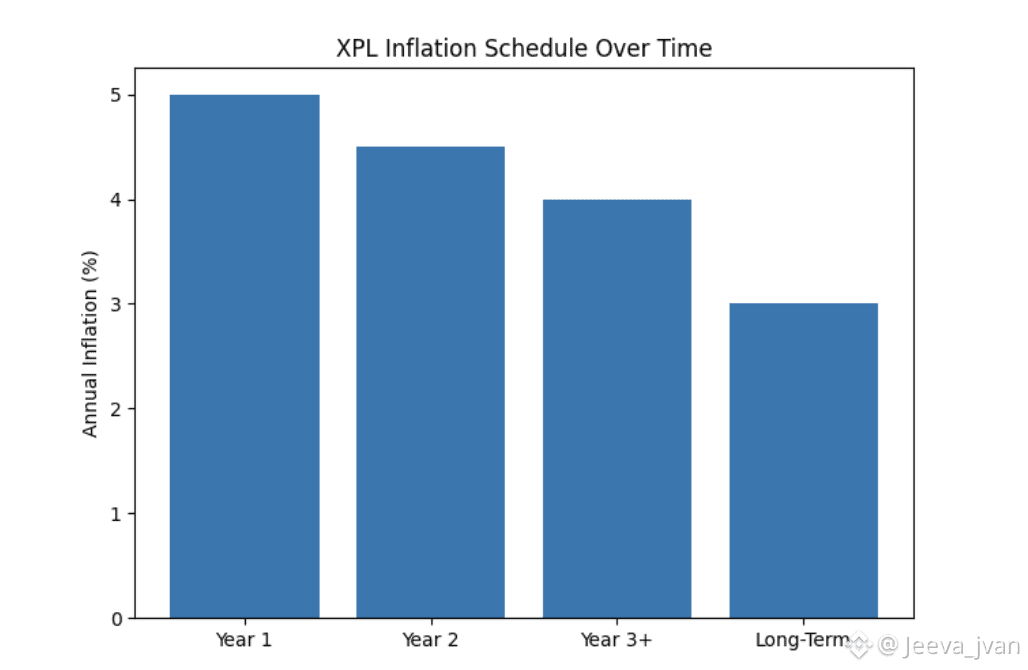
Unlike fixed-supply chains, Plasma embraces controlled inflation as a security budget.
Validator rewards begin at:
• 5% annual inflation
• declining by 0.5% each year
• until stabilizing at 3% long-term
Inflation activates only once external validators and delegation go live, meaning early network phases are protected from premature dilution.
Rewards are distributed solely to stakers; locked team and investor tokens are excluded — further reducing early sell pressure.
🔥 Fee Burning and the EIP-1559 Model
To counterbalance inflation, Plasma adopts a burn mechanism inspired by Ethereum’s EIP-1559.
Base transaction fees are permanently destroyed.
As network usage increases, more XPL is burned — potentially offsetting new issuance and even creating deflationary pressure during periods of heavy adoption.
This introduces a powerful dynamic:
More transactions → more burns → lower net inflation → increased scarcity → stronger staking incentives.
For a payments-focused chain targeting trillions in stablecoin flows, this mechanism could become central to XPL’s long-term value proposition.
🧠 Strategic Design for Institutional Adoption
Plasma’s tokenomics appear deliberately engineered for institutions rather than retail speculation.
Key features include:
• long vesting schedules
• gradual ecosystem unlocks
• inflation tied to validator participation
• fee-burn offsets
• governance by validators
• compliance-aware distribution structures
Such design choices align with banks and enterprises that prioritize predictability, stability, and governance clarity over high-volatility issuance models.
🌐 The Macro Case: Stablecoins as Financial Rails
Plasma’s strategy assumes stablecoins will become dominant settlement instruments for global commerce.
If trillions of dollars move through tokenized dollars, euros, or commodity-backed assets, the underlying blockchain must:
• process massive volume
• charge minimal fees
• remain censorship-resistant
• maintain validator incentives
• comply with regulation
• integrate with legacy systems
XPL’s economics are built to support that scale.
🔮 Long-Term Outlook
The success of Plasma’s tokenomics hinges on execution.
If ecosystem funds catalyze institutional adoption, if validators remain competitive, and if stablecoin flows surge, XPL could evolve into a core reserve asset within a new digital monetary layer.
If adoption falters, inflation pressure and unlock schedules could weigh on price.
This duality underscores the importance of usage metrics, staking participation, and fee-burn volumes when evaluating XPL’s trajectory.
🎯 Final Thoughts
XPL is not positioned as a meme asset or speculative experiment.
Its supply distribution, vesting schedules, validator economics, inflation controls, and burn mechanisms reflect a carefully engineered system designed to underwrite a global stablecoin network.
By tying security budgets to adoption, aligning investors with long-term horizons, and embedding fee destruction at the protocol level, Plasma is attempting to construct something far more ambitious than another Layer-1.
If stablecoins truly become the backbone of digital finance, XPL may quietly become one of the most important infrastructure tokens in the ecosystem. @Plasma #Plasma $XPL
