

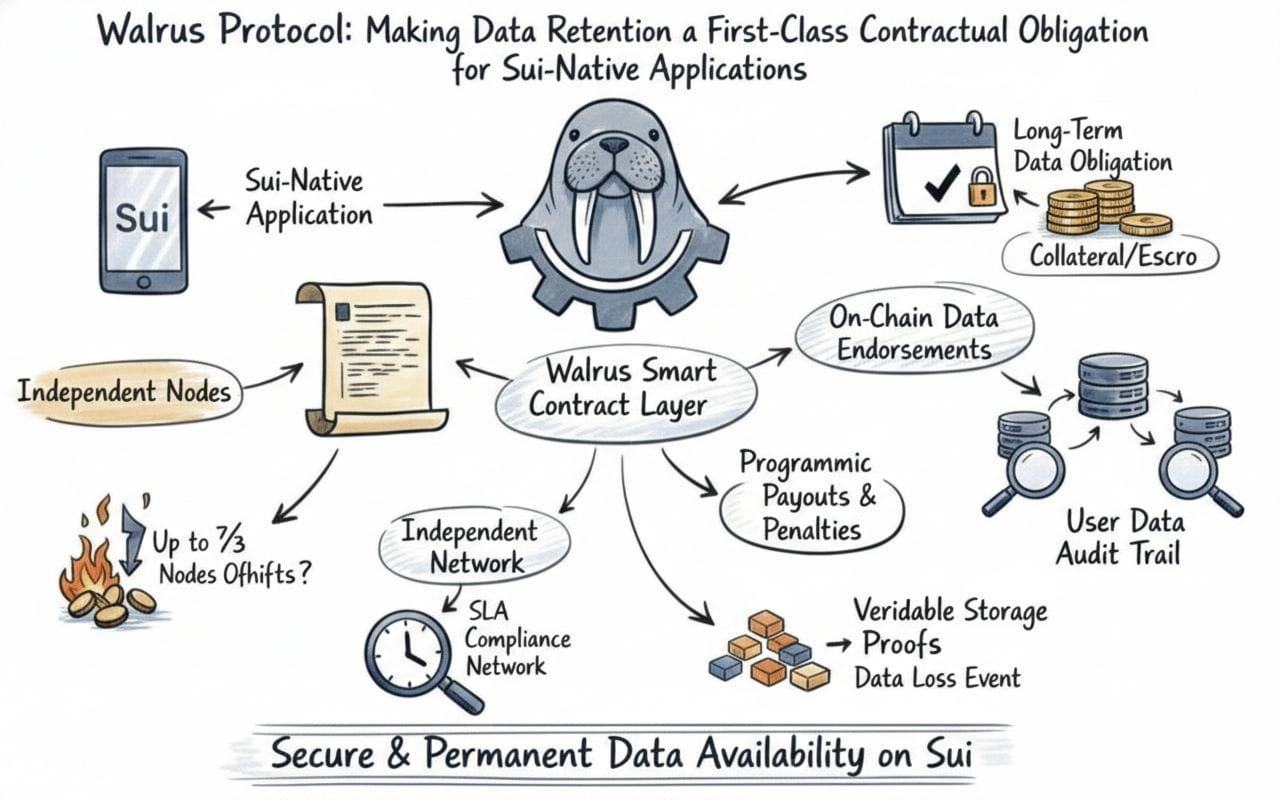
 For years, blockchains treated data as an afterthought. Execution was programmable, consensus was verifiable, but retention the simple question of “will this data still exist when the application needs it?” was never given architectural priority. Instead, developers relied on a patchwork of IPFS pins, centralized buckets, volunteer gateways, and blind trust. The result was fragile by design: data persistence depended on social goodwill, not enforceable guarantees.
Walrus breaks that model. On Sui, data retention becomes a contractual obligation rather than a polite assumption. Applications do not “hope” their blobs exist later they allocate retention the same way they allocate compute. The protocol turns persistence into a hard requirement with explicit lifecycle, verifiable proofs, and economic accountability.
 Retention as an Allocated Resource, Not a Best-Effort Courtesy
Traditional decentralized storage systems replicated data and expected redundancy to approximate permanence. But redundancy alone does not dictate retention. What matters is responsibility: who is accountable for ensuring the data still exists at a future time?
Walrus reframes retention as an allocatable resource governed by Sui’s object semantics. When an application writes data to Walrus, it commits two things:
(1) the object representing the data reference, and
(2) the retention term defining how long the network is obligated to maintain availability.
This structure makes retention a first-class primitive. It has duration, renewal, pricing, and operator commitments attached to it similar to how cloud systems bill storage allocation rather than one-time writes.
Verification Moves From Social Assumption to Protocol Enforcement
The real innovation is not just committing storage; it is committing verification. Walrus continuously audits storage operators using cryptographic proofs rather than optimistic belief. These proofs are anchored on-chain, which creates two outcomes:
✔ the protocol knows whether data is being retained
✔ failure has predefined economic consequences
Retention becomes enforceable instead of inferred, and availability transforms into a publicly verifiable system property rather than a backend implementation detail.
Turning Retention Into a Contract Surface for Apps
When retention is formalized, developers gain a powerful building block that Web3 never had. Applications can now:
• bind retention to state updates
• tie retention to governance rules
• price retention as part of service delivery
• extend retention programmatically over time
• delegate renewal responsibility to other actors
These capabilities are especially important for Sui applications that operate with object-centric state. Data no longer floats outside the execution boundary; it becomes part of the application’s persistence contract.
Why Sui Needed Retention as a First-Class Primitive
Sui’s execution model accelerated performance and concurrency, but richer apps began pushing a different constraint: data longevity. High-throughput applications are state-heavy by nature they generate logs, assets, histories, datasets, and media that outlive the moment of execution. This is true across verticals:
• AI workloads maintaining inference corpora
• social platforms storing user-generated media
• games tracking assets, states, replay files, and metadata
• enterprises holding compliance records and audit trails
• NFT platforms storing dynamic or mutable metadata
• financial apps retaining transaction-linked attachments
These systems do not just need to run; they need to remember. Retention makes that possible without reverting back to centralized cloud providers.
Economic Accountability Replaces Infinite Permanence Narratives
Instead of promising unrealistic “store forever” guarantees, Walrus opts for accountability. Data persists as long as:
1) an actor values the data enough to pay for retention, and
2) operators are compensated for fulfilling their obligation.
This aligns longevity with utility, rather than ideology. It also avoids the trap of forcing permanent storage for temporary data a mismatch that has quietly stalled decentralized storage adoption for years.
From Ad Hoc Persistence to Deterministic Guarantees
The biggest shift is architectural: Sui gains deterministic persistence. Applications no longer embed off-chain assumptions into their trust model. They can instead define retention as part of execution:
“If I write this, the network must keep it for X time at Y cost with Z verification.”
That is contractual retention, and it is the first time blockchains have treated data with the same rigor as compute.
In Simpler Words (Yet High Professional Clarity):
Blockchain apps used to say:
“Hopefully the data is still there.”
Sui + Walrus now lets them say:
“The data will be there until the contract says otherwise and we can prove it.”
 Why This Wins Long-Term
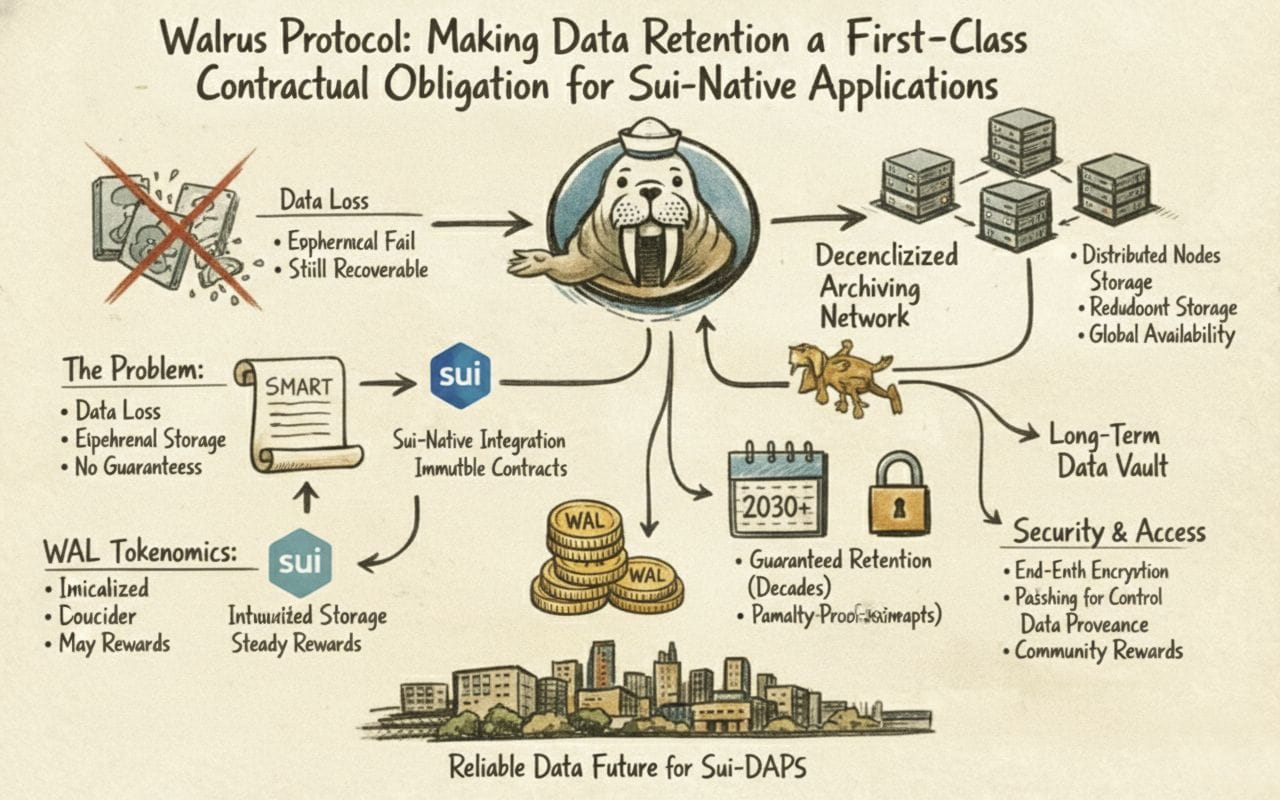
This change is subtle but foundational. Advanced ecosystems from cloud to AI to enterprise infra evolved by making retention explicit. Web3 is finally catching up, but with an even stronger foundation: cryptographic verifiability + economic incentives + decentralized responsibility.
Walrus didn’t just add storage to Sui.
It added retention as a resource, verification as a rule, and responsibility as a contract.
For infrastructure, that’s the difference between “working” and “lasting.”