


When I think about deflationary token models, I try to strip away the slogans and look at the mechanics. Burning tokens always sounds clean and disciplined. Fewer tokens. Scarcity. Long-term alignment. But when a network depends on independent operators to stay online, store data, and behave honestly, the real question is not whether the token supply shrinks. The question is whether people still have a reason to show up and do the work.
This concern matters for Walrus because staking is not decorative. It sits at the center of how storage nodes commit to the network and how reliability is enforced. If rewards dry up, operators leave. If operators leave, the network quietly centralizes. Security does not usually collapse in one dramatic moment. It thins out first.
So I want to walk through this question carefully, without hype, and without assuming the answer in advance.
First, what WAL staking is actually meant to do
I find it helpful to start with intent.
WAL staking is not designed as passive yield. It is meant to align storage providers with the health of the system. Nodes stake WAL to signal commitment. That stake can be at risk if behavior falls below expectations. In return, nodes earn rewards tied to providing storage, responding to challenges, and staying available.
This framing already matters.
If staking rewards were only inflationary handouts, then burning tokens would clearly be a threat. Fewer new tokens would mean weaker incentives. But Walrus does not rely on staking rewards alone as the sole motivation for node operators. The system is built around paid storage, verifiable availability, and ongoing service.
In other words, staking is a bond, not a salary.
What deflation actually changes in practice
A deflationary model reduces total supply over time. It does not automatically reduce total value flowing through the system.
This distinction is easy to miss.
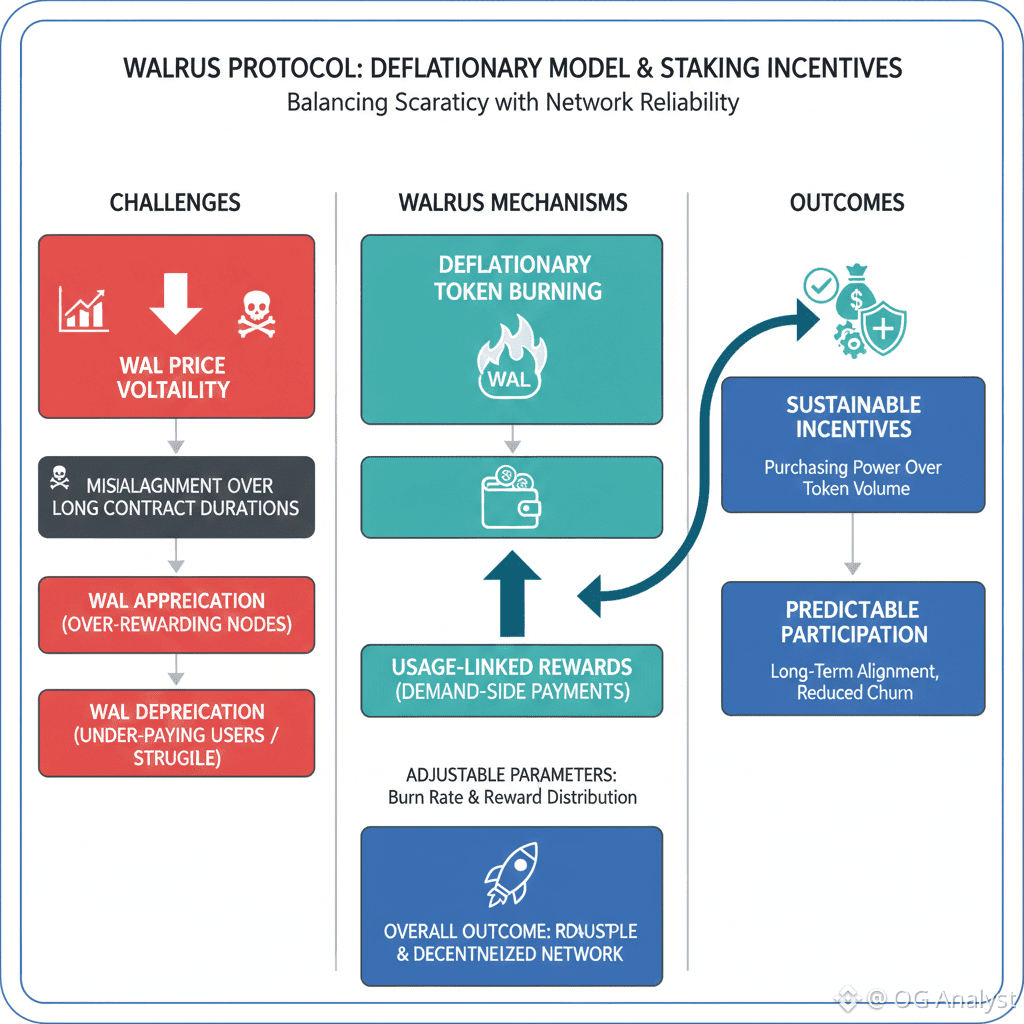
If WAL is burned when users pay for storage, the burn reflects usage. That usage also represents demand for the network. As long as storage demand grows or stays stable, the value captured per remaining token can increase even as supply falls.
From an operator’s point of view, the relevant question is not “Are fewer tokens issued?” but “Is the value of my rewards and fees worth the cost of operating a node?”
Deflation shifts the answer from volume to purchasing power.
Why staking rewards shrinking is a real risk, not a theoretical one
That said, the risk you raise is real. It deserves a serious answer.
If WAL burning continues aggressively while storage usage stagnates, rewards can become too small to justify participation. This is especially true for smaller operators with thin margins. Large operators can absorb volatility. Smaller ones cannot.
When small operators leave, decentralization suffers first.
This is not unique to Walrus. It has happened in other networks where reward structures assumed constant growth that never arrived. Over time, participation concentrated, not because of malice, but because economics quietly pushed it there.
So the concern is not irrational. It is grounded in how networks fail slowly.
Why Walrus does not rely on a single reward stream
One reason I am less alarmed in Walrus’s case is that staking rewards are not the only incentive.
Operators earn value from multiple directions:
Payments for storing data.
Rewards tied to verifiable availability.
Long-term value of staked WAL itself.
Continued participation in a growing storage market.
Burning affects supply. It does not eliminate demand-side payments.
As long as Walrus continues to serve applications that actually need decentralized storage, operators are not living off emissions alone. They are providing a service that someone is paying for.
This reduces the fragility that pure inflation-funded systems suffer from.
Deflation can increase operator stickiness, not reduce it
There is another subtle effect that often gets ignored.
When a token becomes scarcer over time, staked positions become more meaningful. Operators with long-term conviction are less likely to churn in and out. They are incentivized to stay aligned with the network rather than chase short-term yield elsewhere.
This does not help new entrants, but it does stabilize the existing operator set.
In practice, this can reduce sudden drops in participation, which are often more dangerous than gradual changes.
Centralization risk depends on entry costs, not just rewards
A network centralizes when it becomes too expensive or too complex for new operators to join.
Token rewards are only one part of that equation.
Hardware requirements, bandwidth expectations, storage costs, and operational complexity all matter just as much. If Walrus keeps these requirements accessible, then even lower nominal rewards can remain viable.
If those costs rise faster than rewards, then burning becomes irrelevant. Centralization happens anyway.
So the real risk variable is cost-to-participate, not just reward emissions.
Why burn mechanisms are usually adjustable, not absolute
Another point worth emphasizing is flexibility.
Burn rates are not laws of physics. They are parameters. If usage patterns, operator participation, or network health begin to show stress, the system can respond by adjusting how much is burned, how rewards are distributed, or how fees are structured.
A deflationary design does not mean rewards must asymptotically approach zero. It means the system prefers value recycling over unchecked inflation.
As long as governance remains responsive, burning does not lock the network into a failure path.
Security degrades gradually, and Walrus has signals to watch
Security does not disappear overnight. It weakens in stages.
First, small operators leave. Then participation diversity shrinks. Then recovery from outages becomes slower. Only much later does active risk emerge.
Walrus’s architecture allows these signals to be observed early. Participation rates, storage coverage, response times, and stake distribution all provide feedback.
The presence of these signals matters. It gives the network time to adapt before security meaningfully degrades.
Why deflation does not automatically imply under-rewarding work
One misconception I often see is that deflation equals stinginess.
In reality, deflation reallocates value rather than eliminating it. Instead of issuing new tokens endlessly, the system forces rewards to come from real usage. That can actually improve long-term sustainability, even if it feels tighter in the short term.
Operators who remain are compensated by real demand, not dilution of everyone else.
This trade-off is uncomfortable, but it is not inherently unsafe.
Comparing centralization risk to inflationary alternatives
It is also worth asking the opposite question.
Would an inflation-heavy model really be safer?
Inflation can keep operators happy in the short term, but it often masks weak product-market fit. When emissions slow or stop, participation collapses suddenly. That kind of shock is far more dangerous than a gradual, usage-linked reward curve.
Deflation forces the network to confront reality earlier. That can be painful, but it is honest.
My balanced view
I do not think the deflationary burning model guarantees safety. But I also do not think it guarantees failure.
The risk you describe exists if three things happen together:
Storage demand stalls.
Operating costs rise.
Burn rates remain rigid.
If those conditions align, staking rewards could become insufficient, smaller operators could leave, and centralization pressure would increase.
But none of those outcomes are inevitable.
Walrus’s design spreads incentives across usage, staking, and service provision. That diversity matters. It gives the system room to adapt instead of collapsing around a single reward lever.
Final reflection
When I step back, I see WAL’s deflationary model less as a gamble and more as a test.
It tests whether the network can sustain itself on real value instead of perpetual issuance. It tests whether operators are aligned with long-term utility rather than short-term yield. And it tests whether governance can respond before economic pressure turns into structural damage.
Deflation does not remove risk. It changes where risk lives.
In Walrus’s case, that risk is visible, measurable, and adjustable. That does not make it trivial. But it does make it manageable.
And in decentralized systems, manageability is often the difference between slow decay and durable resilience.