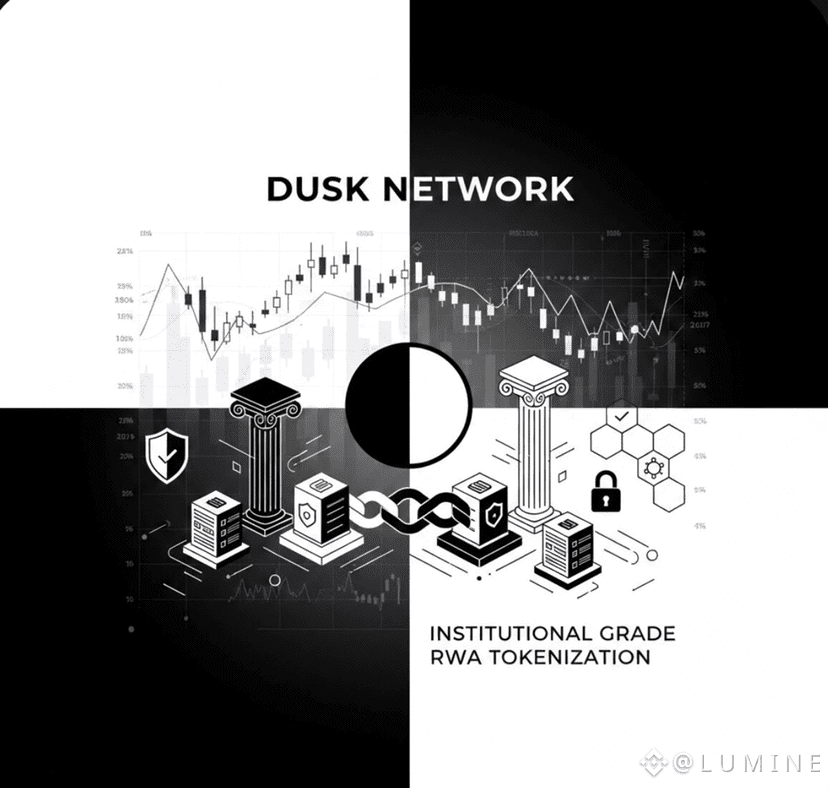
Over the past 24 hours, @Dusk has experienced notable price volatility, drawing renewed attention from both retail traders and institutional observers. While short-term price movement has sparked debate, the deeper conversation surrounding DUSK is far more strategic. Market participants are increasingly shifting focus from short-term fluctuations toward the protocol’s long-term positioning particularly its institutional-grade Real World Asset (RWA) strategy.
This combination of volatility and narrative evolution is not accidental. It reflects a market attempting to price in future relevance while navigating present uncertainty. Understanding DUSK’s institutional focus is critical to interpreting recent price action and anticipating what comes next.
Short-Term Volatility: A Market Reacting, Not Deciding
The recent 24-hour volatility in DUSK is emblematic of a broader market environment where narratives drive momentum as much as technicals. Rapid price movements suggest a tug of war between speculative positioning and longer term conviction.
Such volatility often occurs when an asset sits at the intersection of emerging relevance and incomplete market understanding. Traders react to headlines, sentiment shifts, and macro cues, while longer term participants quietly assess whether the fundamentals justify accumulation.
Importantly, volatility does not inherently signal weakness. In many cases, it reflects growing attention and liquidity both prerequisites for institutional interest.
The Institutional Conversation Around DUSK
What sets $DUSK apart in current discussions is not hype driven adoption, but its deliberate focus on institutional infrastructure. Unlike retail-first blockchains, DUSK is designed with regulatory compatibility, data privacy, and compliance at its core.
Institutions do not chase trends. They demand predictability, legal clarity, and technological robustness. DUSK’s architecture speaks directly to these requirements, positioning it as a serious contender in the next phase of blockchain adoption.
This institutional alignment is increasingly influencing how the market interprets both price volatility and long-term valuation.
RWA Tokenization: Why Institutions Care
Real World Asset tokenization represents one of the most consequential shifts in blockchain’s evolution. It bridges traditional finance with decentralized infrastructure, enabling assets such as securities, bonds, real estate, and funds to exist on chain.
However, RWA tokenization is not viable without compliance, privacy, and selective transparency. Public blockchains, by default, expose transaction data in ways that institutions cannot accept.
This is where DUSK’s strategy becomes especially relevant.
DUSK’s Strategic RWA Positioning
#dusk is architected specifically for institutional grade RWA tokenization, combining blockchain efficiency with regulatory-aware design.
Privacy Without Compromising Compliance
One of DUSK’s defining features is its ability to provide transactional privacy while still meeting compliance requirements. Institutions require confidentiality, but regulators require oversight. DUSK’s infrastructure is designed to balance these two often-conflicting demands.
This selective disclosure capability allows sensitive financial data to remain private while still enabling audits and regulatory checks when necessary.
Built for Regulated Markets
Rather than attempting to retrofit compliance later, DUSK integrates regulatory considerations at the protocol level. This forward thinking approach reduces friction for institutional onboarding and shortens the path from experimentation to deployment.
For institutions, this dramatically lowers risk and operational uncertainty.
Market Sentiment: Speculation vs Strategic Value
The recent volatility in DUSK highlights a familiar market dynamic. Short term traders focus on price swings, while longer term participants analyze strategic value.
This divergence often creates mispricing. Assets with strong institutional fundamentals can experience sharp short-term fluctuations before the market fully appreciates their role in future financial infrastructure.
DUSK currently appears to be in this transitional phase—where speculation dominates price action, but strategic narratives quietly strengthen beneath the surface.
Why Institutional Focus Changes the Investment Thesis
An institutional first blockchain follows a different growth curve than consumer driven networks. Adoption is slower, but far more durable. Infrastructure must be tested, regulated, and trusted before scale is achieved.
This means price discovery can be uneven in early stages, with volatility acting as a byproduct of uncertainty rather than a verdict on viability.
For DUSK, institutional focus suggests a longer runway, fewer sudden hype cycles, and a valuation trajectory tied more closely to real-world implementation than speculative trends.
RWA Strategy as a Long-Term Catalyst
As global financial systems explore tokenization, platforms capable of supporting compliant RWA issuance will be in high demand. DUSK’s positioning aligns with this structural shift rather than short-term market cycles.
Institutions entering blockchain will not compromise on privacy, governance, or legal certainty. Protocols unable to meet these standards will be excluded, regardless of retail popularity.
DUSK’s strategy places it firmly within this institutional conversation, making its long-term relevance less dependent on market sentiment and more on execution.
Interpreting Volatility Through a Strategic Lens
When viewed through the lens of institutional infrastructure development, recent price volatility becomes less alarming and more contextual.
Volatility reflects:
Growing awareness of DUSK’s narrative
Market participants repositioning based on long-term potential
Uncertainty around timing rather than direction
This phase often precedes periods of stabilization as conviction replaces speculation.
Final Thoughts: DUSK Beyond the Noise
DUSK’s recent price volatility is drawing attention, but the real story lies deeper. Its focus on institutional-grade RWA tokenization, privacy-preserving compliance, and regulatory alignment places it in a distinct category within the blockchain landscape.
Markets are still digesting this positioning, and price action reflects that uncertainty. However, narratives tied to institutional adoption tend to unfold over years, not days.
For observers willing to look beyond short-term fluctuations, DUSK represents a project aligned with where blockchain is heading not where it has already been.
In a market increasingly driven by real world integration, DUSK’s strategy may prove to be its strongest asset.