

 There’s a point in every technology cycle where the interesting breakthroughs stop happening on stage and start happening in the background. Screens stop showing fancy dashboards. Benchmarks stop getting tweeted. The real progress becomes infrastructure invisible, unglamorous, and completely indispensable. Stablecoins are now in that phase. The excitement has already been proven. The demand already exists. The world doesn’t need new reasons to care about stablecoins, it needs better infrastructure to carry them.
Plasma is building exactly that kind of infrastructure.
Stablecoins today occupy a strange middle ground. They’re used like money for payments, remittances, liquidity shuttling, payroll, treasury sweeping but they behave like crypto tokens under the hood. They require gas in a different token. They settle probabilistically. Fees are unpredictable. Finality is uncertain. Bridges are clumsy. And UX still expects the user to tolerate friction that traditional finance resolved decades ago.
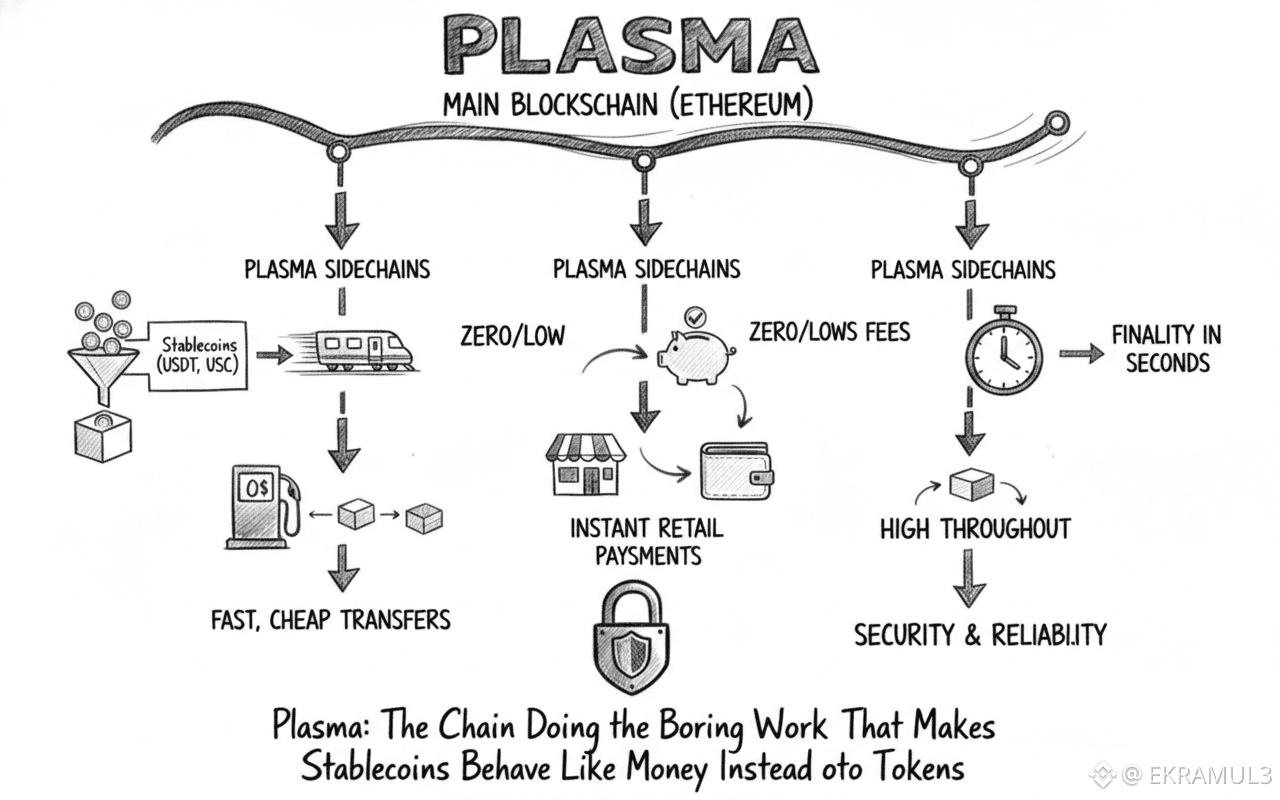
Plasma’s thesis is painfully simple: if stablecoins are going to function as digital dollars, the chain carrying them must behave like a payment rail, not a general-purpose compute environment.
That means deterministic finality rather than “eventually confirmed.”
That means stablecoin-based fees rather than gas gymnastics.
That means UX that fades into the background instead of asking users to think about block production.
That means network guarantees that resemble service levels, not demos.
This is where Plasma deliberately separates itself from the performance theater that dominates blockchain marketing. Instead of broadcasting TPS numbers, it focuses on predictability, determinism, and settlement confidence the attributes that matter once the excitement is over and real money starts moving through the pipes.
The core enabler of this model is PlasmaBFT, a pipelined HotStuff-derived consensus that pushes finality into the sub-second window and keeps it there under load. Not for bragging rights, but because one of the hard truths about payments is that latency compounds psychologically. A 200 millisecond confirmation feels instant. A 2 second confirmation feels tolerable. A 12 second confirmation feels like a failure. Users won’t articulate that threshold. They will just exit.
Plasma doesn’t try to fix this by training users to care less. It fixes the system.
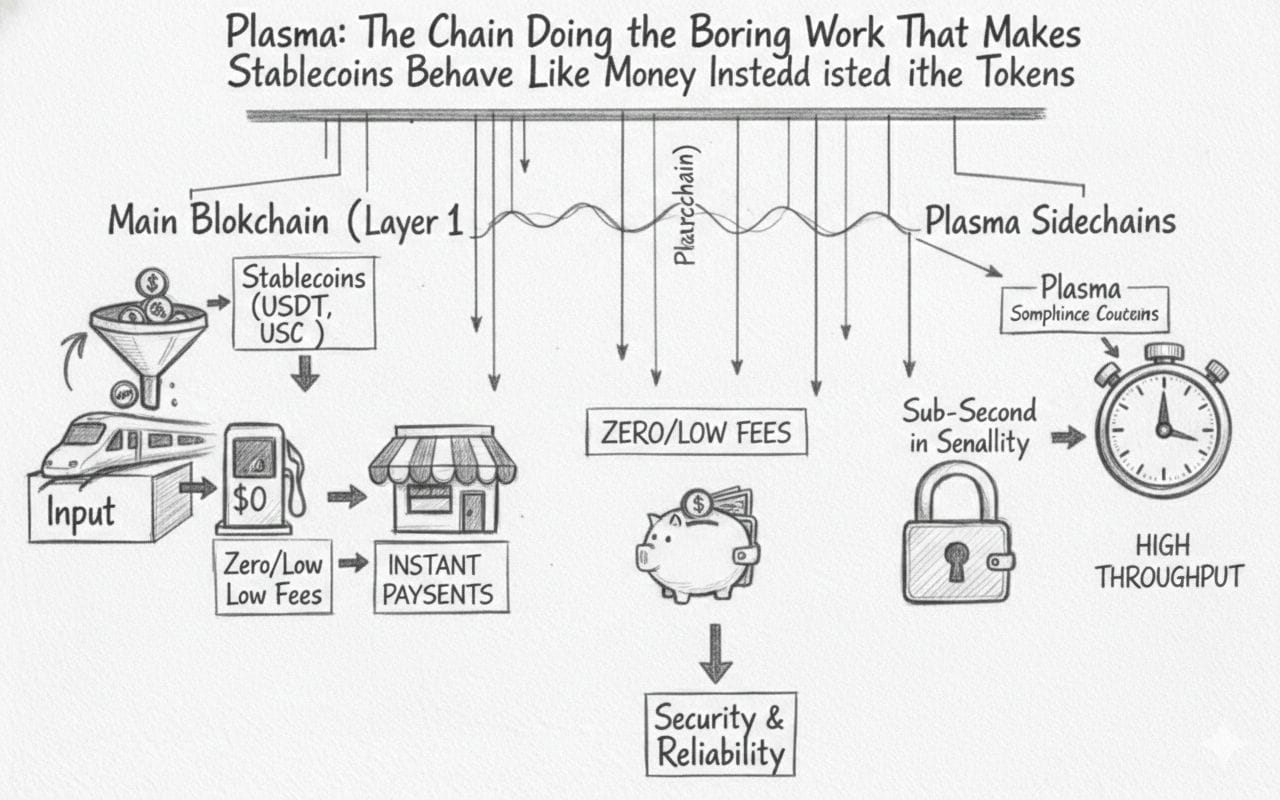 But speed alone isn’t the differentiator. The more radical choice is Plasma’s stablecoin-first execution model. Gasless USDT transfers, stablecoin-denominated gas, and EVM compatibility allow stablecoins to behave like a first-class monetary unit rather than an asset sitting awkwardly on compute rails designed for dApps. For many users in emerging markets, this design choice matters more than any consensus breakthrough. They don’t want exposure to chain tokens. They don’t want to manage wallets with dual balances. They don’t want to do onboarding gymnastics. They want to send value and know it arrived.
Plasma doesn’t sell this as innovation. It treats it as infrastructure.
Institutions pay attention to that difference. Banks, PSPs, and FX desks don’t adopt systems because they look futuristic. They adopt systems because they can model risk, settlement timing, and cost. They adopt systems where failure cases are bounded and boring. They adopt systems where the data path behaves the same at 10TPS and 10,000TPS. That kind of reliability has no meme value, but it does have balance sheet value. Plasma understands this, which is why it quietly integrates Bitcoin anchoring, stablecoin liquidity depth, and deterministic sequencing rather than chasing narrative oxygen.
 None of this means Plasma has won. Infrastructure doesn’t win by shipping it wins by accumulation. Builders need to arrive. Liquidity needs to settle. Users need to stick around after their first transfer. Settlement must remain predictable during volatile windows. Entire workflows payroll, merchant settlement, treasury management must migrate without friction.
But the interesting shift is already visible: Plasma is building for the moment where stablecoins escape crypto culture entirely. A moment where people pay invoices, settle outstanding balances, remit salaries, redeem earnings, and sweep balances to custodians without ever discussing block times, slippage, gas markets or bridge risk. In that future, no one cares what chain is underneath. They only care that the money shows up.
Plasma is betting that when that world arrives, the winning chain won’t be the loudest one, it’ll be the one that spent years doing the boring infrastructure work while everyone else tried to impress each other.
That is not a glamorous strategy.
But it is the strategy that actually wins once money replaces speculation as the binding force of the system.