
Regular blockchain relies on radical transparency being a positive thing, and assuming no one needs financial privacy, or that someone has something to hide. This has led to systems with exposed transaction histories, structural front-running, and a difficult relationship to the law and finance.
Dusk Network works with the other blockchain protocols and financial markets better than most. Unlike most “blockchain solutions,” Dusk Network collaborates with regulations, using privacy and the ability to disclose things on a “need to know” basis, or when justified, to make a case.
From Ideological Privacy to Operational Necessity
The greatest challenge institutional grade DeFi faces is determining the balance between customer privacy and a loss of customer privacy based on audits being done. The current solutions do not result in the creation of a better system when the privacy aspect is touched.
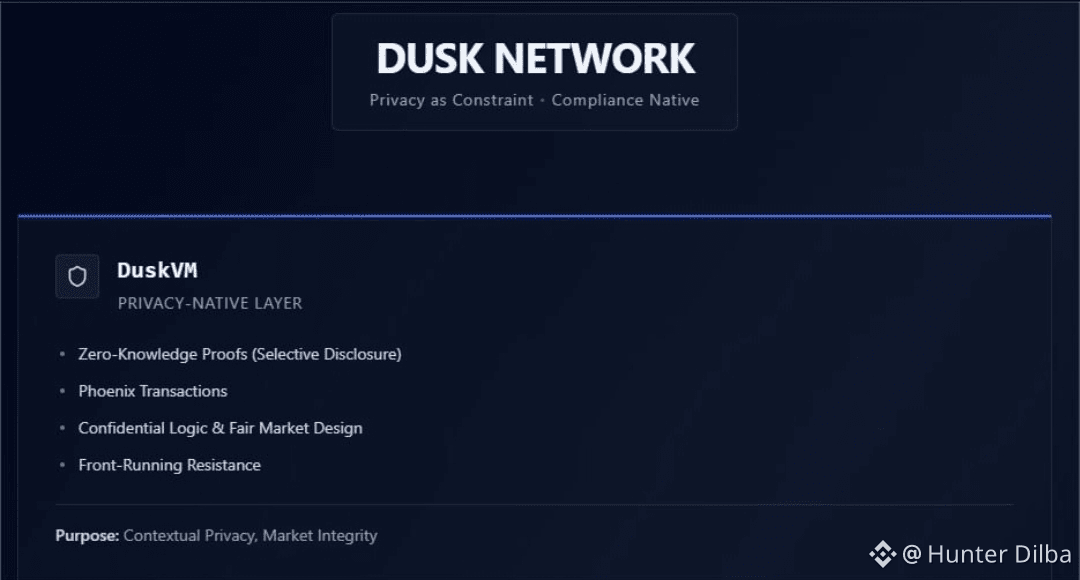
Dusk uses zero-knowledge proofs (ZKPs) to create selective transparency.
This is most evident in Dusk’s Phoenix transaction model. Phoenix doesn’t just hide data; it sets rules for how it can be revealed. Participants can provide a cryptographic proof that they have an accredited investor status, that they are within a trading limit, or that they have done a KYC without having to reveal the underlying sensitive data. This is exactly how things were done in traditional finance: you’ve got a book that the counterparties and competitors can’t see, but the authorized auditors and the regulators can get a verified view when they need to. Dusk makes this dynamic native to the protocol and, in the process, changes the perception of privacy from being a shield against oversight to being a means for compliant functionality.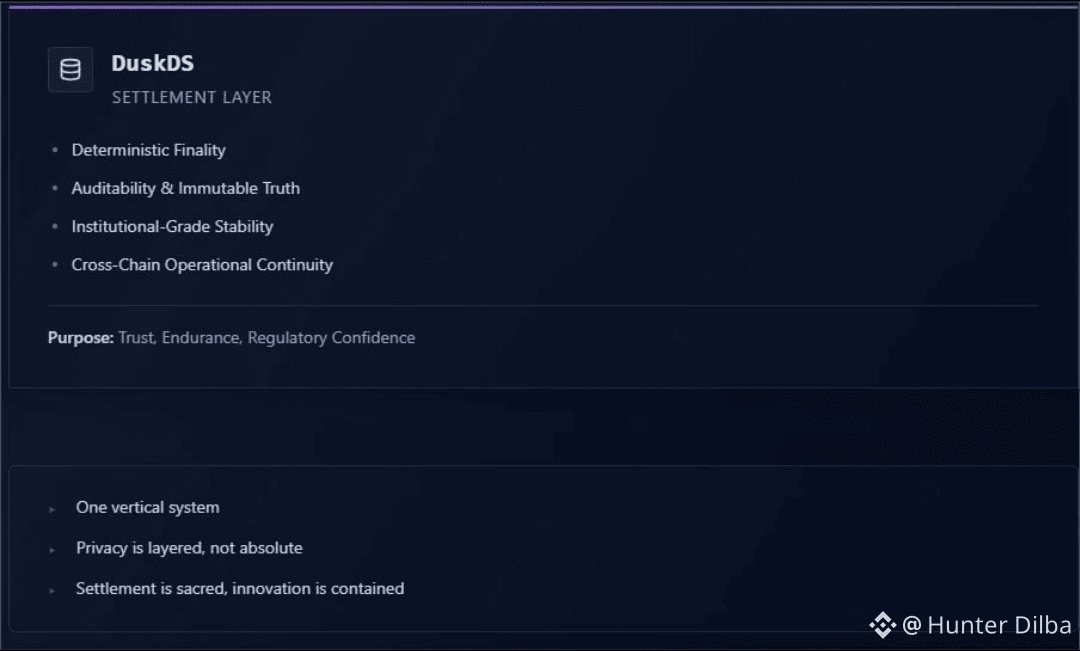
Note the Absence of Purist Dogma
This grounded philosophy is evident in Dusk’s technical evolution. Dusk’s transition to mainnet was marked by the usual deliberate phased deployment—quite the opposite of the ‘big bang’ launches that are the norm in the industry. This shows a commitment to operational security and network stability, the prerequisites for offering the ability to handle assets of a significant value.
Moreover, Dusk’s design reflects modularity and an absence of idealism. The network is intentionally fragmented into several layers, each with a distinct specialization:
DuskDS (Settlement Layer): Offers the bedrock of rapid, deterministic finality.
DuskEVM (Compatibility Layer): Provides Ethereum tools to developers, making it easier to get started.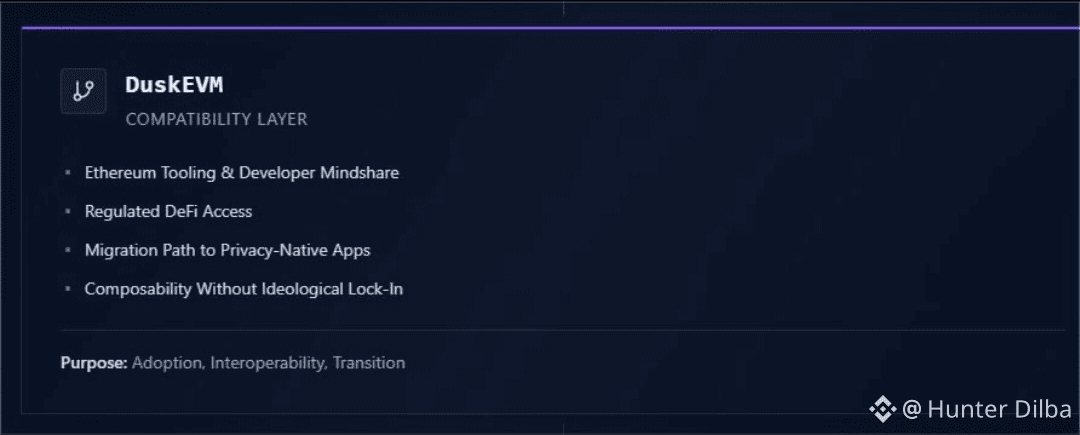
DuskVM (Privacy-Native Layer): Supports complex apps needing logic and confidentiality.
This structure considers an important reality of the market: developer mindshare and tools that already exist are significant value. By providing an EVM-compatible ecosystem, Dusk prevents self-sabotage by not forcing developers to leave their beloved ecosystems. It creates an environment to support developers, while giving a definitive clear pathway to the more advanced, privacy-native VM. This layered structure fosters a necessary division of focus and concern. The settlement layer offers immutable and irreversible truths, while the top layers support innovation and composability. This is akin to the separation of trading venues and clearinghouses in finance.
Dusk’s approach to privacy leaves aside asset shielding to market inefficiencies in market design. Projects such as Hedger, in a way, focus on the opacity of decentralized exchanges. In traditional finance, the intentional opacity of an order book is not an accident; it’s done to prevent front-running and other predatory mechanics.
Dusk is attempting to create fairer and more efficient markets by utilizing privacy on-chain.
Dusk is likely attempting to create profit loss mitigation is not just due to wanting to make anonymous systems. This is likely what appeals to institutional investors.
Sustainable Long-Term Economics
The overall economic design of the Dusk token is aligned with the core proposition of the network. It acts as a singular economic unit for staking, governance, and fees across all levels of the protocol. The emissions schedule is long and even, with an emphasis on network security and sustainable levels of validator participation. The current stage, with a large percentage of total supply actively circulating, is focused on ecosystem utility and security, which corresponds with the maturity of essential infrastructure more so than the utility of a financial instrument.
The Declining Features of Legacy Systems
Dusk acknowledges the quite unpopular, but necessary, institutional on-ramps of a disconnected, multi-chain environment. DUSK, and thus all of its active users, is engaged across Ethereum, BSC, and Dusk’s native chain. Instead of ignoring the complexity, Dusk attempts to provide seamless, rigorously documented, and operationally safe cross-chain bridging solutions with an emphasis on operational continuity.
The real world always demands pragmatic approaches. In the world of financial workflows, dogma induced risk is out of reach.
Conclusion: a solid foundation, not a feature, is that the network believes privacy is a constraint, not a problem.
Dusk Network prioritizing the real world challenges of privacy, compliance, and interoperability, represents the case the financial blockchains of the future need to stand. From the DeFi movement, the need for purpose is equally as important as the need for disruption. Achievements will not be based on grandiose proclamations, but on the quiet strength of a blockchain that will be able to create transactions that are private but can still be audited, block assets that have on-chain compliance, and settle with the best of them.
Dusk will be the butterflies we’ve needed for the blockchain ecosystem. With the unique achievement in the maturation of technology for the blockchain, we will also have a professional upgrade.