
The reason why modern AI systems are failing is not due to their lack of intelligence. They are unsuccessful because the infrastructure below them is unable to ensure execution, persistence and accountability. The blockchain networks most of them were not designed to handle long-term, stateful processes. Not to maintain systems that have to remember context, have to repeat, and have to finish workflows, they were created to record transactions.
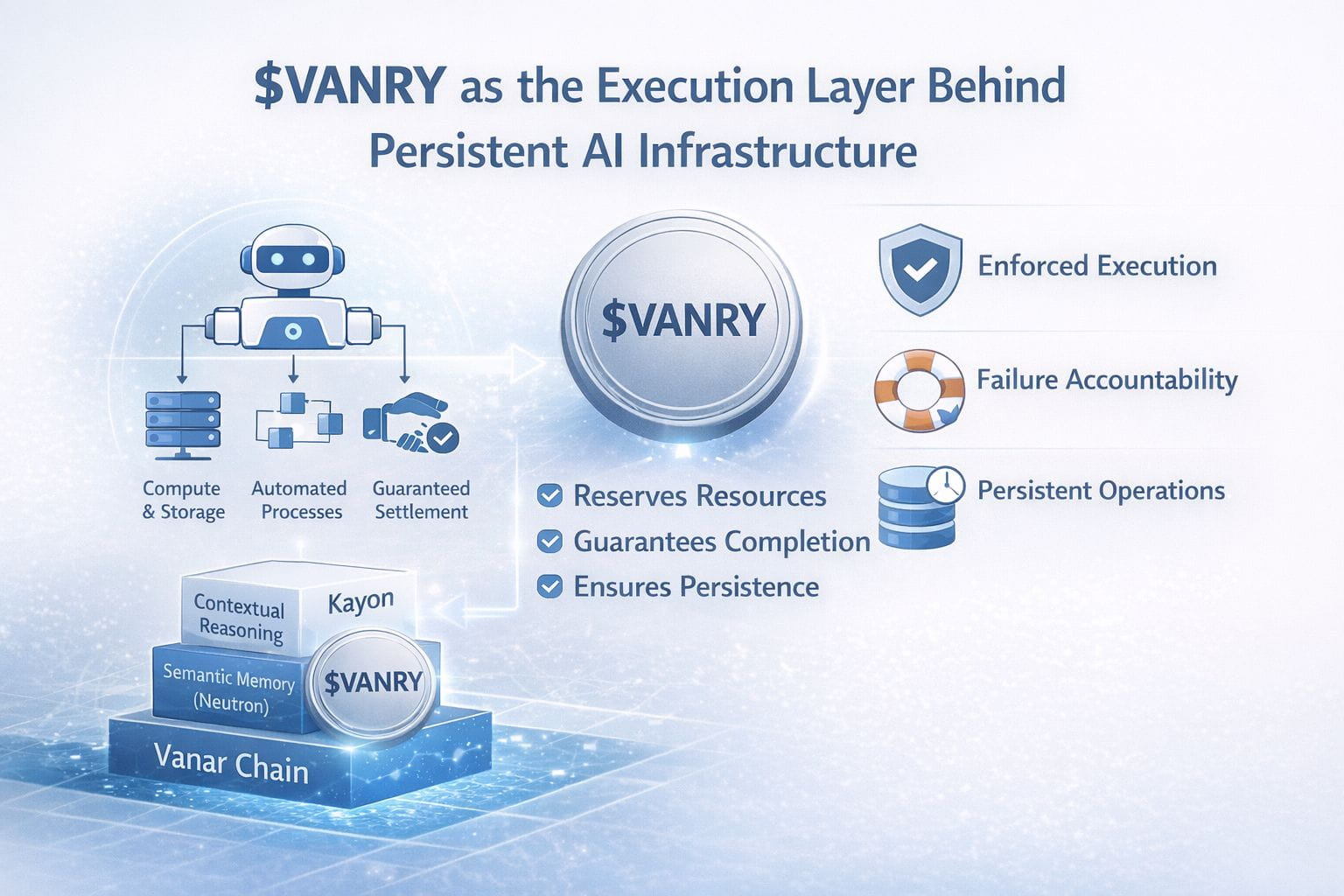
The architecture of @Vanar is a backward operation based on this constraint. As opposed to considering AI as an application layer add-on, Vanar considers execution to be a first-class requirement. In this design, there is no placement of $VANRY as a narrative or speculative commodity. It works as the implementation layer which glues computation, memory and settlement into a regime capable of effectively sustaining the AI working load that can be sustained.
The characterizing difficulty is persistence. AI agents and smart applications do not work in solitary instances. They are based on context stored, changing state, and action coordination through the course of time. When the execution can be postponed, left half completed or abandoned because of congestion or fee volatility then the system becomes unreliable. Here is where many generic chain stores fail. They believe in best-effort performance and settle incentives ex-post.
@Vanar does things differently. The execution is economically mandated in advance before it can commence. $VANRY has to allocate the resources required to accomplish a task compute, storage, coordination, and settlement capacity, so that when execution commences, the network is bound to complete it. This transforms execution to a probabilistic event to a certainty.
The design has significant implications on failure handling. In most of the settings, the failure in one task is not clear as to whether network congestion, validator behavior, or application logic caused the failure. @Vanar eliminates this gray area by linking the responsibility of execution with commitment in the beginning. When a process fails, its failure will be observable, localized, and responsible at an infrastructural level. It is a precondition to the construction of systems that can be relied upon by the enterprises, institutions, and consumer applications.
Predictability is also a critical role of $VANRY. Applications based on AI need cost structures that are stable. It is impossible to provide uniform user experiences because of sudden increases in fees or inconsistent costs of execution. The economic model used by @Vanar is meant to remove this complexity to end users. The predictable execution guarantees interact with developers and AI systems and the token insidiously subsidies the cost of persistence and completion in the background.
Notably, this model maintains blockchain machineries in the shadows. There is no need of the end users to know about gas pricing, network conditions and validator incentives. AI-powered services are not an experimental infrastructure R_VANRY allows this to be true as it is an aspect of the structure, not a point of contact.
This implementation-based design is also the reason why @Vanar focuses on what can be done, rather than what can be theorized. Aspects such as semantic memory, contextual reasoning, and intelligent workflow are only important as long as these can be continuous. VANRY makes these functions economical, so that memory is accessible, logic actionable and automated processes remain long lasting.
In this respect, VANRY is not only facilitating transactions. It is supporting continuity. It does not guarantee the state changes of intelligent systems on a case-by-case basis, but the lifecycle of such systems, including the initiation and the completion. That difference will only grow more significant when AI systems turn into production infrastructure, instead of being an experimental tool.
With the increased adoption of AI, infrastructure will be evaluated based on the metrics less on throughput and more on reliability, persistence, and accountability. The systems unable to assure execution will not be helpful to support real-life scenarios. The architecture of Vanar also recognizes this fact. $VANRY represents the implementation layer of the persistence layer of AI infrastructure due to the fact that without the enforced execution, intelligence is not believed to scale.