
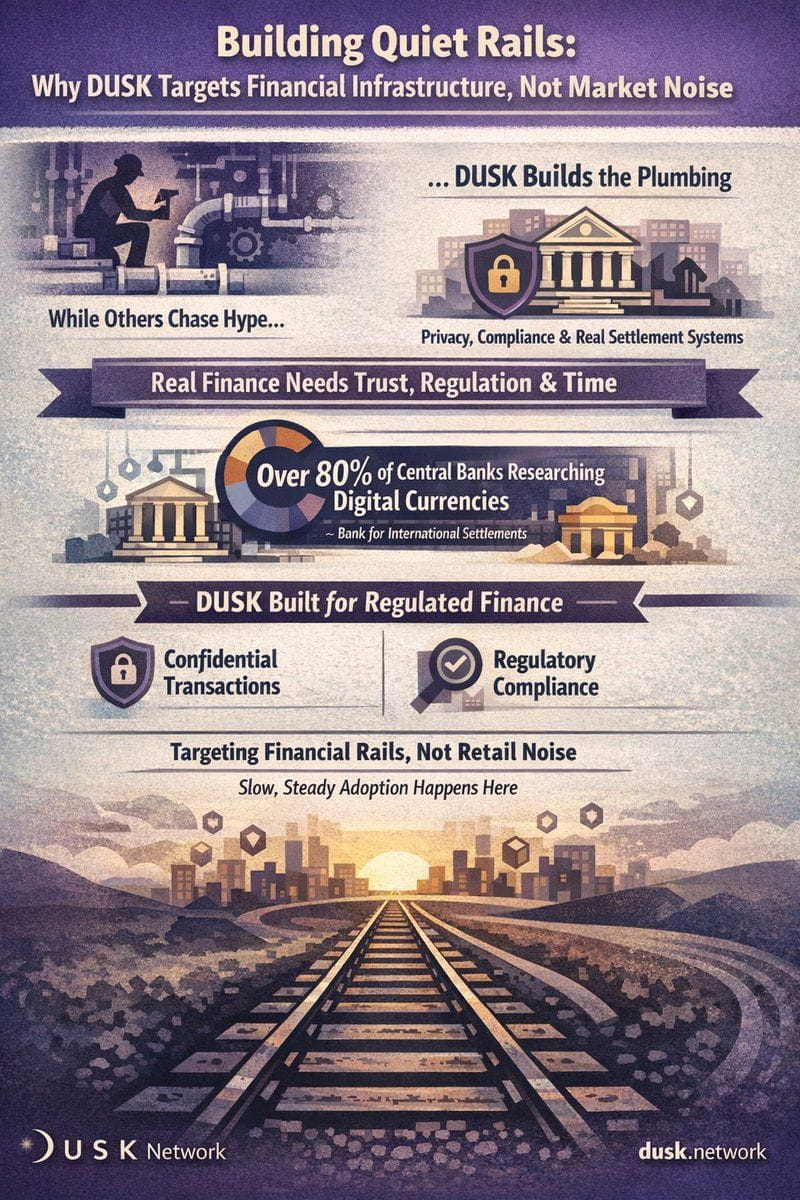
The market price of a digital asset often masquerades as a verdict. Green candles imply progress; red ones suggest failure. Yet price is a surface phenomenon, a reflection of liquidity, narrative cycles, and speculative appetite. Infrastructure, by contrast, evolves on a different timescale. Its value lies not in momentary valuation but in whether it can carry real economic weight. When considering a network like Dusk and its native asset $DUSK, the central question is therefore not how the token trades, but whether the system can actually implement the institutional-grade financial architecture it envisions.
This distinction between price and substance mirrors a broader maturation in the digital asset industry. Early crypto cycles were driven by the romance of decentralization and the velocity of capital. Now the frontier is quieter and more structural. It concerns settlement guarantees, privacy frameworks, compliance tooling, and the integration of blockchain systems with the legal and operational machinery of global finance. In this phase, the metric that matters most is not market capitalization but infrastructural credibility.
Dusk positions itself within this more demanding arena. Its thesis is that regulated financial markets require a base layer built for confidentiality, deterministic settlement, and rule-aware programmability. Public blockchains demonstrated how value could move without central coordination. They did not solve how securities, bonds, and regulated instruments—assets embedded in legal obligations and disclosure regimes—could exist natively on-chain without exposing sensitive information or violating compliance norms.
The architecture implied here is subtle. It suggests that the next stage of blockchain evolution will not merely extend existing decentralized finance patterns but will federate new forms of trust between cryptographic systems and institutional governance. In such a design, privacy is not cosmetic. It is structural, shaping how transactions are validated, how identities are represented, and how oversight is exercised. The ledger becomes less a public billboard and more a secure settlement chamber, where correctness is provable even when details remain concealed.
The role of the $DUSK token must be interpreted within this context. Tokens in infrastructure networks typically serve as economic coordination mechanisms. They incentivize validators, secure consensus, and align participants around the health of the system. Their market price fluctuates with sentiment, but their deeper function is to anchor the protocol’s internal economy. If Dusk succeeds as a financial settlement network, $DUSK’s relevance would stem from its role in sustaining security and governance rather than speculative momentum alone.
This reframing forces a harder question: can a privacy-preserving, institution-focused blockchain truly operate at the scale and reliability required by regulated markets? Optimists argue that the convergence of advanced cryptography and distributed consensus now makes this plausible. Zero-knowledge techniques, confidential transaction models, and selective disclosure mechanisms allow networks to verify compliance with rules without broadcasting every detail. Regulators could gain cryptographic assurance. Institutions could maintain strategic discretion. Market integrity could be preserved without sacrificing efficiency.
Such a system would represent a blueprint for the internet of value that differs markedly from early open-ledger paradigms. Instead of assuming that universal transparency guarantees fairness, it assumes that fairness emerges from verifiable processes embedded in law and code. The network becomes a mediator between visibility and confidentiality, enabling a structured flow of information rather than an indiscriminate one. In this sense, Dusk’s design philosophy aligns more with the institutional logic of capital markets than with the radical openness of early crypto experiments.
The potential advantages are considerable. Settlement cycles could compress dramatically. Corporate actions, asset issuance, and ownership transfers could be executed through programmable contracts that respect regulatory constraints by design. Reconciliation across intermediaries could give way to shared state. Operational risk might decline as manual processes yield to automated, cryptographically verifiable workflows. Markets that today depend on fragmented infrastructure could operate on a unified, tamper-resistant substrate.
Yet the obstacles are equally real. Privacy-enhancing cryptography increases system complexity. Complex systems are harder to audit, harder to explain, and potentially harder to secure. Institutions will demand not only technical sophistication but long-term stability, clear governance, and predictable upgrade paths. A protocol optimized for regulated finance cannot afford frequent disruptive changes. Its evolution must balance innovation with conservatism—a difficult equilibrium in a rapidly changing technological landscape.
Governance becomes a central concern. A network serving institutional markets may naturally gravitate toward concentrated influence among large stakeholders, infrastructure providers, or regulated entities. While this may increase accountability, it also risks diluting the decentralization that underpins blockchain resilience. The system could evolve into a quasi-consortium, where participation is technically open but practically bounded by regulatory and economic thresholds. Whether this represents pragmatic adaptation or philosophical compromise depends on one’s perspective.
There is also the question of interoperability within a broader mesh of chains. Financial activity will not reside on a single network. Public, permissionless ecosystems will continue to host innovation, experimentation, and retail participation. Regulated, confidential networks will host institutional flows. The challenge is to design secure bridges between these domains. Value must move without eroding compliance guarantees or exposing private data. The architecture of these boundaries may prove as important as the design of any individual chain.
From the standpoint of $DUSK’s price, these considerations are largely invisible in the short term. Markets react to headlines, partnerships, and macro liquidity conditions. Infrastructure maturity unfolds through audits, regulatory dialogues, pilot programs, and gradual integration. The dissonance between price volatility and infrastructural progress can be stark. A token may stagnate while its underlying protocol quietly becomes more robust. Conversely, exuberant rallies may occur long before real adoption materializes.
This mismatch is not unique to Dusk. It reflects a structural feature of the crypto asset class: tokens are traded like commodities but often represent long-duration technological ventures. Evaluating them requires a venture-style lens focused on product-market fit, regulatory alignment, and ecosystem development rather than short-term technical patterns. For networks targeting regulated finance, the gestation period may be particularly long. Institutional adoption rarely happens overnight.
Skeptics might argue that the very premise is flawed. Traditional financial institutions already operate digital systems that are fast, scalable, and legally integrated. Why migrate to a blockchain, even a privacy-preserving one? The answer offered by proponents is that shared infrastructure reduces fragmentation and counterparty risk. A neutral settlement layer can enable interoperability across jurisdictions and institutions without relying on a single central operator. Cryptographic guarantees can complement, not replace, legal frameworks.
Still, the burden of proof rests with the technology. It must demonstrate not only theoretical advantages but operational reliability under stress. Markets do not tolerate ambiguity in settlement or ownership. Any failure could have systemic implications. This is why the path toward institutional blockchain adoption is likely to be incremental: limited-scope use cases, controlled environments, and gradual expansion as confidence builds.
In this journey, the symbolic role of price should be treated with caution. It can attract attention and capital, but it can also distort incentives. If token economics overshadow infrastructure goals, networks risk optimizing for speculation rather than resilience. The deeper measure of success is whether the system can federate trust among participants who are bound by law, risk models, and fiduciary duty. That form of trust is slower to earn and easier to lose.
Ultimately, the debate around Dusk and $DUSK points to a maturation in how value is understood in digital systems. Price is a signal, but not the substance. Substance lies in whether a protocol can serve as reliable financial plumbing, invisible yet indispensable. It lies in whether institutions can embed their processes into code without surrendering necessary discretion. It lies in whether regulators can supervise through cryptographic proofs rather than paper trails alone.
Technology can encode rules, verify transactions, and secure networks. It cannot, by itself, generate legitimacy. Legitimacy arises when human institutions—courts, regulators, market participants—recognize the system as trustworthy. In this sense, the future of confidential, regulated blockchains is less a purely technical question than a social one. It concerns how societies choose to structure trust in an increasingly digital world.
If Dusk’s architecture succeeds, its most important achievement will not be reflected in the day-to-day chart of $DUSK. It will be seen in the quiet normalization of blockchain-based settlement within regulated markets, where transactions occur smoothly and disputes are rare because the rules are embedded and verifiable. The network would become part of the background infrastructure of finance, like clearing systems and messaging networks before it.
In that outcome, price becomes an echo rather than the source of value. The true foundation is the capacity to align cryptographic certainty with human governance. Markets ultimately run not only on numbers but on confidence that those numbers correspond to rights, obligations, and shared expectations. Blockchains can strengthen this correspondence, but they cannot define it alone.
The facade of price may flicker with every market cycle. Beneath it lies the slower construction of systems meant to carry real trust. Whether Dusk becomes a lasting component of that architecture remains to be seen. But the question worth asking is not how high $DUSK can rise in speculative terms, but whether the network can help shape a durable blueprint for the internet of value—one where technology refines, rather than replaces, the fragile, essential fabric of human trust.
@Dusk $DUSK #Dusk