
I stopped looking at Vanar like “another L1”, and started looking at it like a stack
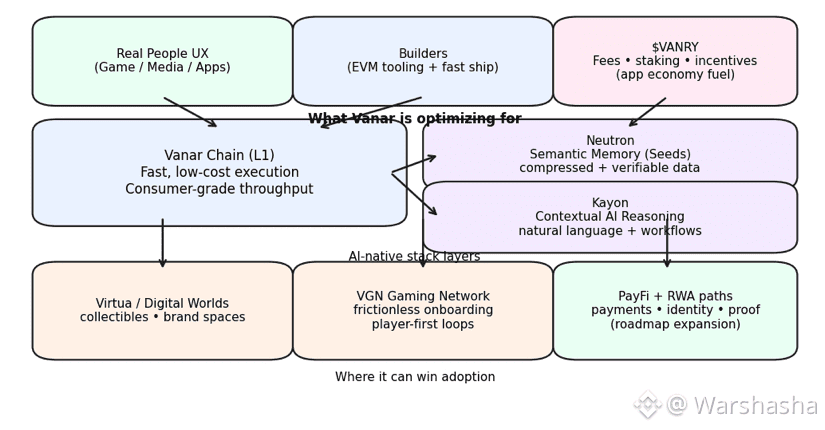
The easiest mistake people make with #Vanar is to judge it like every other chain: fees, TPS, hype cycles. But the more I read through how they’re positioning the product suite, the more it feels like Vanar isn’t trying to be “just a chain” at all — it’s trying to be an AI-first infrastructure stack where the chain is only layer one, and the intelligence layers become the real differentiator. Vanar’s own framing is literally a 5-layer architecture (Vanar Chain + Neutron + Kayon + Axon + Flows).
 That’s also why the project narrative has quietly shifted. The older “metaverse collectible” era was real, but today’s direction is broader: payments, tokenized assets, AI agents, and app intelligence living directly on-chain — not as a bolt-on service you pay for off-chain later.
The real bet: turning blockchain from “programmable” into “intelligent”
Most networks are built to store and execute. @Vanar is pushing hard on a different premise: store + execute + remember + reason.
What caught my attention is how explicitly they describe the “intelligence” path:

Neutron = semantic memory (data becomes “Seeds” that keep meaning/context, not just hashes).
Kayon = contextual reasoning (natural-language query, insights, workflows, even compliance-style logic).
Axon + Flows = automation + industry workflows (positioned as “coming soon,” but clearly meant to make apps behave more like autonomous systems than static dApps).
That’s the difference between “AI narrative” and “AI as product.” If they execute, Vanar becomes the place where apps don’t just run — they adapt.
Neutron is the part I think people will underestimate
If you’ve built anything in Web3, you know the dirty secret: data is fragmented, context gets lost, and apps become glue code between random storage layers. Vanar’s Neutron pitch is basically: make data compact, verifiable, and AI-readable so it can live on-chain without being dead weight.
They even give a very concrete claim: compressing ~25MB into ~50KB via a layered compression approach, turning raw files into “Seeds” meant to be light enough for on-chain use while keeping verifiability.
Whether the exact ratios hold across all real-world datasets is something the market will test over time — but the direction matters: Vanar is trying to make memory a first-class primitive, not an afterthought.
Kayon: not “chatbot integration” — more like an on-chain reasoning engine
Kayon’s description is less “AI helper,” more “reasoning layer that can plug into enterprise + Web3 backends.” A few details stand out:
Natural-language querying across datasets (“ask complex questions… get plain-English answers”).
Compliance-by-design angle (monitoring rules across jurisdictions, automating reporting, enforcing compliance natively).
MCP-based APIs mentioned as the bridge into explorers, dashboards, ERPs, and custom systems.
If you’re tracking where “serious adoption” comes from, it’s usually where systems become explainable and workflow-compatible. Kayon is clearly aimed at that.
What’s “new” here (the updates I’d actually track)
Instead of repeating old “gaming + metaverse” headlines, these are the current signals I think matter most:
1) The stack is being productized, not just described.
Vanar is actively pushing the five-layer narrative and the idea that intelligence is native, not middleware.
2) Axon + Flows are being treated as the next unlock.
Even third-party tracking pages are highlighting Axon/Flows as near-term focus items, and framing them as the on-chain automation/workflow layer.
3) Real-world visibility through events.
Their own site lists upcoming appearances (e.g., Step Conference in Dubai, Feb 11–12, 2026). That’s not “tech,” but it’s a hint they’re pushing business development + ecosystem presence.
4) The ecosystem narrative is expanding beyond entertainment into PayFi/RWA language.
This is visible in how Vanar describes itself now: AI-powered infrastructure for PayFi and tokenized real-world systems.
$VANRY : how I think about the token
For $VANRY , I look at it like a simple question: is there a real economy forming on-chain that needs this token repeatedly?
Right now, the basics are straightforward: VANRY is the network token, and the supply numbers are publicly tracked — lists a max supply of 2.4B and circulating supply around 2.23B (at the time of their snapshot).
Where the story becomes interesting is if the “intelligence layers” actually drive repeat usage — because semantic memory + reasoning + automated workflows naturally create lots of micro-actions. Neutron even frames expected activity patterns like “millions of micro-transactions” tied to queries and integrations.
That’s the scenario where VANRY becomes more than “gas.” It becomes the fuel of an on-chain intelligence economy.
My bottom line
Vanar’s most underrated angle isn’t “metaverse” or “gaming” — it’s the attempt to make blockchain context-aware. If Neutron genuinely becomes a standard for on-chain semantic memory, and Kayon becomes the reasoning layer that makes apps feel intelligent (not just interactive), Vanar could carve a very specific lane that most L1s aren’t even building toward.
And if they don’t execute those layers into daily user habits, then VANRY will behave like most alt L1 tokens do: pulled around by cycles more than utility.
Either way, it’s one of the few ecosystems where I feel like the roadmap is aiming at a real endgame: making Web3 feel invisible — because the intelligence is built into the rails.