

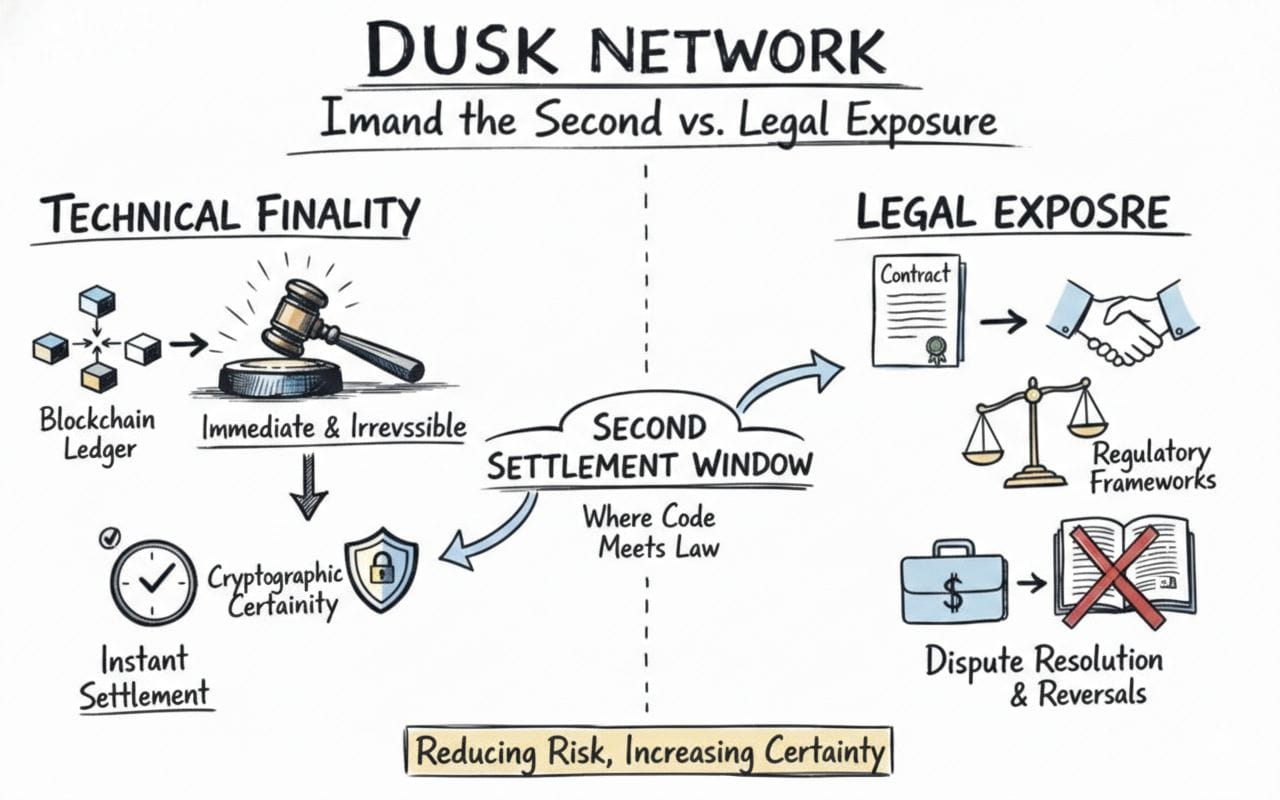
 Most blockchains treat settlement as a single moment: a transaction confirms, the block is finalized, and the system declares success. Finance has never worked that way. In regulated markets, the point where machines say “done” and the point where the law says “done” are separated by an invisible but critical buffer. Between those two points lies exposure to disputes, reversals, compliance checks, counterparty defaults, and legal interventions. Dusk is the first network that explicitly designs for that second settlement window instead of pretending it does not exist.
The Misalignment Between Code Finality and Legal Finality
Crypto’s obsession with deterministic finality grew from technical constraints, not legal realities. A chain that does not reorg feels definitive. But legal finality is not about immutability. It is about enforceability. Courts care less about whether a block can be reorganized and more about whether a transfer can be reversed, challenged, or frozen. On most chains, that layer doesn’t exist at all. Dusk treats it as a first-class concern.
Finality as the Beginning of a Legal Timer, Not the End of It
In Dusk’s worldview, the end of block finality is the start of the accountability window. It is the interval in which regulators can request disclosures, counterparties can reconcile obligations, and issuers can validate eligibility conditions. The transaction is immutable, but not yet released from its legal orbit. Once that second window expires, obligations crystalize and only then can the system consider the transaction “settled” in the financial sense, not just in the computational one.
 Why Regulated Markets Need a Controlled Delay
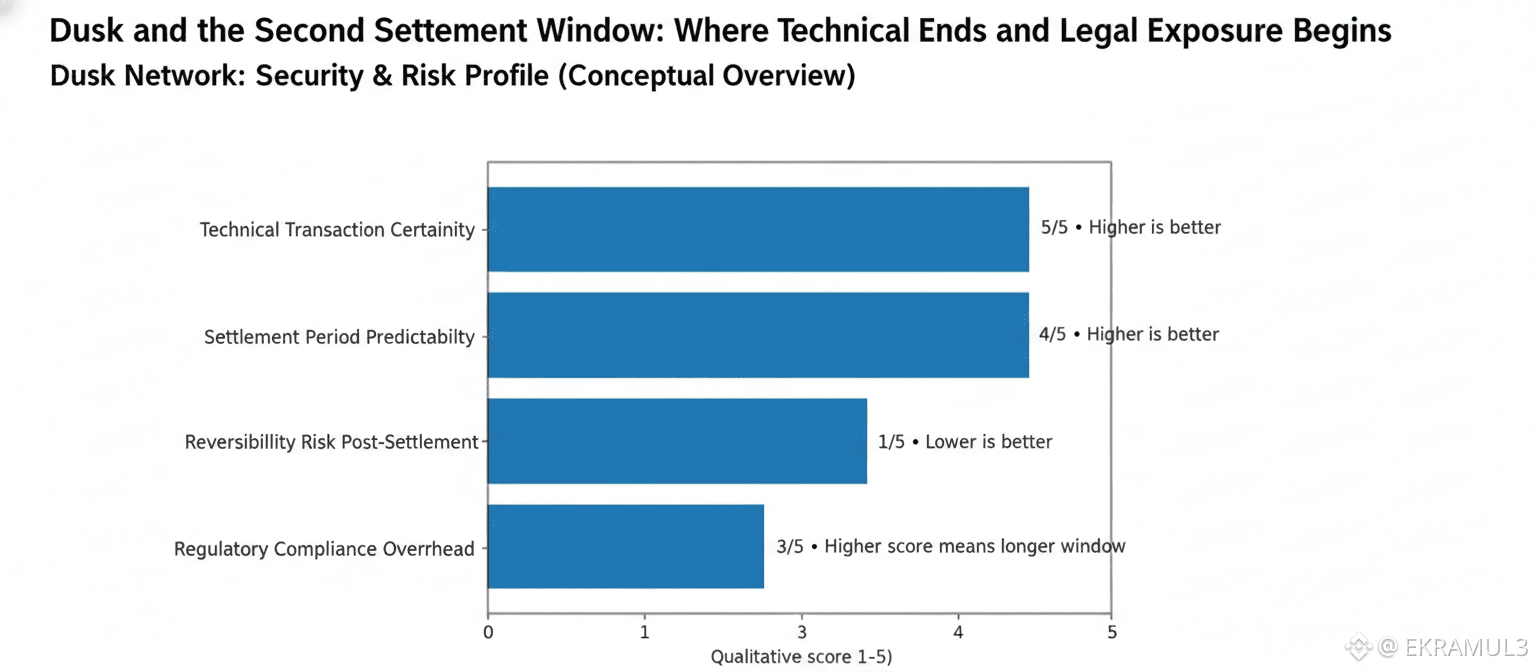
In the securities world, nobody assumes instantaneous legal discharge. Settlement cycles like T+2 exist precisely because reconciliation is not a technical exercise; it’s a risk transfer exercise. When assets become tokenized, the temptation is to collapse all time horizons to zero. Dusk resists that impulse. It acknowledges that compressing risk does not eliminate it; it merely hides it. The second settlement window makes that risk explicit and governable.
Selective Disclosure as the Compliance Mechanism Within the Window
During this second window, Dusk does not reveal everything to everyone. Instead, it enables selective disclosure: regulators gain visibility without leaking counterparty data to the market, and issuers gain enough information to satisfy rule-based transfers without exposing cap tables. This is not privacy as secrecy; it is privacy as regulated information control. It is the closest digital analogue to how real securities transfer systems function today.
The Cost of Pretending This Window Doesn’t Exist
Most blockchains never model this layer at all, which is why their RWA experiments tend to break when real issuers show up. Forcing institutional finance into a one-shot irreversible transfer without a compliance buffer creates two fatal conditions:
1. legal uncertainty, because enforceability is unclear, and
2. operational fragility, because disputes have no structured place to resolve.
Dusk’s separation of finality from legal discharge removes both problems without sacrificing the strengths of distributed settlement.
 When Instant Finality Becomes a Liability
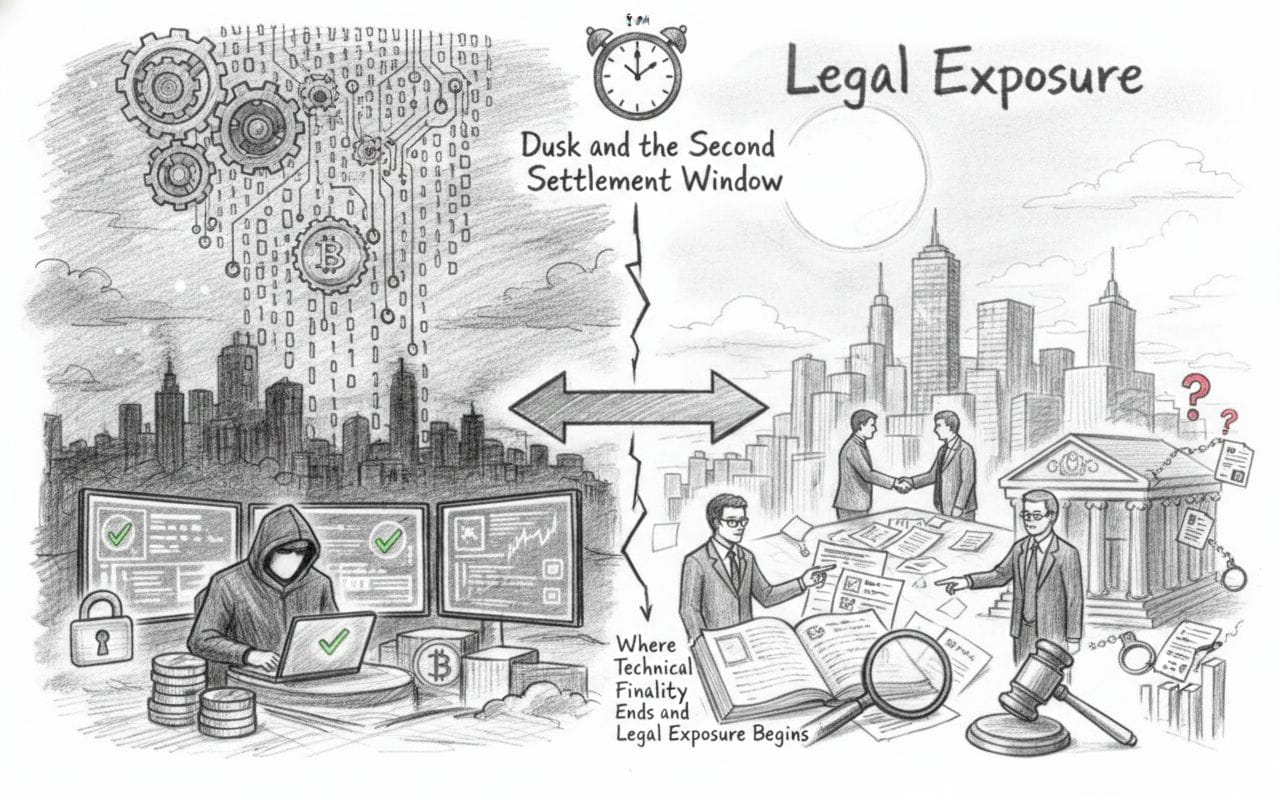
Crypto treats instantness as the highest virtue. Finance treats reversibility as the safety mechanism. In highly regulated markets, the faster a transfer becomes irreversible, the more capital must be reserved to cover disputes. This is why markets like equities and credit instruments require structured settlement cycles. Dusk engineers the buffer digitally instead of relying on institutions to simulate it manually.
The Moment the Window Closes
The critical point is what happens when the second window ends. At that moment, three things converge:
✓ the transaction is immutable,
✓ the transaction is enforceable, and
✓ the transaction is discharged.
That trifecta is what regulated settlement requires and what blockchains have historically failed to deliver.
Why This Model Will Age Well
Most crypto narratives try to predict the future by assuming institutions will conform to crypto. Dusk takes the opposite approach: institutions will adopt blockchain once blockchain conforms to the operational logic of finance. The second settlement window is not a feature. It is an admission that real markets are built on obligations, not block heights.