
There’s a specific kind of market behavior that always makes me lean in: not volatility, but hesitation. Candles don’t explode, they repeat. Price doesn’t instantly react, it waits for confirmation like participants need extra certainty before they act. In most coins, that’s just weak demand. In #Dusk , it can also be something else: supply getting committed instead of cycled.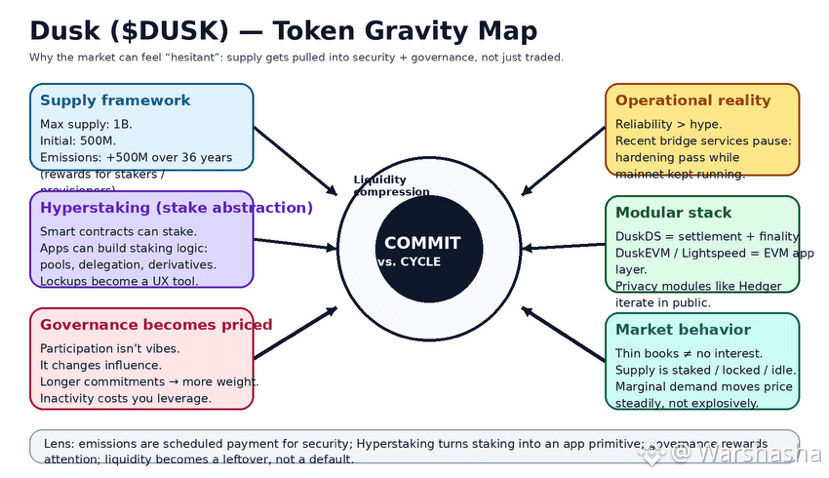
The boring cap that hides a long game
On paper, Dusk’s supply reads almost too clean: 1B max supply, defined upfront. What matters is how it gets there. $DUSK started with 500M initial supply, then emits the other 500M over a 36-year schedule—explicitly as staking rewards.
That single choice changes the vibe. Inflation exists, but it’s slow, predictable, and framed as “paying for security over decades,” not “printing for hype.” When emissions are treated like infrastructure payroll, sell pressure tends to show up more gradually.
Hyperstaking is where “staking” stops being a button
Hyperstaking (stake abstraction) is the moment the mechanics stop being theoretical. The point isn’t just “stake and earn.” It’s that smart contracts can participate in staking, which makes staking something apps can compose—delegation services, pooled strategies, staking derivatives, automated logic.
That’s why the behavior you described makes sense: longer lockups start to cluster, short-term actors self-select out, and liquidity quietly thins because the network is literally paying people to be patient.
Governance isn’t a virtue signal here — it’s an economic lever
A lot of protocols “encourage participation.” Dusk’s design pushes participation closer to a priced variable: influence consolidates toward entities that stay active and committed (especially when staking itself becomes programmable and app-driven). Hyperstaking’s whole direction points toward governance becoming more meaningful over time because staking stops being passive.
Reliability > performance: the quiet institutional tell
Dusk’s tone also feels different because it’s aiming at regulated financial rails—where uptime and rule adherence matter more than “fastest TPS.” That’s why I pay attention to operational updates like the January 16, 2026 bridge incident notice: the mainnet wasn’t impacted, bridge services were paused, and they framed it as a hardening pass. That’s not marketing—it’s ops culture.
The modular stack explains the “compressed” feel
@Dusk has been openly positioning itself as modular: DuskDS as the settlement/finality layer, and an EVM-compatible execution environment (DuskEVM / Lightspeed) to pull in Solidity builders while keeping settlement on Dusk.
When a network is structured like that, liquidity isn’t always the main objective—security and composability are. You end up trading against a system designed to reward long-duration behavior.
