
Picture this. Every time you rebalance a portfolio, pay a contractor, or move funds between wallets, the entire world can watch the amounts, timing, and counterparties. Public ledgers made that kind of transparency feel normal in crypto, but in real finance it is closer to publishing your bank statement on a street corner. The uncomfortable truth is that most serious users do not want secrecy for its own sake. They want control. They want to prove they are playing by the rules without broadcasting their strategy, their clients, or their margins.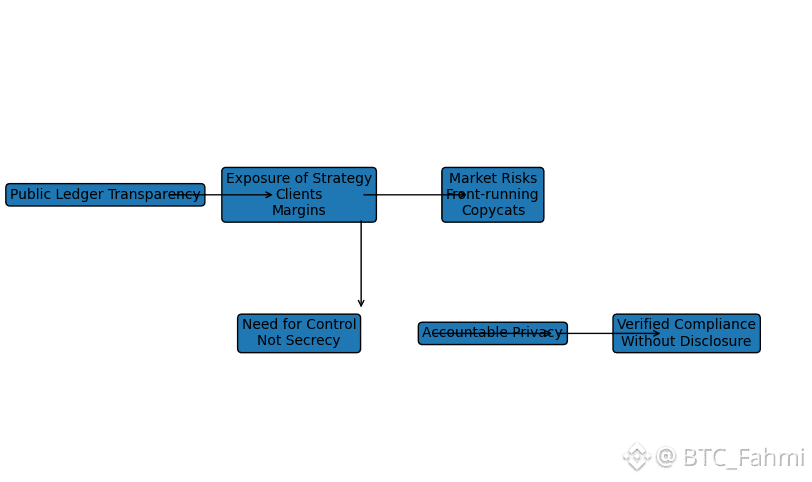
That is the idea behind Dusk’s framing of privacy as accountability rather than obscurity. In plain terms, the goal is not to hide wrongdoing. The goal is to keep sensitive details private while still allowing verification when it matters. Dusk describes this as bringing privacy and compliance together through zero knowledge proofs and a compliance framework that supports selective disclosure, meaning participants can demonstrate they meet requirements without exposing personal or transactional details.
For traders, the practical value is easy to miss until you have lived through it. If you run a desk, even a small one, your edge often sits in patterns that are obvious once they are public. If every transfer to an exchange, every treasury move, and every hedge is visible, you invite copycats, front runners, and narrative traders who build stories around your wallets. For investors in tokenized assets, the risks are more personal. A cap table, a bond position, or even a payroll stream becomes a map of relationships. Privacy that still supports auditability is not a luxury feature. It is table stakes if regulated markets are going to touch public infrastructure.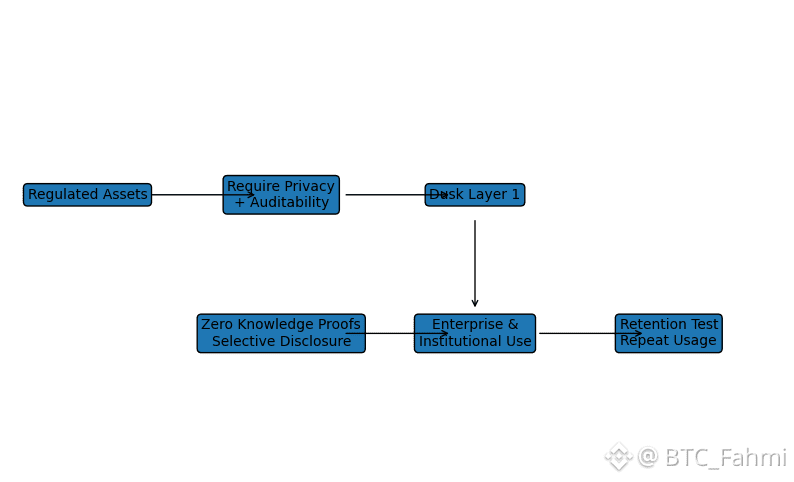
Dusk positions itself as a Layer 1 built for regulated financial markets, with confidentiality as a native property rather than an optional add on. Its documentation highlights zero knowledge technology for confidentiality and on chain compliance aligned with regimes such as MiCA, MiFID II, the DLT Pilot Regime, and GDPR style requirements, along with a proof of stake consensus design aimed at fast settlement. On the application side, Dusk explicitly promotes confidential smart contracts so enterprises can use public infrastructure while keeping data confidential. If you strip away the marketing, the strategic bet is straightforward. Regulated assets need privacy but regulators and counterparties still need assurance. The product is selective visibility, not blanket darkness.
The institutional narrative is not hypothetical here. Dusk has an official commercial partnership with NPEX, described as a step toward a blockchain powered securities exchange for issuing, trading, and tokenizing regulated instruments. It also announced work with NPEX and Quantoz Payments to bring EURQ to Dusk, framed as enabling regulated finance to operate at scale on the chain. More recently, Dusk reported adopting Chainlink standards including CCIP with NPEX to bring regulated European securities on chain and connect them to broader liquidity. These are the kinds of integrations that matter to investors because they are about distribution and workflow, not just cryptography.
Now put the technical story to the side and look at what the market is saying today. As of January 26, 2026, CoinMarketCap lists DUSK at about $0.1642 with a roughly $81.63M market cap and about $109.36M in 24 hour volume, with a 24 hour range shown around $0.1367 to $0.2162. CoinGecko shows a similar spot price around $0.1648 and 24 hour trading volume around $100.7M. The striking detail is not the price level, it is the activity relative to size. CoinMarketCap’s volume to market cap figure is shown around 133.97% for the last 24 hours. That kind of turnover is consistent with heavy speculative participation, momentum flows, and fast rotation. It can be an attention signal, but it is not the same thing as adoption.
This is where the retention problem becomes the real investment question. Crypto is full of networks that can explain their tech for an hour and still fail at the simple test of habit. Do users come back next week when the excitement cools. Do builders keep shipping when incentives flatten. Do institutions keep routing real activity through the rails when a competitor offers a new grant program. High volume days can create a flattering chart, but retention shows up in boring places: repeat settlement, recurring issuance, steady developer output, and products that survive quiet months.
For Dusk specifically, retention will likely hinge on whether “accountable privacy” becomes operational inside regulated workflows. Partnerships are promising, but markets pay for execution. If NPEX related trading venues, custody tooling, and regulated issuance pipelines actually pull repeat flow onto the chain, the privacy thesis gains credibility because it is solving a daily pain, not a philosophical one. If instead the story remains mostly narrative and exchange driven liquidity, the token may continue to trade like a theme rather than infrastructure.
If you are approaching DUSK as a trader, treat it like a market that can flip regimes quickly. Today’s data shows high activity and wide intraday ranges, which can reward discipline and punish overconfidence. If you are approaching it as an investor, your job is to verify retention, not just catalysts. Follow the actual deliverables tied to regulated adoption, watch for repeat usage signals around issuance and settlement, and read the primary materials rather than relying on social summaries. Start with Dusk’s own overview of how it combines confidentiality and on chain compliance, then map that to real counterparties and timelines.
Privacy that earns a place in finance is not about disappearing. It is about proving you are compliant while staying strategically and personally protected. The opportunity in Dusk is that it is building for that exact tension. Your call to action is simple. Do not buy the story, audit the habit. Track whether users and institutions return when nobody is watching, because in the end, retention is the only privacy preserving metric that markets never stop revealing.

Artikel
Dusk: Privacy That’s Accountability, Not Obscurity
Ansvarsfriskrivning: Inkluderar åsikter från tredje part. Ingen ekonomisk rådgivning. Kan innehålla sponsrat innehåll. Se användarvillkor.