

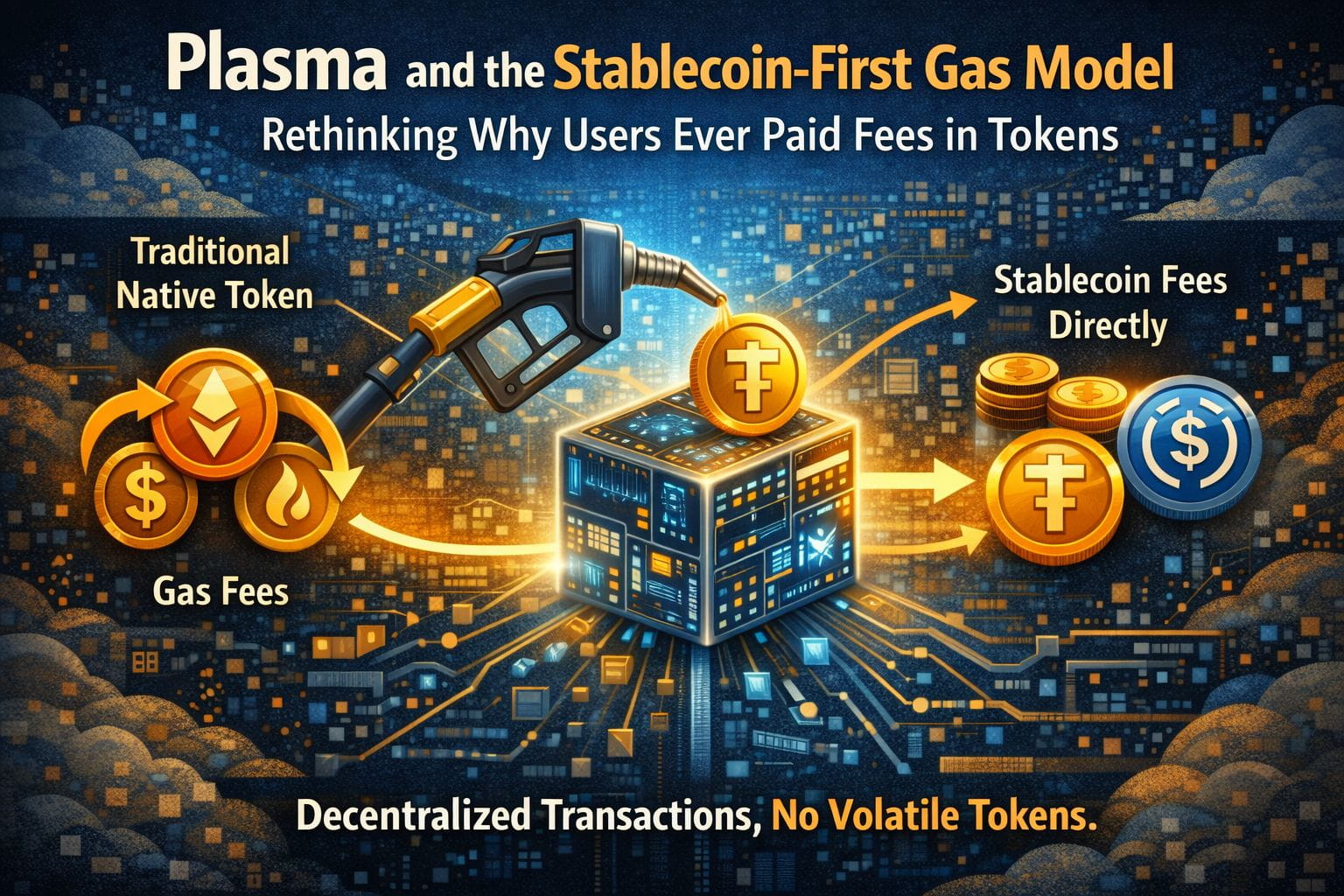
 The idea that users must hold a volatile native token just to move stable money has been quietly accepted for so long that most people no longer question it. Gas fees became a cultural norm in crypto: confusing at first, annoying forever, but tolerated because “that’s how blockchains work.” Yet when you step outside crypto-native thinking and look at how people actually use money, this model starts to feel strange. Stablecoins were created to remove volatility, but the gas model surrounding them re-introduced uncertainty through another door. This is the exact contradiction Plasma is designed to confront, not with cosmetic fixes, but with a structural economic redesign.
Traditional blockchains treat every transaction the same. Whether you are deploying a complex DeFi protocol or sending five dollars to a friend, you participate in the same gas market, bid with the same native token, and compete for the same block space. From a protocol purity standpoint, this is elegant. From a user experience and economic efficiency standpoint, it is deeply mismatched. Stablecoin transfers are repetitive, high-volume, and low-complexity. They do not benefit from open gas auctions or volatile fee discovery. Plasma begins with a simple observation: if the primary activity on a network is stablecoin movement, the gas model should be built around stablecoins, not around a speculative asset designed for security abstraction.
In a native-token gas system, fees serve multiple purposes at once. They protect against spam, reward validators, and serve as a demand sink for the token. This categorization brings about the concept of hidden friction. Users have to get the native token in order to manage the balances and transactions around the fee spikes. For developers, it means teaching users about gas before they can use the product. Plasma untangles this grouping. Instead of asking users to subsidize network security through token demand, it treats stablecoin transfers as infrastructure flows whose costs can be internalized, abstracted, and managed at the system level.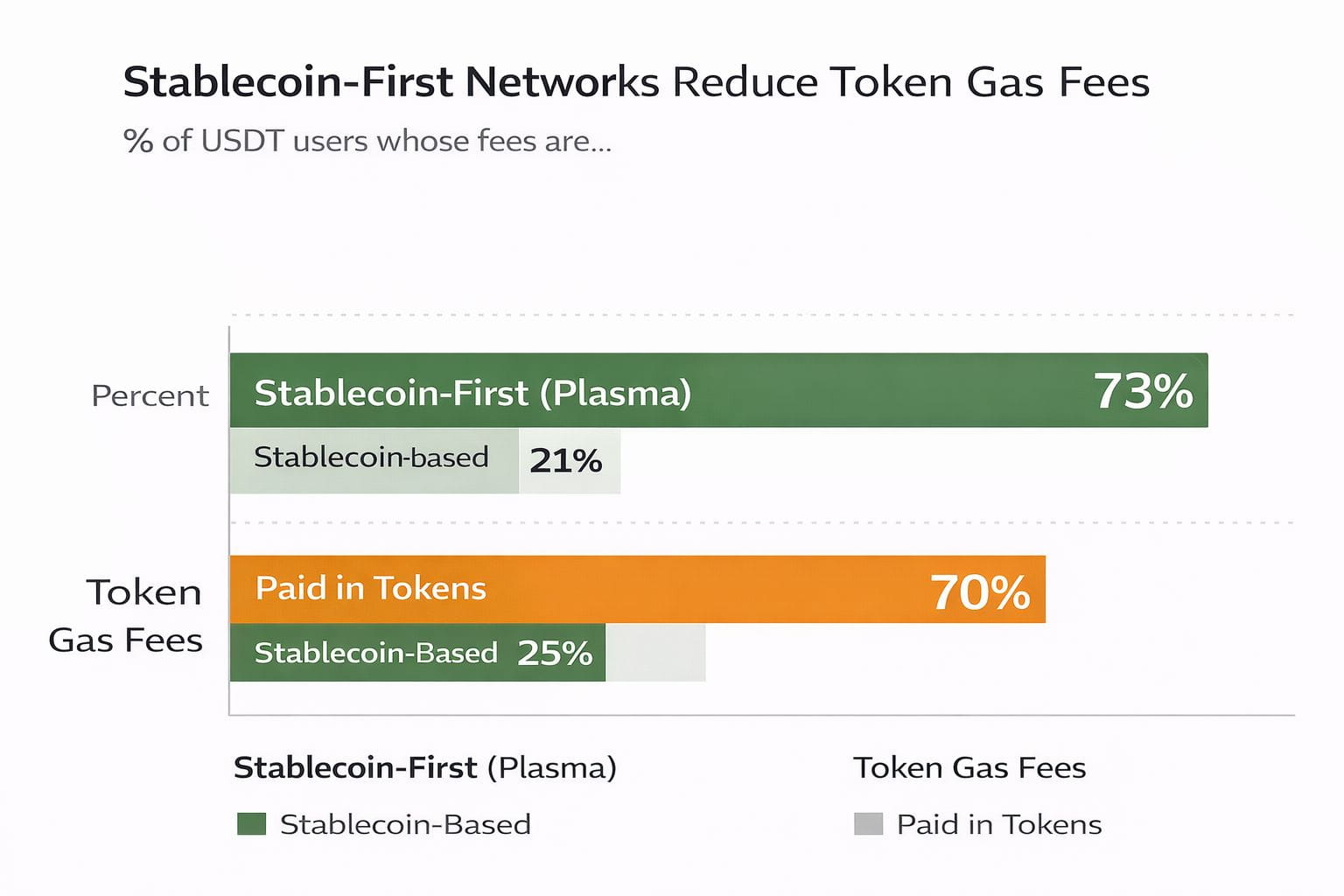
The stablecoin-first gas model flips the direction of dependency. Instead of USDT depending on a native token to move, the network depends on USDT usage to justify its existence. Fees do not disappear; they are re-positioned. Costs are handled by the protocol, operators, or integrated service layers, rather than being surfaced as a volatile, user-managed variable. From the sender’s point of view, there is no gas decision to make. The transaction either conforms to network rules or it doesn’t. This removes an entire cognitive step that has quietly excluded millions of potential users from on-chain money movement.
Economically, this design shifts incentives in a subtle but important way. Native-token gas models often encourage speculation as a side effect. Holding the gas token becomes an investment thesis, and network usage is framed as something that should “drive value” into that asset. Plasma deliberately steps away from this reflex. In doing so, the economic model is now centered on stablecoin throughput, which means that success is measured by reliability, predictability, and volume, rather than token hype. The network’s value proposition becomes operational rather than narrative: can it move stable value cheaply, consistently, and at scale?
This specialization also changes how sustainability is framed. In many chains, sustainability depends on maintaining token demand even when real usage is low. Plasma’s model rewards actual settlement behavior with sustainability. The players and infrastructure are incentivized to facilitate volume, uptime, and settlement flow integration. The economics start to look more like payment infrastructure and less like a speculative network. This does not make Plasma less “crypto.” It makes it more honest about what problem it is solving.
From a technical standpoint, separating stablecoin transfers from generic gas markets reduces systemic fragility. Congestion spikes on general-purpose chains often come from unrelated activity: NFT mints, arbitrage bots, or sudden DeFi liquidations. Stablecoin users pay the price for events they have nothing to do with. Plasma isolates stablecoin settlement from this noise by designing a network whose primary resource allocation logic is tuned for predictable, repetitive transfers. This isolation is not fragmentation; it is domain optimization.
There is also a regulatory and institutional dimension to this gas redesign. Institutions are not allergic to fees; they are allergic to uncertainty. A model where transaction costs are stable, abstracted, and denominated in familiar terms fits far more naturally into accounting systems, compliance workflows, and risk models. Native-token gas introduces balance-sheet exposure to volatility that many organizations simply cannot accept. Plasma’s model lowers this barrier without compromising on cryptographic settlement or decentralization principles.
Critics sometimes argue that removing native-token gas weakens security incentives. Plasma’s response to this is to redefine security as a service rather than a speculation engine. Validators and operators are rewarded in predictable economic flows rather than in token appreciation. This is to align incentives around service quality rather than protecting token price stories. Security becomes operational discipline rather than market psychology.
Perhaps the most interesting consequence of Plasma’s design is psychological rather than technical. When users are no longer forced to think about gas, blockchain transactions start to feel normal. Not exciting, not risky, not technical just functional. This is a normalization that is uncomfortable for some aspects of crypto culture that thrive on complexity and insider knowledge. But for stablecoins to fulfill their promise as everyday money, boring reliability may be the highest achievement.
Seen this way, Plasma’s stablecoin-first gas model is not a rejection of blockchain principles, but a refinement of them. It asks whether decentralization must always be accompanied by user-visible friction, and whether economic alignment requires speculative tokens at every layer. By designing fees around the asset people actually want to move, Plasma challenges a long-standing assumption in blockchain architecture: that gas must always be someone else’s problem. Instead, it quietly absorbs that complexity and lets stablecoins behave like what they were always meant to be stable value, moving without drama.