

Liquidity providers are often described as the backbone of DeFi, but in practice they are treated more like expendable capital. Many protocols attract liquidity with short-term incentives, high headline APYs and aggressive emissions, only to leave providers exposed to risks they never signed up for.
If you’ve ever provided liquidity on a typical AMM, you already know the trade-offs. You lock capital, earn fees when volume flows through, and accept impermanent loss as “part of the game.” What’s less discussed is how much information asymmetry and structural disadvantage LPs face in most systems.
DUSK approaches liquidity from a different direction. Instead of asking LPs to subsidize the market with blind risk, it builds market infrastructure where liquidity provision looks closer to professional market making than speculative farming.
The real problem with liquidity in most DeFi markets
Most liquidity pools today are designed for simplicity, not fairness.
Anyone can see the pool balances. Anyone can see pending transactions. Anyone can model how trades will move prices before they happen. For traders, this is transparency. For liquidity providers, it’s exposure.
Front-running, sandwich attacks, and toxic flow are not edge cases. They are structural features of transparent AMMs. LPs lose value not because markets move, but because they are predictably exploited by faster actors.
Over time, this creates a pattern:
Sophisticated traders extract value
Passive LPs absorb losses
Incentives are used to mask the imbalance
This is why many liquidity providers eventually leave, even when APYs look attractive on paper.
Why DUSK starts from a different assumption
@Dusk does not assume that transparency always benefits everyone equally.
In traditional finance, professional market makers operate in environments where order flow is protected. Trade sizes, intentions, and strategies are not broadcast to the entire market before execution. This is not secrecy for its own sake; it is how liquidity remains stable.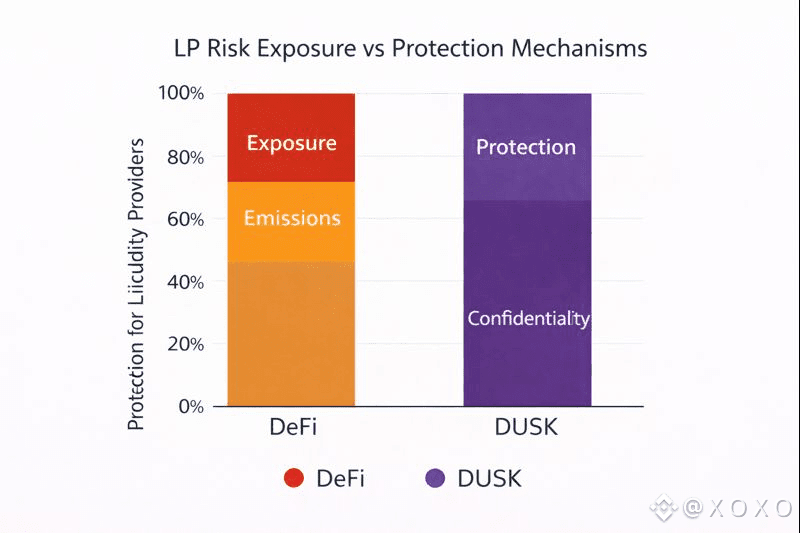
DUSK brings this logic on-chain.
By enabling confidential transactions and private order flow, DUSK changes the risk profile for liquidity providers. LPs are no longer forced to reveal their positions to every arbitrage bot watching the mempool.
This single difference has cascading effects.
Liquidity without being a target
On DUSK, liquidity providers are not sitting in a glass box.
Because trades can be executed privately and verified cryptographically, LPs are shielded from many forms of extractive behavior that plague open AMMs. This does not eliminate risk, but it removes avoidable risk.
In real life terms, this is the difference between running a shop with prices posted but transactions private, versus announcing every customer’s purchase before it happens. One invites exploitation. The other enables normal business.
Why regulated liquidity changes everything
Another major difference is the type of markets DUSK supports.
Most DeFi liquidity exists around volatile, speculative assets. DUSK is designed for regulated assets, tokenized securities, and compliant financial instruments. These markets behave differently.
They attract:
Longer-term participants
Lower churn
More predictable flow
For liquidity providers, this matters more than yield spikes. Stable, repeatable volume with lower adversarial behavior produces more sustainable returns than high-frequency chaos.
Fairer pricing through protected order flow
In many AMMs, pricing efficiency is achieved by arbitrage after the fact. This means LPs lose value first, and arbitrageurs “correct” the price later.
DUSK allows pricing to happen closer to execution, with less information leakage. This reduces the gap between fair price and executed price, directly benefiting liquidity providers.
LPs earn from facilitating trades, not from being the shock absorber for inefficiencies.
Incentives aligned with long-term participation
DUSK does not rely on excessive token emissions to attract liquidity. Instead, it focuses on making liquidity provision structurally safer.
This matters because incentives can attract capital, but only structure retains it.
When LPs feel that:
Their positions are not being gamed
Their returns reflect real market activity
Their risks are understood and bounded
They stay longer. Markets deepen organically.
Real-world comparison: retail vs institutional liquidity
Retail-focused DeFi liquidity often resembles a public betting table. Everyone sees the odds, the bets, and the outcomes in real time.
Institutional liquidity operates differently. Information is controlled, execution is fair, and participants are protected from predatory behavior.
DUSK is one of the few on-chain environments that attempts to bridge this gap without sacrificing verifiability.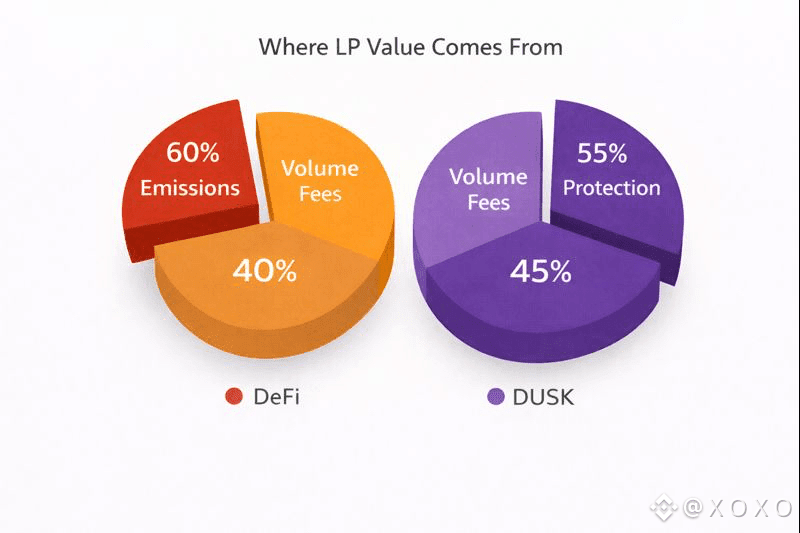
Why this matters beyond DeFi
Liquidity is not just about trading tokens. It underpins:
Tokenised stocks
On-chain funds
Credit markets
Regulated derivatives
These markets cannot function if liquidity providers are constantly leaking value to opportunistic actors.
DUSK’s approach makes on-chain liquidity viable for markets that require professionalism, not speculation.
The difference between yield and durability
High yields attract attention. Durable liquidity builds markets.
DUSK focuses on durability.
By protecting order flow, supporting compliant assets, and aligning incentives around real usage, it offers liquidity providers something rare in crypto: predictability.
Not guaranteed profits. Predictable conditions.
Final perspective
DUSK does not promise liquidity providers outsized returns. It offers something more valuable: an environment where providing liquidity makes economic sense.
In a space where LPs are often treated as exit liquidity, DUSK treats them as infrastructure.
That difference is subtle, but it changes everything.