

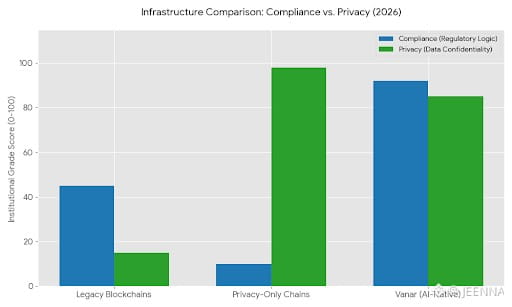
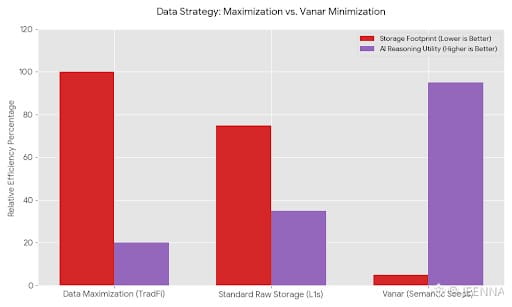
In early 2026, Vanar Chain has solidified its positioning as one of the most notable AI-centric blockchain projects by delivering purpose-built infrastructure rather than retrofitting intelligence onto legacy systems. Unlike Layer-1 networks that treat AI as an add-on via oracles or APIs, Vanar was designed from the ground up for AI workloads and semantic data processing, enabling smart contracts and decentralized applications to think, reason, and act on structured knowledge rather than just record transactions.
At the heart of Vanar’s architecture lies the Vanar Stack, a multi-layer ecosystem built to support next-generation intelligent systems. The base layer, Vanar Chain itself, is a modular, EVM-compatible L1 that supports fast, low-cost transactions and forms the foundation for semantic memory, reasoning engines, and intelligent automations. Above this base is Neutron, a semantic memory engine that compresses large datasets into compact, on-chain “Seeds” — essentially AI-readable knowledge objects that replace traditional file storage with verifiable, context-rich data. This allows smart contracts and AI agents not only to store data onchain but to understand it, enabling automated logic and decision-making tied directly to blockchain state.
Complementing Neutron is Kayon, Vanar’s on-chain reasoning engine, which allows applications to query, analyze, and derive insights from the semantic memory layer. This level of native intelligence means that smart contracts can autonomously interpret compressed data, trigger conditional actions, or evaluate regulatory rules without off-chain intermediaries. Vanar also plans further expansions such as Axon (intelligent automation) and Flows (industry-specific modules), which together will support enterprise workflows, cross-chain actions, and AI-guided execution paths that bridge reasoning and economic activity.
2026 has also seen Vanar deepen its focus on real-world utility and financial infrastructure. In late 2025, the project made a strategic move by appointing Saiprasad Raut as Head of Payments Infrastructure, signaling an emphasis on agentic payments, stablecoin settlement, and autonomous economic flows — areas where intelligence and compliance intersect. The company’s presence alongside global payment leaders at Abu Dhabi Finance Week 2025 underscored its intent to engage mainstream financial systems and demonstrate how programmable, AI-driven settlement can function within regulated environments.
Vanar’s ecosystem narrative has shifted from its earlier identity as a gaming-focused chain to one focused on PayFi (payment finance), tokenized assets, and intelligent automation. This evolution reflects a broader industry trend where chains must provide operational value rather than mere transactional throughput. Observers note that Vanar’s design — from EVM compatibility to semantic reasoning — is intended to address real pain points in current blockchain infrastructure such as fragmented data storage, off-chain dependencies, and siloed processing logic. By tackling these at the protocol level, Vanar aims to attract developers building applications where data continuity, memory, and AI reasoning are core to functionality.
From a tokenomics perspective, the native $VANRY token remains central to network operations, serving as the gas token, staking asset, and economic unit for AI tool subscriptions and automated workflows. By tying usage of AI services (like semantic storage or reasoning queries) to token consumption, Vanar aims to create intrinsic demand for $VANRY that goes beyond speculative trading. This can strengthen the network’s value capture if builds onchain activity and AI usage metrics expand meaningfully.
Market dynamics in late January 2026 reflect this transitional phase: while the token has experienced volatility and episodic rallies, the broader narrative among developers and infrastructure watchers emphasizes long-term technology adoption over short-term speculation. Industry commentary suggests Vanar’s value is shifting from hype-driven narratives to ownership of AI-native productivity, positioning $VANRY as more than a speculative asset — instead as a unit of access to on-chain intelligence infrastructure.
Despite these advancements, challenges remain. Adoption metrics such as daily active semantic memories, AI-driven contract executions, and enterprise integrations will be key indicators to watch in 2026 as developers and institutions evaluate whether Vanar’s intelligent stack delivers measurable utility beyond theoretical promise. If these adoption signals strengthen, Vanar could become a foundational layer for the next wave of intelligent applications — blending blockchain security with AI-powered cognition and automation.