Vanar did not begin with the loud promise of becoming the fastest chain or the cheapest chain or the next place for quick speculation. It began with a quieter question that most blockchains avoid asking because the answer is uncomfortable. Why does blockchain still feel hard, expensive, and unnecessary to ordinary people and real businesses? From the very start, Vanar’s idea was shaped by frustration with complexity. High fees that punish small actions. Wallets that confuse first-time users. Systems that demand technical literacy before offering value. Instead of racing for headlines, Vanar chose to focus on removing friction, believing that if blockchain ever wants to matter beyond insiders, it must feel natural, almost invisible. That belief slowly evolved into a chain designed not only to move value, but to understand context, memory, and intent, because real life is not just transactions, it is meaning layered over time.
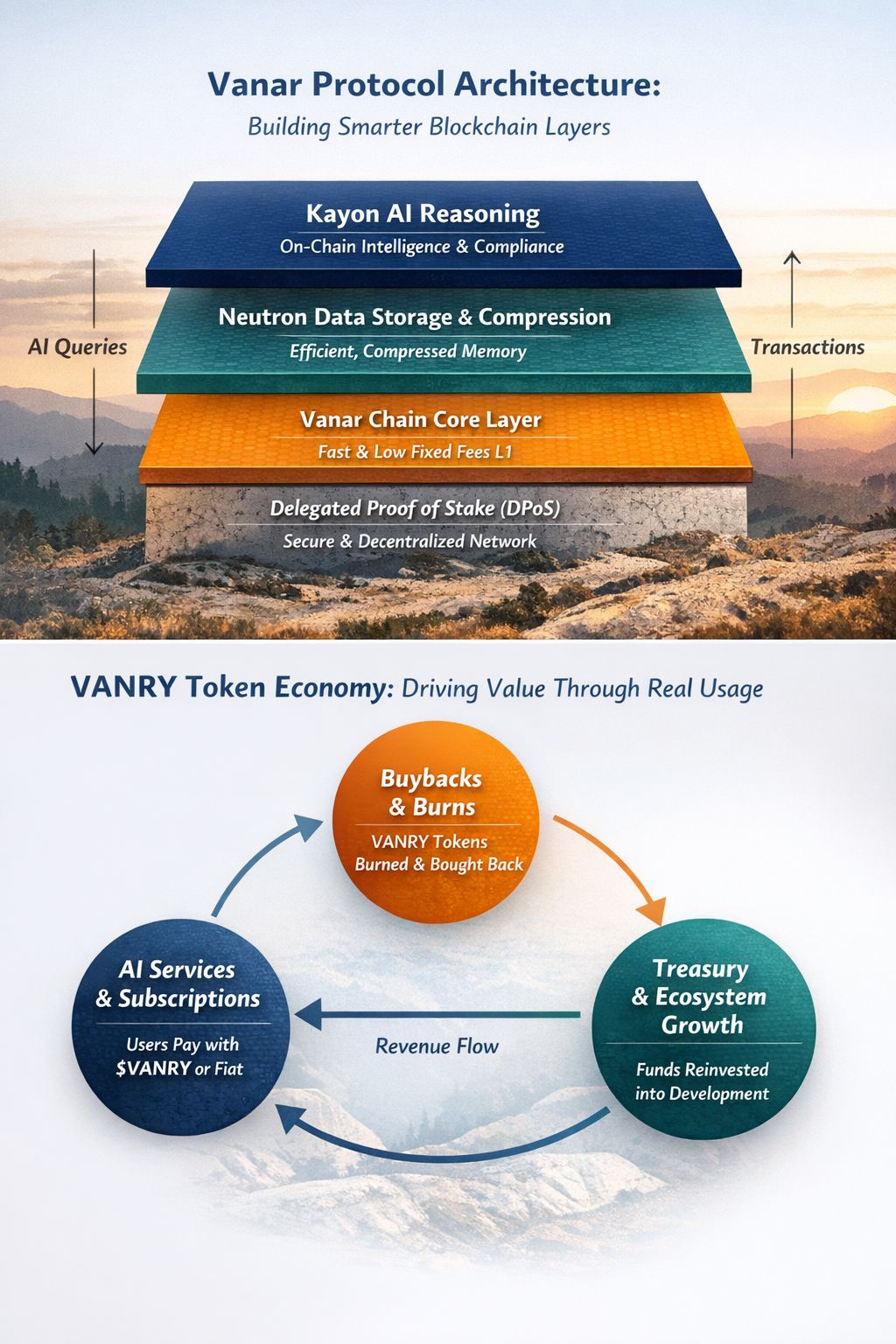
At its core, Vanar feels less like a traditional blockchain and more like an intelligent foundation quietly working in the background. The base layer focuses on predictability and low fixed fees so people are not afraid to use it. When fees are fractions of a cent and do not spike unexpectedly, behavior changes. Users experiment. Developers design freely. Small payments, subscriptions, and repeated actions suddenly make sense. On top of that base, Vanar introduced something unusual for a blockchain. Memory. Through its Neutron system, data is compressed and stored in a way that preserves meaning rather than raw size. Documents, images, and records are not just dumped on-chain but reduced into efficient, structured forms that can live long-term without becoming a burden. This is where the chain stops being a passive ledger and starts to feel alive.
The real emotional shift happens when you understand Kayon, the AI reasoning layer. Instead of forcing every application to interpret data on its own, Vanar allows intelligence to sit close to the data itself. This means the chain can help applications understand what data represents, whether it meets certain rules, and how it should be treated. For people building real-world systems like payments, compliance, education, or asset management, this matters deeply. It reduces human error. It reduces manual review. It reduces the invisible stress that comes from trusting systems that do not truly understand what they are processing. When a blockchain can assist rather than obstruct, trust grows naturally.
What makes Vanar feel more human than theoretical is that these ideas are not locked in a whitepaper. Products like myNeutron are already live and used. People upload files, build persistent AI memory, and pay for extended features using either fiat or VANRY. That moment is important because it transforms belief into experience. A user is no longer imagining a future product. They are using it, upgrading it, and depending on it. Revenue is generated. Costs are paid. The system is tested under real behavior, not ideal scenarios. This is where many blockchain projects stumble, but Vanar deliberately stepped into this uncomfortable phase early.
The economics follow the same grounded logic. Instead of relying purely on hype-driven demand, Vanar ties token value to usage. When people pay for AI services and storage, part of that value flows back into buying and burning VANRY. This creates a quiet feedback loop where real activity slowly reduces supply and strengthens the treasury. It is not dramatic and it is not instant, but it feels honest. It respects the idea that value should come from usefulness, not from promises. Of course, this only works if people continue to use the products, and Vanar does not hide from that truth. The token is not pretending to be magic. It is a tool whose strength depends on how much it is needed.
There are risks here, and pretending otherwise would be dishonest. Adoption takes time. Enterprises move slowly and ask hard questions. Storing meaningful data, even in compressed form, invites legal and regulatory scrutiny that cannot be solved by code alone. AI systems must prove reliability and fairness under pressure. Cross-chain connections expand reach but also increase exposure to failures elsewhere. Vanar is walking a path that demands patience and discipline, because intelligence and compliance are not forgiving domains. One mistake can damage trust that takes years to rebuild. The project’s future depends on execution far more than narrative.
What gives Vanar emotional weight is its focus on people rather than markets. University roadshows, creator tools, and educational outreach are not just marketing tactics. They are signals that the team understands adoption is learned, not assumed. When students, researchers, and creators build habits around a tool, they carry those habits forward into their careers and companies. This is slow growth, but it is durable growth. It builds familiarity, not just awareness.
If Vanar succeeds, the future it points toward is subtle but powerful. A world where blockchain fades into the background while quietly supporting everyday workflows. Where AI remembers what matters so humans do not have to. Where compliance is assisted instead of enforced through fear. Where small actions are affordable and meaningful. It is not a loud revolution. It is a gentle correction to an industry that forgot why it started.
In the end, Vanar feels like a project that understands fatigue. Fatigue from complexity. Fatigue from empty promises. Fatigue from systems that demand trust without earning it. Its vision is not to impress, but to be useful. And sometimes, the most meaningful change does not arrive with noise, but with relief, when something finally works the way it always should have.