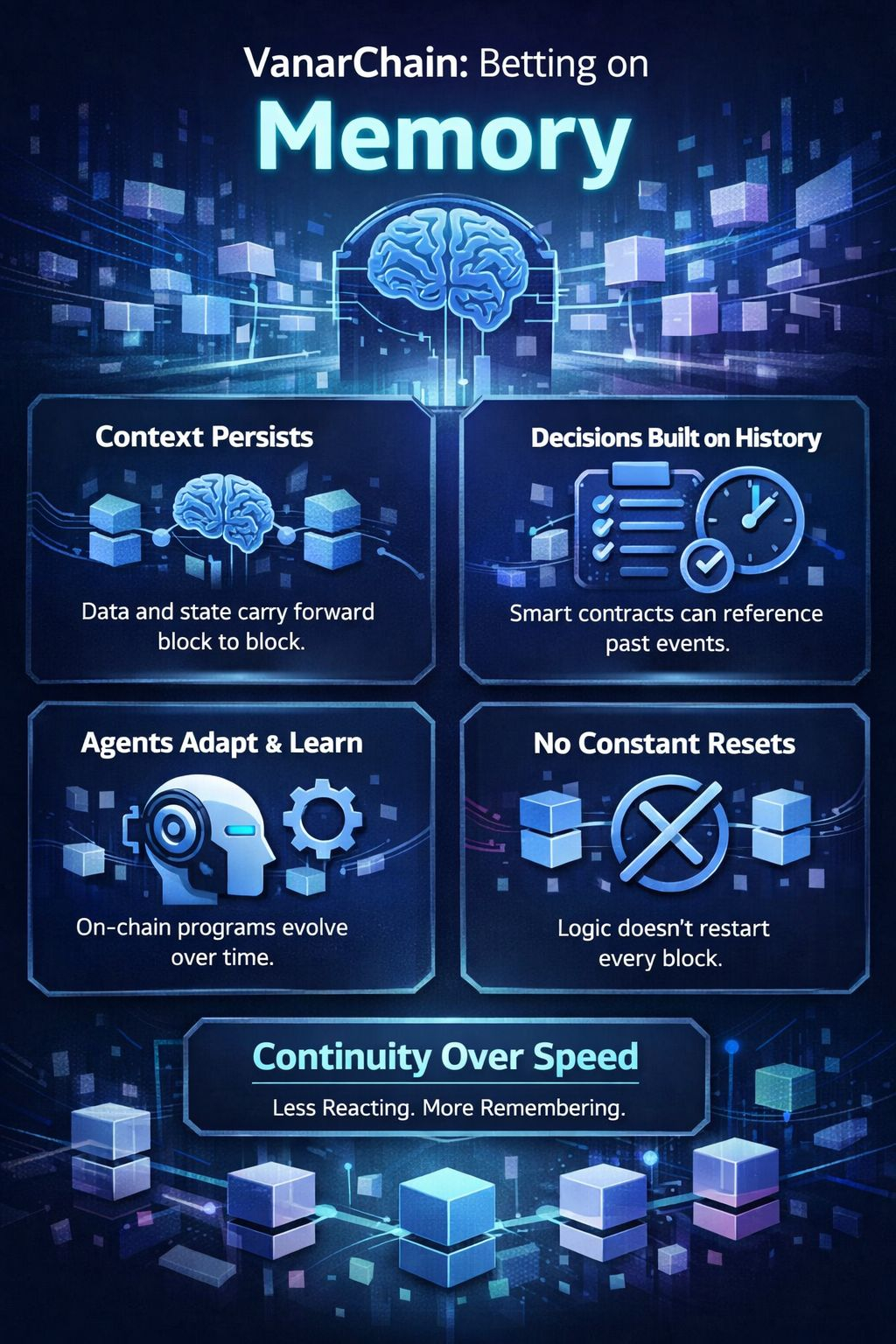
VanarChain doesn’t make its case with speed. What stands out is how little of its design revolves around restarting. In a market obsessed with constant throughput, that choice feels intentional and slightly uncomfortable.
Blockchain performance is usually framed through measurable bursts of activity. Thousands of transactions fly through the system, blocks finalize, and everything resets. Context is discarded. Execution ends, and memory evaporates.
That design forces meaning to live elsewhere. Applications and external systems must piece together history, decisions, and logic that the chain itself refuses to hold. The result is shallow infrastructure that reacts quickly but understands very little.
Vanar’s design challenges that pattern. It treats continuity as foundational. Context carries forward. Decisions don’t exist in isolation. Logic can accumulate over time rather than resetting every cycle.
This matters more now than before. The explosion in AI infrastructure highlights the cost of forgetting. Systems that can’t retain understanding waste resources reprocessing what they already encountered. Efficiency suffers, and automation becomes fragile.
On-chain, continuity changes behavior. Agents stop acting like one-off instructions. They become processes with memory, capable of referencing history and adapting accordingly. That depth opens doors that pure speed never could.
There are real tradeoffs. Persistent state increases complexity. Mistakes don’t vanish on their own, and auditing becomes harder. It’s also harder to sell a philosophy of patience in a market trained to chase numbers.
But as autonomous systems take on greater responsibility, coordination will matter more than raw execution. In that environment, blockchains built to remember may steadily outperform those designed only to move fast.$VANRY @Vanarchain #vanar