I’m not going to pretend I joined crypto for noble reasons.
I didn’t.
I joined because everything was moving and everyone was talking.
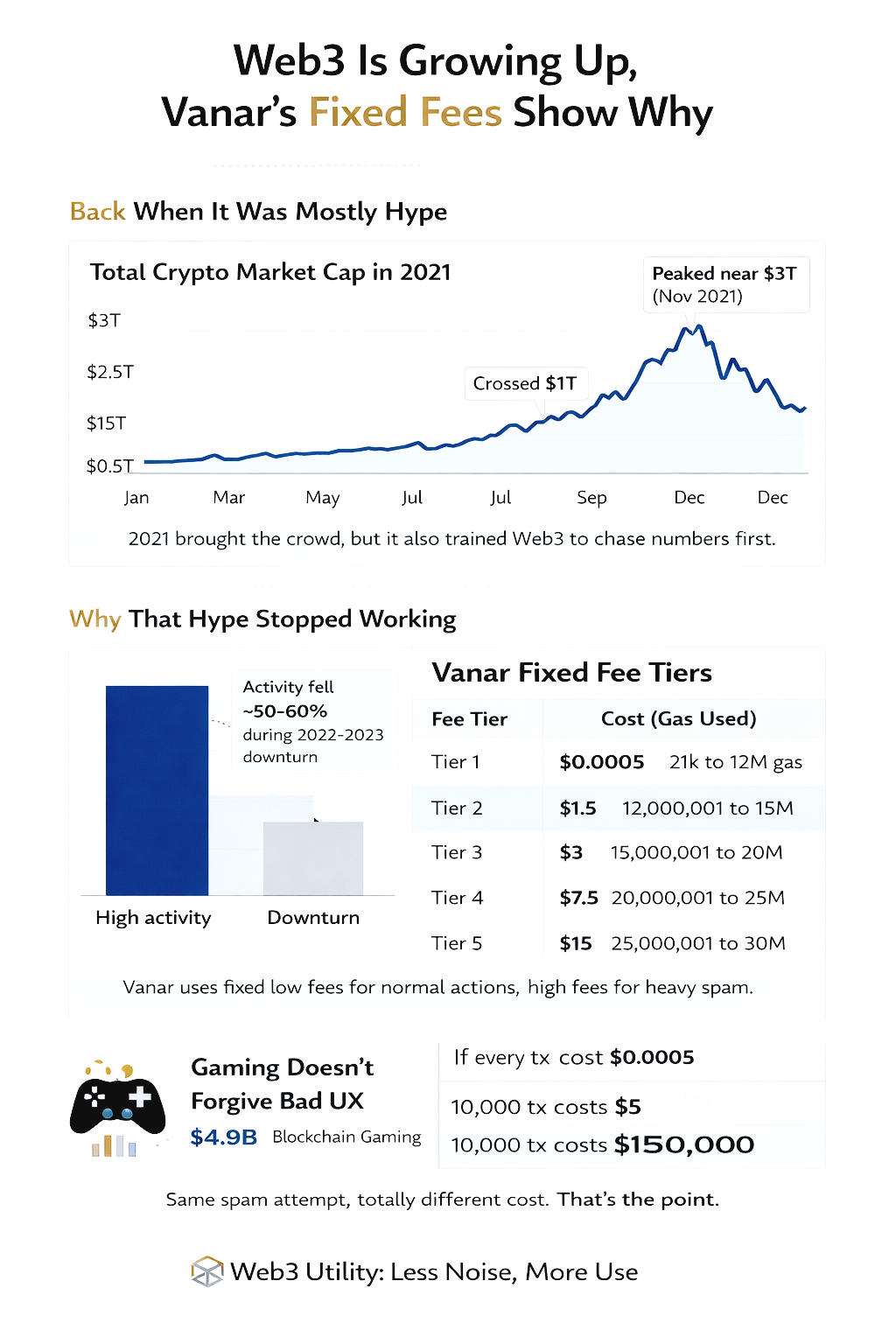
In 2021, the total crypto market cap pushed past $1 trillion, then ran up close to $3 trillion by November. That kind of number makes people curious, even if they don’t know what a blockchain is. It pulled in traders, creators, gamers, random friends from school, literally everyone.
But here’s the thing.
Most of those people weren’t using WEB3. They were watching prices. That’s not the same.
When the market cooled in 2022 and 2023, a lot of activity dropped hard, in some places around 50 to 60 percent.
I’m not even saying that to be dramatic.
You could feel the silence.
And honestly, part of it was predictable.
If your main reason to show up is “profit,” you leave when profit looks harder. But another part was something Web3 folks don’t like admitting.
The apps were rough.
I’ve tried wallets that made simple steps feel like homework. I’ve clicked “confirm” and waited long enough to open another app, come back, and still see it loading.
Then the fee hits and you’re like, wait, why did that cost so much?
People don’t rage quit because they hate the idea. They quit because it’s annoying.
So when people say “utility,” I don’t think of big speeches. I think of small stuff working smoothly.
Fast transactions.
Fees that don’t surprise you.
Apps that feel normal.
That’s it.
If a chain wants gaming and entertainment, it needs to handle thousands of tiny actions without making users feel it. Even a $0.10 fee can get painful when it repeats again and again. And delays are worse. In games, delay kills the vibe fast.
I’ve noticed something funny too.
When a system is smooth, nobody claps. People only talk when something breaks. That’s the standard now.
But vanar is doing differently.
Vanar Chain is interesting because it seems built around that boring “make it work” mindset.
One of the biggest things is its fixed, dollar-based fees. Instead of gas swinging up and down, Vanar uses five fee tiers based on how big the transaction is. Most normal actions sit at the bottom tier, around $0.0005 per transaction.
The tiers range from $0.0005 up to $15. Transfers, minting NFTs, swaps, staking, and similar everyday actions are meant to stay in the cheapest band.
And the pricing isn’t random.
The docs give a spam example that actually made me pause for a second. If someone pushed 10,000 large transactions on a chain with a 3-second block time, they could clog it for over 8 hours. If every one of those costs $0.0005, the spam only costs $5. If it costs $15, it becomes $150,000.
That’s a totally different story.
This is the kind of design choice that screams “we care about real usage,” not just headlines.
Vanar’s focus on gaming and entertainment makes sense because that’s where weak chains get exposed fast.
Players aren’t patient. They won’t sit through friction for “future potential.” If the experience feels clunky, they leave, and they don’t write a long tweet about it either. They just vanish.
Blockchain gaming was valued at around $4.9 billion in 2023 (depending on who’s counting and how they measure it). Even with messy estimates, the direction is clear.
More games, more digital items, more micro-actions.
And those micro-actions only work if fees stay tiny and the system stays stable.
Speculation will always be part of crypto. People like excitement. I’m not judging that.
But it can’t be the whole story anymore. If Web3 wants the next wave of users, it has to feel normal. Not “crypto normal,” just normal.
What I like about Vanar’s approach is the practicality.
Fixed fees.
Clear tiers.
Cheap everyday actions.
Expensive spam.
It’s not glamorous, but it’s the kind of thinking that actually supports real apps.
Maybe the next era of Web3 won’t look like 2021 at all. Less noise, fewer wild promises, more stuff that just works.
And yeah, that sounds boring… but boring is exactly how adoption happens.
@Vanarchain $VANRY #vanar #Vanar