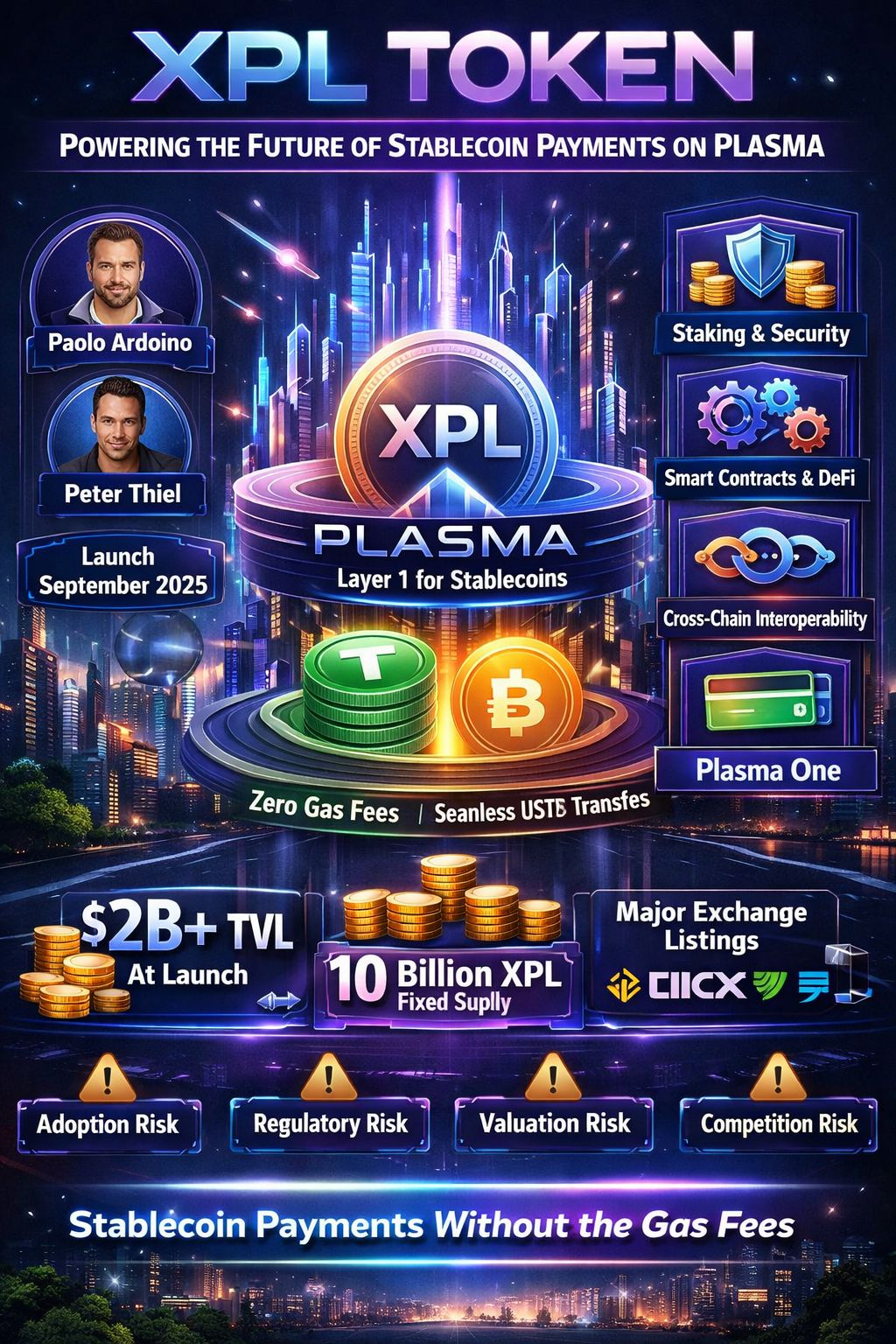
$XPL is the native cryptocurrency of Plasma, a Layer-1 blockchain engineered specifically for high-volume stablecoin transactions. Launched in September 2025, Plasma addresses one of crypto's most persistent friction points: the requirement to hold native gas tokens simply to transfer stablecoins. With XPL, users can send USDT with zero gas fees, while the token itself secures the network, rewards validators, and powers advanced smart contract operations. This article provides a comprehensive examination of XPL's technology, tokenomics, utility, market performance, and risk profile.
---
1. The Plasma Vision: Stablecoins as Money 2.0
Plasma was not built to compete with general-purpose smart contract platforms. Rather, it was designed with a singular focus: becoming the optimal settlement layer for stablecoins . As Tether CEO Paolo Ardoino and PayPal co-founder Peter Thiel—both advisors to the project—have recognized, the existing blockchain infrastructure was never optimized for the trillion-dollar stablecoin market .
The Core Problem: Sending USDT on Ethereum requires ETH for gas. Sending USDC on Solana requires SOL. This forces users to maintain multiple token balances and creates friction for mainstream adoption. Plasma's breakthrough is simple yet profound: stablecoin transfers should not require a separate gas token .
Plasma achieves this through its proprietary PlasmaBFT consensus mechanism and a custom gas token system that allows whitelisted assets—initially USDT and pBTC—to cover transaction fees directly . For everyday stablecoin transfers, fees are eliminated entirely. This positions Plasma not as "Ethereum competitor" but as dedicated payments infrastructure for the digital dollar economy.
---
2. XPL Tokenomics: Designed for Long-Term Alignment
2.1 Supply and Distribution
XPL has a fixed total supply of 10 billion tokens. At mainnet launch, approximately 1.8 billion XPL (18%) entered circulating supply, though effective tradable supply is lower due to U.S. participant lockups . The distribution model reflects a deliberate strategy to align incentives across all stakeholders :
Allocation Percentage Amount Vesting Conditions
Public Sale 10% 1B XPL Non-US: unlocked at mainnet; US: locked until July 2026
Ecosystem & Growth 40% 4B XPL 8% unlocked at mainnet; remaining 32% unlocks monthly over 3 years
Team 25% 2.5B XPL 1-year cliff, then 2-year linear vesting
Investors 25% 2.5B XPL 1-year cliff, then 2-year linear vesting
Key Observation: Team and investor tokens are subject to three-year full unlock schedules, with a one-year cliff preventing any early distributions . This structure—often described as "locking skin in the game"—forces long-term commitment. As one analyst noted, if the project fails within three years, team and investor returns "go down the drain" .
2.2 The U.S. Lockup Distinction
A unique feature of XPL's launch involves differential treatment based on purchaser jurisdiction. U.S. participants in the public sale face a 12-month lockup expiring July 28, 2026, while international buyers received tradable tokens immediately upon mainnet . This reflects Plasma's conservative approach to U.S. securities regulations and effectively reduces near-term sell pressure from American retail participants.
2.3 Inflation and Fee Burning
Plasma employs a controlled validator reward inflation schedule beginning at 5% annually, decreasing by 0.5% each year until stabilizing at 3% . This issuance funds network security.
Crucially, Plasma implements an EIP-1559-style fee-burning mechanism. A portion of every XPL transaction fee is permanently removed from circulation. As network usage grows, the burn rate increases, creating deflationary pressure that counterbalances validator rewards . This establishes a direct relationship between adoption and token value—more transactions mean more XPL permanently destroyed.
---
3. XPL Utility: Beyond Simple Value Transfer
3.1 Network Security and Staking
Validators must stake XPL to participate in consensus, aligning economic incentives with honest behavior. Unlike many proof-of-stake networks, Plasma implements reward slashing rather than stake slashing . Malicious validators forfeit future rewards but do not lose principal staked capital. This design reduces risk for institutional participants and lowers the barrier to validator entry.
Future upgrades will introduce delegated staking, allowing token holders to stake with validators and earn rewards without operating infrastructure . Importantly, team and investor tokens remain ineligible for staking during their vesting periods, preventing supply distortions .
3.2 Gas Token for Complex Operations
While simple USDT transfers are gasless, smart contract interactions, dApp deployments, and complex transactions require XPL as gas . This creates baseline demand tied directly to developer activity. The custom gas token system also allows users to pay fees using USDT or pBTC, with the protocol automatically converting these to XPL in the backend .
3.3 Governance
XPL functions as a governance token, granting holders voting rights on protocol upgrades, parameter adjustments, and ecosystem fund allocations . This democratizes decision-making and aligns with Plasma's stated commitment to decentralized infrastructure.
3.4 Cross-Chain Interoperability
XPL facilitates cross-chain activity through Plasma's integration with LayerZero's Omnichain Fungible Token (OFT) standard for assets like pBTC . This enables unified liquidity across multiple blockchains and positions XPL as a bridge asset within multi-chain DeFi strategies .
3.5 Enterprise Integration
For businesses, XPL provides the economic backbone for Plasma One, a stablecoin-native neobank offering digital dollar cards with cashback rewards, and Swarm, a regulated DeFi platform for tokenized equities . These products generate real economic activity that ultimately flows back to XPL through fee burns and increased network utilization.
---
4. Market Performance and Liquidity
4.1 Launch Day Metrics
XPL began trading on September 24, 2025, at approximately $1.00**, briefly surging to **$1.54 before stabilizing . Launch metrics included:
· $2 billion+ in stablecoin TVL on day one
· $1.9–2.8 billion initial market capitalization
· ~$10.5 billion fully diluted valuation
· Listings on Binance, OKX, Bitfinex, Bitget, Uniswap, and PancakeSwap
Public sale participants who purchased at $0.05 in July 2025 realized approximately 20x returns at launch pricing .
4.2 Post-Launch Price Action
As of January 2026, XPL trades near $0.1248, reflecting both broader market conditions and the gap between launch hype and current adoption levels . Critics note that on-chain transaction volume remains significantly below theoretical capacity, suggesting user engagement has not yet matched initial enthusiasm .
4.3 The Airdrop Strategy
Plasma executed an unconditional airdrop to early depositors, distributing approximately 25 million XPL (worth ~$25.4 million at launch) regardless of deposit size. Individual recipients received allocations valued at $9,639 . This aggressive community-building strategy generated significant social media attention and demonstrated Plasma's willingness to reward early participants.
---
5. Competitive Positioning and Strategic Partners
5.1 Backers and Advisors
Plasma's backers distinguish it from typical Layer-1 projects. The investment syndicate includes Founders Fund (Peter Thiel), Framework, and Bitfinex . More notably, Paolo Ardoino (Tether CEO) serves as an advisor, providing credibility within the stablecoin ecosystem .
5.2 Comparison to Ethereum and Solana
Analysts at Delphi Digital characterize XPL as "indirect exposure to Tether" —a way to bet on stablecoin infrastructure growth rather than any single stablecoin issuer . While Ethereum and Solana function as general-purpose compute platforms, Plasma optimizes specifically for settlement. This narrow focus represents both strength (superior UX for targeted use cases) and limitation (reduced TAM compared to generalist chains) .
5.3 DeFi Integrations
At launch, Plasma integrated with over 100 DeFi protocols, including Aave, Ethena, Fluid, and Euler . These integrations provided immediate liquidity and utility, positioning Plasma among the top ten blockchains by TVL on day one.
---
6. Products Built on Plasma
6.1 Swarm: Regulated Tokenized Securities
Swarm offers nine tokenized stocks issued under EU prospectus regulation, providing holders with legal rights to underlying assets . This represents a compliance-first approach to real-world asset tokenization, differentiating Plasma from unregulated competitors.
6.2 Plasma One: Stablecoin Neobank
Targeting regions with significant cross-border capital movement—initially the Middle East—Plasma One offers digital dollar accounts, payment cards with up to 4% cashback, and permissionless access to dollar-denominated savings . This product bridges self-custodial crypto with familiar banking interfaces.
6.3 pBTC: Programmable Bitcoin Collateral
Plasma's Bitcoin wrapper, pBTC, employs institutional-grade bridge security with multiple independent signers running full Bitcoin nodes . As a LayerZero OFT, pBTC maintains unified liquidity across chains, avoiding the fragmentation that plagues traditional wrapped assets.
7. Risk Assessment
7.1 Adoption Risk
Plasma's fundamental challenge is bridging the gap between theoretical capability and actual usage. Despite $2 billion in launch liquidity, current on-chain activity remains modest relative to network capacity . The network's value proposition depends entirely on achieving meaningful transaction volume; without it, the fee-burning mechanism cannot generate sufficient deflationary pressure.
7.2 Regulatory Risk
As a stablecoin-optimized blockchain, Plasma is uniquely exposed to stablecoin regulation. Changes in how jurisdictions treat USDT, USDC, or algorithmic stablecoins could directly impact Plasma's core use case . The project's decision to impose U.S. buyer lockups suggests legal caution, but regulatory evolution remains an unpredictable variable.
7.3 Valuation Risk
Launching with a $10.5 billion fully diluted valuation requires substantial future growth to justify current pricing. Critics argue that early valuation detached from adoption fundamentals, leaving XPL vulnerable to extended price discovery .
7.4 Competition
Plasma is not the only blockchain pursuing stablecoin optimization. Established incumbents (Solana, Tron) already process significant stablecoin volume, while emerging competitors may offer similar gasless experiences. Plasma's first-mover advantage in dedicated stablecoin infrastructure is real but not insurmountable.
7.5 Standard Crypto Risks
XPL carries the standard risks applicable to all crypto assets: volatility, liquidity fluctuations, cybersecurity threats, and potential forking events . Wealthsimple's assessment explicitly notes these general risks alongside project-specific considerations.
8. Future Outlook
Plasma's roadmap includes delegated staking activation, continued ecosystem fund deployment, and geographic expansion of Plasma One beyond the Middle East . The three-year unlock schedule for team and investor tokens removes near-term distribution overhang while creating concentrated unlocking events in late 2026 and 2027.
The fundamental thesis for XPL rests on a simple proposition: if stablecoins become dominant money forms, dedicated settlement infrastructure should capture significant value. Plasma's early execution—$2 billion TVL, top-tier advisors, functional products—suggests seriousness of purpose. Whether that translates into sustained user adoption remains the open question.
For investors and observers, XPL represents a pure-play bet on stablecoin infrastructure rather than another general-purpose Layer-1. Its success will be measured not by Twitter mindshare but by USDT transfer volume, validator participation, and the gradual destruction of XPL supply through economic activity.
Conclusion
XPL is not merely another native blockchain token. It is the economic engine of a network explicitly architected for the stablecoin-dominated future of digital payments. With carefully structured tokenomics that align team, investor, and community incentives, distinctive utility centered on gasless stablecoin transfers, and immediate liquidity at launch, Plasma has demonstrated execution capability.
Yet the gap between launch momentum and sustainable adoption remains significant. XPL's long-term value will be determined not by its September 2025 debut but by whether Plasma becomes the default settlement layer for the trillions of dollars in stablecoin volume analysts project for the coming decade.
The promise: Stablecoins that finally behave like money—instant, free, global.
The token: XPL, securing the network where that promise becomes reality.
This article is for informational purposes only and does not constitute financial advice. Cryptocurrency investments carry significant risk. Readers should conduct their own research before making investment decisions.#Plasma @Plasma