

What happens when a developing crypto project builds quietly while retail traders remain fixated on short-term price swings? The contrast between FOGO’s structural progress and broader market psychology reveals a recurring pattern in digital assets: attention often lags behind infrastructure. Recent public updates around FOGO indicate steady ecosystem work occurring alongside fluctuating market conditions shaped by Bitcoin volatility and capital rotation cycles.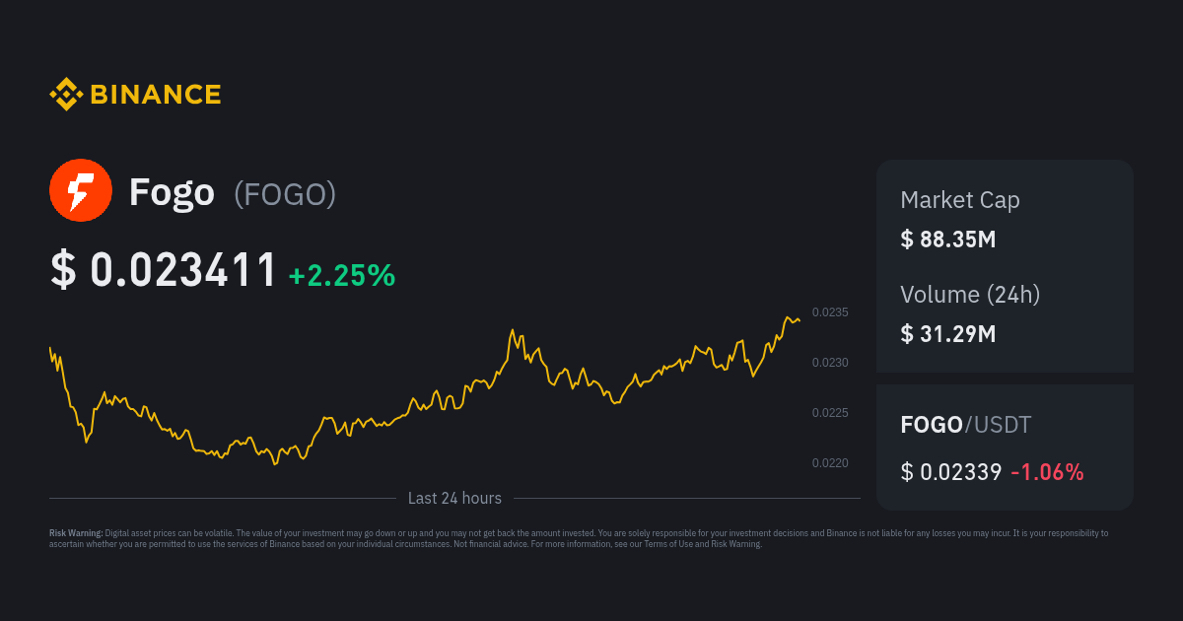
• Recent protocol-level optimization aimed at improving transaction efficiency and network throughput
• Ongoing infrastructure reinforcement, including validator-side improvements and backend stability updates
• Gradual ecosystem expansion through integration efforts within utility-focused blockchain sectors
• On-chain activity reflecting steady wallet interactions relative to overall market drawdowns
• Token supply mechanics remaining unchanged, with circulating metrics transparently reported
• Infrastructure-oriented tokens across the market showing similar consolidation behavior
• Utility-driven ecosystems maintaining developer activity despite macro volatility
• Broader crypto market influenced by Bitcoin dominance shifts and liquidity concentration in large-cap assets
FOGO’s recent price action has largely mirrored broader mid-cap market structure behavior. During periods of heightened Bitcoin volatility, correlation levels increased, with FOGO experiencing synchronized downside pressure as liquidity concentrated in large-cap assets. When Bitcoin stabilized, smaller ecosystem tokens, including FOGO, demonstrated brief volume upticks consistent with sector-wide capital rotation patterns.
Volume and liquidity metrics suggest that FOGO’s trading environment has remained reactive rather than independently driven. Spikes in activity have aligned with broader market-wide momentum waves instead of isolated token-specific catalysts. This indicates that market structure, not narrative speculation, has primarily dictated short-term movement.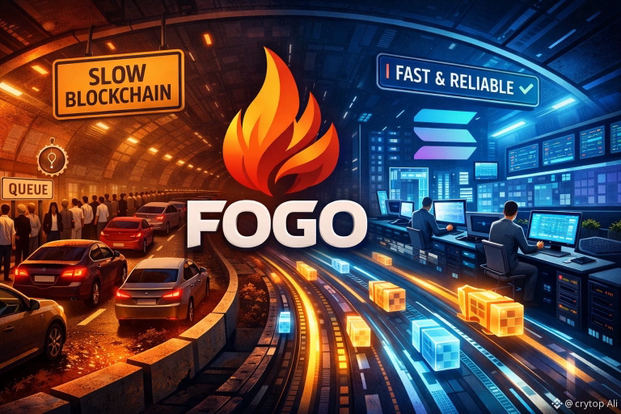
Retail traders often misinterpret such consolidation as stagnation. However, comparative performance across infrastructure tokens shows a similar compression phase. Utility-focused coins and emerging ecosystem assets have exhibited parallel behavior—reduced speculative volume, tighter ranges, and stronger correlation to Bitcoin’s directional bias.
Bitcoin’s dominance levels have played a decisive role. When dominance expands, capital typically consolidates into established large-cap cryptocurrencies. This reduces liquidity available to mid-cap and niche ecosystem tokens like FOGO. Conversely, when dominance stabilizes or contracts, observable rotation flows toward infrastructure and utility-driven projects.
FOGO’s on-chain signals add context. Wallet activity has not demonstrated abrupt contraction despite broader market hesitancy. Transaction flows have remained proportionate to ecosystem growth stages, suggesting that usage-related engagement has not deteriorated in line with speculative volume declines.
Market psychology often amplifies visible price movement while ignoring backend development. In the current cycle, several infrastructure-oriented tokens have continued network optimization efforts even as chart structures remain compressed. FOGO’s ecosystem trajectory aligns with this broader industry pattern: build phases occurring during capital concentration in major assets.
Liquidity behavior further supports this observation. Order book depth and trading spreads have widened during broader risk-off conditions, consistent with sector-wide tightening. Exchange flow patterns suggest neutral positioning rather than aggressive distribution, reinforcing the interpretation of macro-driven consolidation rather than isolated project weakness.
The wider crypto environment provides additional clarity. Infrastructure tokens, utility-driven ecosystems, and emerging blockchain networks have collectively experienced subdued speculative interest during periods of Bitcoin-led volatility. As capital rotates in response to macro conditions, smaller ecosystems temporarily move to the background despite ongoing development milestones.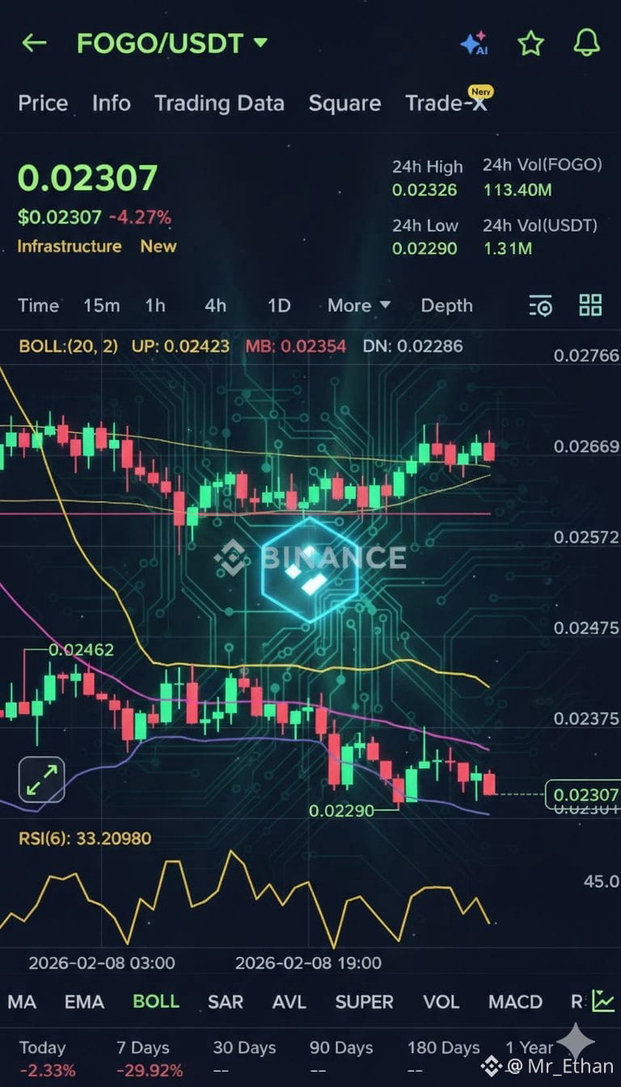
FOGO versus market psychology ultimately highlights a structural reality: retail attention often tracks volatility, while network progress unfolds incrementally. In the present market phase—defined by Bitcoin influence, liquidity concentration, and cautious capital rotation—FOGO’s behavior reflects systemic crypto dynamics rather than project-specific anomalies. Understanding this distinction clarifies what retail traders frequently overlook: price compression does not equate to ecosystem inactivity, particularly within infrastructure-stage digital assets.