


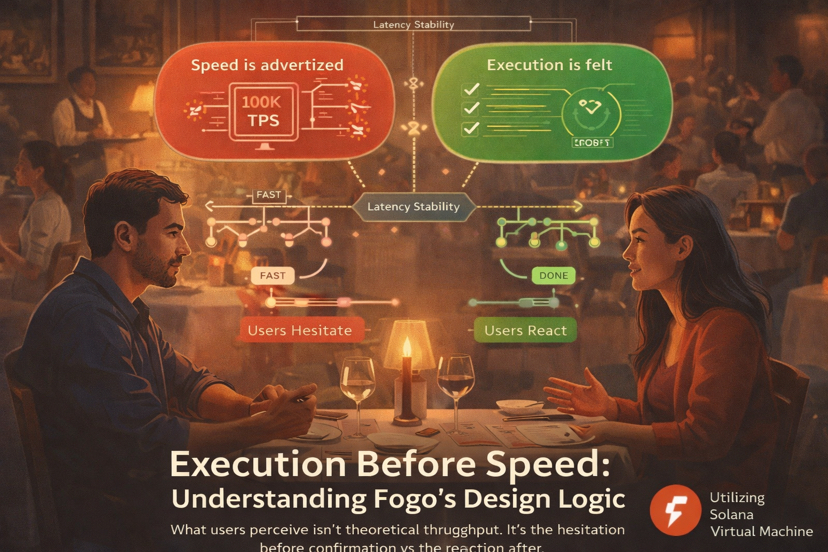
I was sitting alone at a restaurant table when the thought formed.
Nothing dramatic. Just background noise, quiet conversations drifting between tables, the soft rhythm of plates and glasses moving through the room. The kind of environment where your brain slows down enough to notice ideas that usually pass too quickly.
And that was exactly it.
Speed is what most blockchains try to make you notice.
Execution is what users actually remember.
The distinction feels small until you observe how people behave inside systems. In theory, performance is measured in throughput, block times, finality metrics. In practice, performance is experienced as something much more human. A click. A pause. A reaction. A subtle moment where expectation either holds or fractures.
Users do not feel transactions per second.
They feel hesitation.
A restaurant, strangely enough, makes this easier to see.
When you place an order and the waiter nods, disappears, and returns with smooth predictability, you stop thinking about service speed. Your mind relaxes because the loop between action and response feels stable. The system fades into the background.
But if the response wavers, even slightly, something else happens. You start wondering whether your request was registered. You begin monitoring the flow. You become aware of the machinery instead of the experience.
The discomfort is not created by slowness alone.
It is created by uncertainty.
This is where the design logic behind Fogo begins to feel less like a speed experiment and more like an execution experiment. The architectural posture does not seem obsessed with how fast the system can move under perfect conditions, but how consistently it behaves when conditions become messy.
Speed without consistency is merely volatility expressed in milliseconds.
And volatility, even when technically impressive, rarely produces trust.
Distributed systems have an uncomfortable truth hidden beneath average metrics. The experience is rarely defined by the mean. It is defined by the tail. The worst moments. The unexpected delays. The confirmations that arrive quickly sometimes and unpredictably other times.
Variance is what users interpret as fragility.
A chain may advertise high throughput while still producing hesitation if latency behaves erratically. From a psychological standpoint, inconsistency feels slower than uniformly moderate performance. Human perception penalizes unpredictability more harshly than absolute delay.
Execution, then, becomes a problem of timing stability rather than raw velocity.
This is a different optimization target.
Reducing latency variance requires structural decisions that do not always translate well into marketing language. It involves validator coordination behavior, networking topology, scheduling efficiency, propagation jitter, hardware assumptions. None of these produce flashy headline numbers. They produce something subtler.
They compress uncertainty.
And uncertainty is the hidden tax inside every interactive system.
When confirmations behave predictably, users stop adjusting their behavior defensively. They stop refreshing. They stop double-clicking. They stop second-guessing whether the state they see is trustworthy. The chain begins to feel less like infrastructure under observation and more like infrastructure taken for granted.
That transition is more important than speed itself.
Because habitual usage does not emerge from peak performance moments. It emerges from environments where interactions consistently map to outcomes without friction, drama, or doubt.
What users often describe as “fast” is frequently something else entirely.
It is the absence of disruption.
This is why two networks with similar theoretical performance can feel radically different. One may deliver impressive averages while generating unpredictable confirmation rhythms. The other may achieve lower peaks while maintaining tight latency distribution. Users rarely articulate the difference technically, yet they gravitate toward the environment that feels stable.
Predictability quietly compounds.
Developers build more confidently inside systems where timing behavior is reliable. They design flows without excessive safety buffers. Markets function more smoothly when execution uncertainty declines. Cognitive load decreases because users are not constantly verifying system integrity.
Execution reliability becomes behavioral infrastructure.
Seen from that lens, Fogo’s design emphasis reads less like a pursuit of speed supremacy and more like an attempt to engineer smoother interaction loops. Parallel execution capacity, faster block cadence, validator locality strategies, scheduling discipline — these mechanisms matter not as isolated features, but as contributors to timing stability.
The goal is not movement alone.
The goal is rhythm.
Rhythm is what determines whether systems feel natural or mechanical. In trading environments, rhythm shapes decision tempo. In gaming, rhythm defines immersion. In financial flows, rhythm determines whether participants trust execution timing enough to act without hesitation.
Humans are extraordinarily sensitive to broken rhythm.
Even small delays become amplified when they violate expectation patterns.
This reframes performance entirely. Instead of asking how fast the chain can go, the more revealing question becomes how often the system introduces doubt into the interaction loop. Peak speed impresses observers. Stable execution retains users.
The difference is structural, not cosmetic.
Back at the restaurant table, the analogy felt unexpectedly precise. Good service is not remembered because it was extraordinarily fast. It is remembered because it was frictionless. Predictable. Invisible.
Infrastructure succeeds when it disappears.
Speed is visible.
Execution quality is felt.
And perhaps that is the quiet thesis embedded in Fogo’s design logic. Not simply accelerating computation, but reducing the moments where users are reminded that they are waiting on a distributed machine.
Because in real systems, the experience is rarely defined by how fast things move.
It is defined by how rarely they hesitate.