
I once stayed up until almost sunrise just to see whether a protocol could keep its price data updated in time, because I knew that slipping by only a few beats could drag a whole stack of positions away without warning. That night, I looked at Fogo the same way, not through emotion, but through the dry details I’ve learned to respect.
After enough cycles, I’m no longer persuaded by promises of an “exploding ecosystem.” DeFi that lasts is DeFi with a real route, and a real route means capital doesn’t get stuck, data doesn’t drift, and applications don’t choke when conditions turn ugly. Fogo is picking the exact trio that forces my attention: oracles, bridges, and indexing. Maybe they’re trying to build a highway, not a billboard, and I judge the project by that standard.
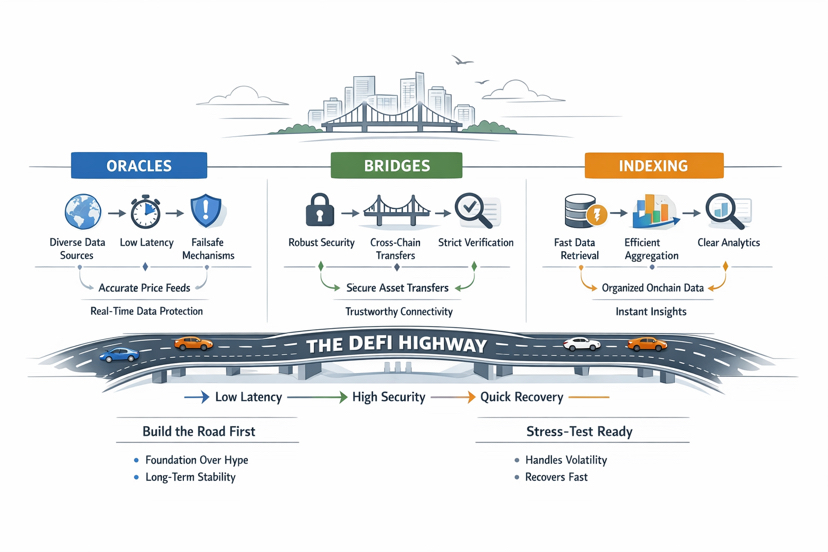 Oracles are where everything begins. If the oracle is wrong, every mechanism built above it is resting on soft ground. It’s ironic: most people only remember oracles when mass liquidations happen, and in calm times everyone just assumes “the data will be correct.” I look at Fogo’s oracle through three very practical signals: are the sources diverse enough to resist distortion, is latency measured and continuously optimized, and when bad data shows up, is there a built in brake to prevent a chain reaction, or does the system simply let it run.
Bridges are the plumbing of liquidity, and also the place where trust gets tested the hardest. I’ve seen too many stories start with a “convenient” bridge and end with a long season of sleepless nights for both the team and users. Honestly, a good bridge is one you forget exists, because everything passes through smoothly. A bad bridge needs only one slip for the whole community to remember it forever. If Fogo wants a real highway, its bridge has to put safety ahead of speed, and it has to show discipline in upgrade authority, in verification, and in incident response.
Indexing is the layer outsiders tend to ignore, but builders can’t. Without strong indexing, onchain data is like a warehouse with no labels: the inventory exists, but finding anything takes time, aggregating is painful, and real time state is easy to get wrong. I think Fogo understands this is part of the “user experience,” not just “pure engineering.” When indexing is strong, developers can build complex flows while still returning information fast, and users can track positions and history without guessing.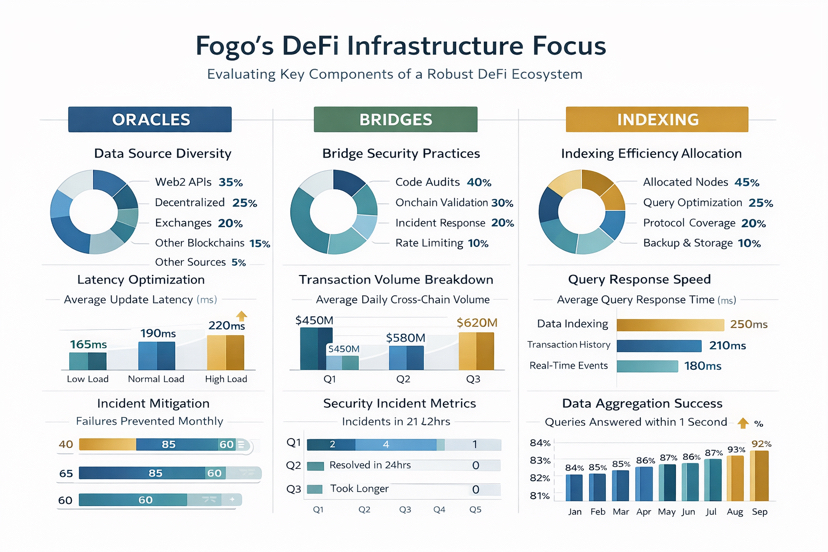
What I keep watching is how these three pieces fit together in live conditions. Oracles feed data in, bridges move assets and state across boundaries, and indexing turns everything into answers applications can read instantly. When they lock in sync, you finally get that DeFi highway feeling: fewer frictions, faster queries, and small faults don’t get amplified into system wide accidents. Maybe this is what makes Fogo different from projects that love talking about “the future,” while Fogo is talking about “today.”
But a highway is only trustworthy if it can survive rush hour. When traffic spikes, when volatility turns data noisy, when liquidity thins and every second becomes expensive, the system’s weak points show themselves. I don’t judge that by vibes, I judge it by operating metrics: how latency scales with load, how error rates move during abnormal events, whether recovery time keeps shrinking over time. It’s ironic: the things that decide long term trust often live inside internal dashboards, not in upbeat posts.
From a product lens, I like the approach of “build the road first, then worry about the scenery.” When the base layer is solid, application features have room to grow, and data becomes an asset rather than a burden. From an investor lens, I know this path won’t earn loud applause, because the market always prefers shiny things over durable ones. But I’m tired enough to know that what survives multiple seasons is rarely the loudest thing in the room, and if Fogo can keep its rhythm, it will answer the skepticism on its own.
If $FOGO keeps pouring effort into oracles, bridges, and indexing, they’re choosing the long game, where mistakes get magnified and discipline gets rewarded. And by then, the question won’t be whether you believe Fogo story, but whether you’re willing to trust the invisible layers and test drive this highway on the hardest day the market can throw at you.