

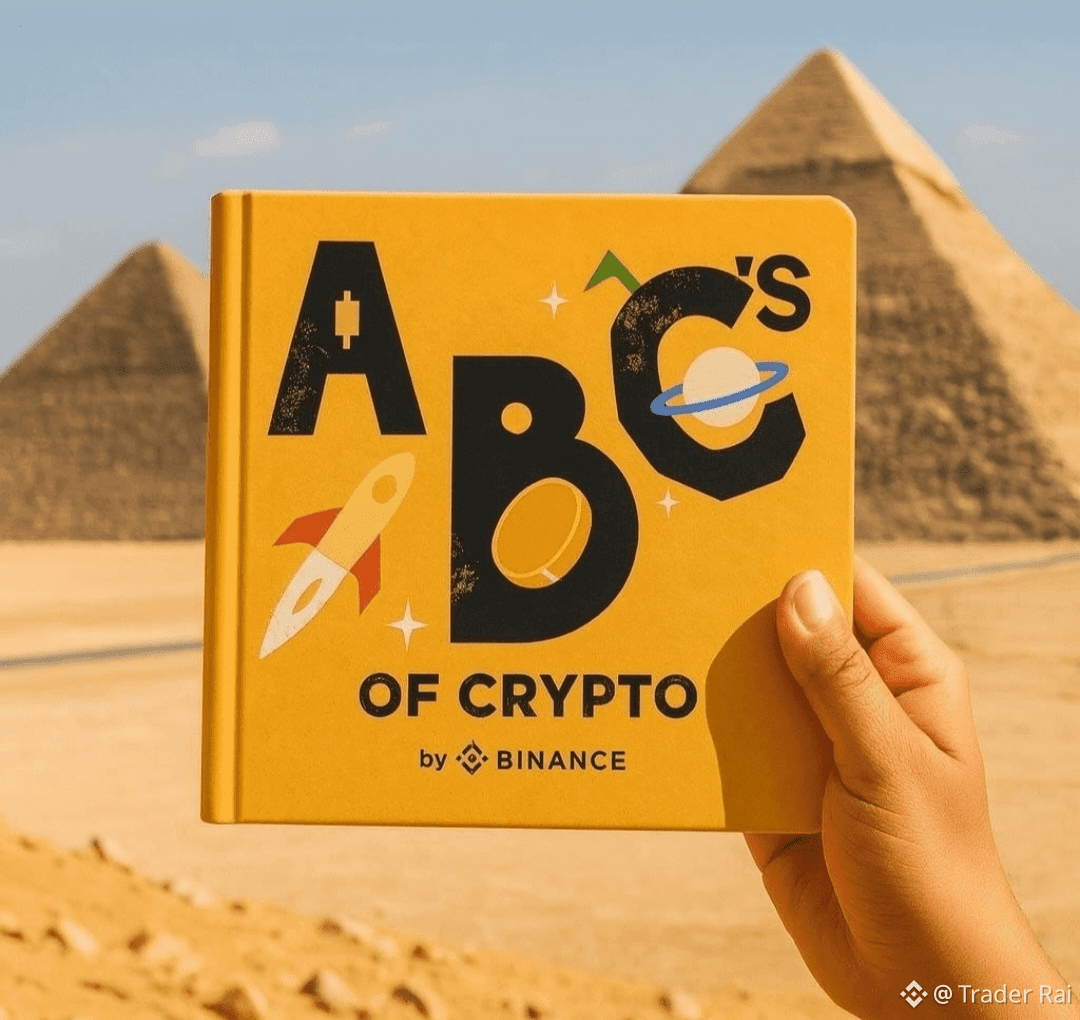
In a world where financial systems are being rewritten in real time, crypto has emerged not just as a new asset class, but as a new way of thinking about money, ownership, and freedom. The image of a bright yellow “ABC’s of Crypto” book held against the timeless pyramids is more than aesthetic — it’s symbolic. It represents the meeting point between ancient civilizations and the digital future, reminding us that while technology evolves, the human pursuit of value and trust remains constant.
Just as ancient societies built monuments that stood the test of time, blockchain technology is attempting to build financial infrastructure designed to last beyond borders, governments, and generations. Crypto is not a trend; it is a technological evolution rooted in mathematics, cryptography, and decentralized consensus.
At its core, crypto begins with simple principles. Bitcoin introduced the idea of digital scarcity — something never achieved before in the digital world. Ethereum expanded this idea by adding programmability, enabling smart contracts and decentralized applications. From there, the ecosystem exploded into decentralized finance (DeFi), NFTs, layer-2 scaling solutions, and real-world asset tokenization. What started as an experiment has grown into a multi-trillion-dollar economy.
The “ABC” approach to crypto is essential because mass adoption does not happen through complexity — it happens through education. Understanding wallets, private keys, transactions, and block confirmations is the foundation. Without this knowledge, users are exposed to unnecessary risk. With it, they gain financial sovereignty.
Exchanges like Binance have played a critical role in this educational journey. By lowering barriers to entry, providing learning resources, and offering secure infrastructure, they help bridge the gap between traditional finance and decentralized systems. For millions of users globally, crypto education begins not with whitepapers, but with accessible tools and simple explanations.
Crypto is also redefining trust. In traditional systems, trust is placed in institutions. In blockchain systems, trust is placed in code, transparency, and open verification. Every transaction is recorded, immutable, and auditable. This shift has profound implications — especially for regions where access to banking is limited or financial systems are unstable.
The presence of pyramids in the background of the image is particularly powerful. These structures were built as stores of value, symbols of power, and expressions of belief systems. In a modern sense, Bitcoin is often referred to as “digital gold” — a store of value built not from stone, but from cryptographic proof. Different eras, same human instinct: preserve value against time.
However, crypto is not without challenges. Volatility, regulatory uncertainty, scams, and misinformation remain real risks. This is why education must evolve alongside innovation. Long-term success in crypto is not achieved by chasing hype, but by understanding fundamentals, managing risk, and staying disciplined.
The future of crypto goes far beyond trading charts. Tokenized assets, decentralized identity, blockchain-based voting, and on-chain governance are already reshaping how societies may function. As artificial intelligence, blockchain, and digital finance converge, we are witnessing the early stages of a new economic architecture.
Crypto literacy will soon be as essential as internet literacy once was. Those who take the time to learn the basics today will be better positioned tomorrow — not just financially, but intellectually. The “ABC’s of Crypto” is not just a title; it is a mindset. Start with the fundamentals, respect the risks, and think long term.
From ancient pyramids to decentralized ledgers, history shows us one truth: systems change, but those who adapt early shape the future. Crypto is writing the next chapter — and it starts with understanding the basics.

