Walrus Protocol is quickly becoming one of the most discussed names in decentralized storage, mainly because it treats storage like real infrastructure, not a simple “upload file and forget” service. Walrus is designed as a decentralized data storage and availability protocol, which means it focuses not only on storing blobs (large chunks of data like files, images, videos, datasets) but also ensuring that this data stays accessible, verifiable, and usable for applications that need reliability at scale.
But here’s something important: a decentralized storage network becomes truly powerful only when developers can easily read what’s happening inside it. Builders need to know who the operators are, how blobs are moving, how often blobs are being created, what events are happening on the network, and how the entire protocol is performing. That’s where the Blockberry Walrus API becomes a major piece of the ecosystem.
The Blockberry Walrus API provides endpoints that reveal advanced data about the major entities on Walrus. In simple words, it works like a structured gateway that helps developers, analysts, explorers, and dashboards pull Walrus network data in an organized and developer-friendly way. Instead of manually collecting information from different sources, the API gives a clean way to access protocol-level analytics and entity details.
The most exciting part is the depth of data it supports. The API isn’t limited to simple counts or basic network stats. It provides advanced information about operators, data blobs, blob events, and protocol analytics. That means the ecosystem can track not just “how many blobs exist,” but also what’s happening around them — how blobs are being written, how they are being handled in the network, and what the live behavior of the system looks like. This adds a new layer of transparency and confidence, because serious builders don’t want blind systems. They want measurable infrastructure.
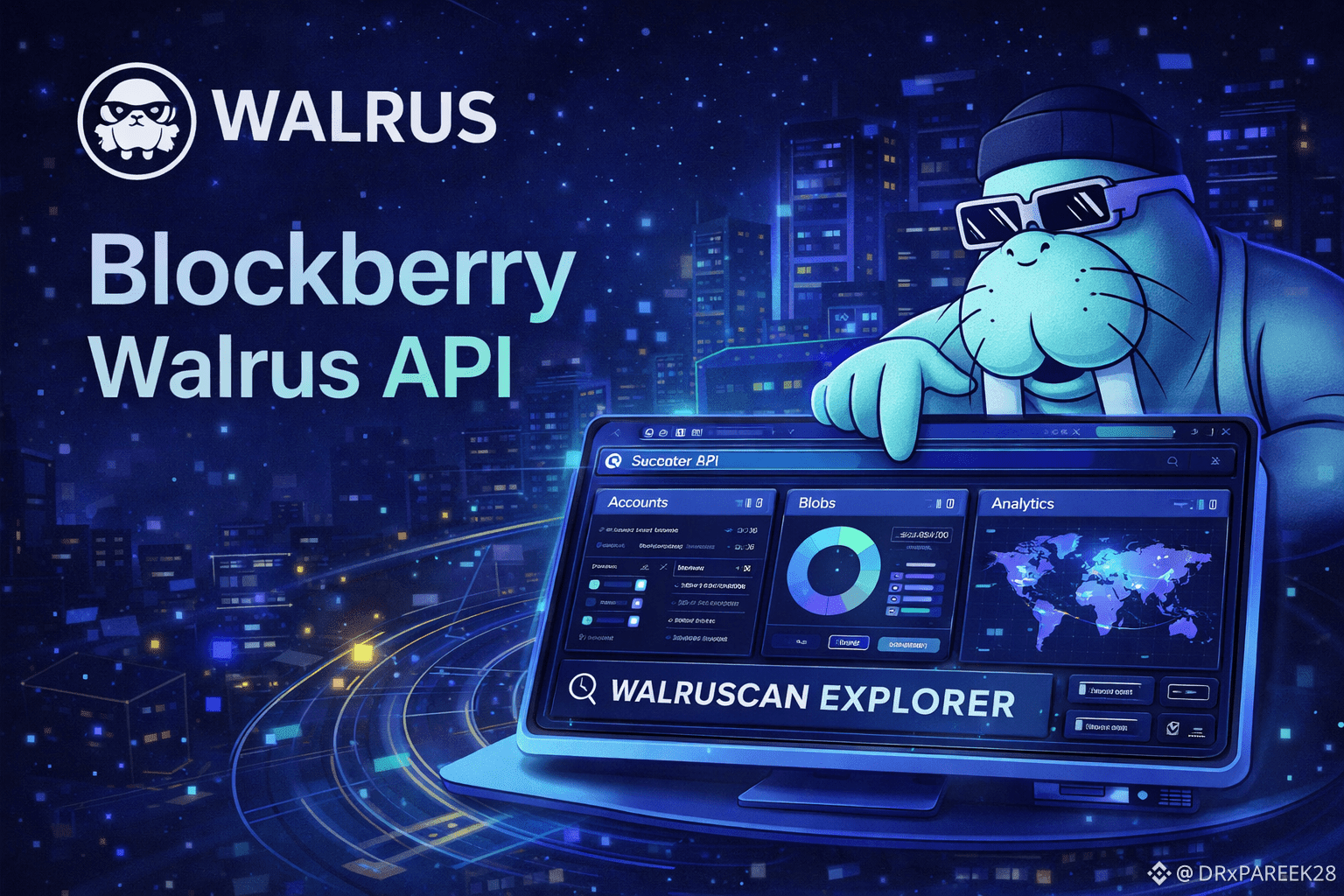
Another huge contribution is that Blockberry didn’t stop at an API. They also developed Walruscan Explorer, which visualizes the data provided by the Blockberry Walrus API. This is important because explorers are the public face of a blockchain or protocol. For most users, explorers create trust. When people can view network details, operators, blobs, and analytics visually, Walrus becomes easier to understand and easier to adopt. It also shows maturity — the ecosystem isn’t only technical, it’s accessible.
The structure of the API is also practical. It’s broken into sections based on the entities indexed from the Walrus network. This includes categories like accounts, blobs, and analytics. This is exactly what builders expect from a serious API reference: clear separation of core components so projects can quickly integrate what they need without confusion. Accounts represent participant identity layers, blobs represent the stored data units, and analytics represent the bigger picture — network health, behavior trends, and performance insights.
Overall, this shows a deeper truth about Walrus Protocol: it’s not just building decentralized storage, it’s building a full stack ecosystem where storage is observable, measurable, and developer-friendly. When APIs and explorers exist at this level, they unlock more real-world use cases like dashboards, monitoring tools, storage performance tracking, blob exploration, and even business-level analytics. That’s the kind of infrastructure Web3 needs if decentralized storage wants to compete with Web2 cloud systems.