The first time I really understood what Dusk is trying to solve, it wasn’t from price charts or hype threads. It came from a simple thought: most blockchains are designed for open transparency, but real financial markets don’t work like that. Institutions, regulated assets, private settlement, confidential order books — these things require privacy, control, and compliance, not just speed.
That’s where Dusk starts to feel different.
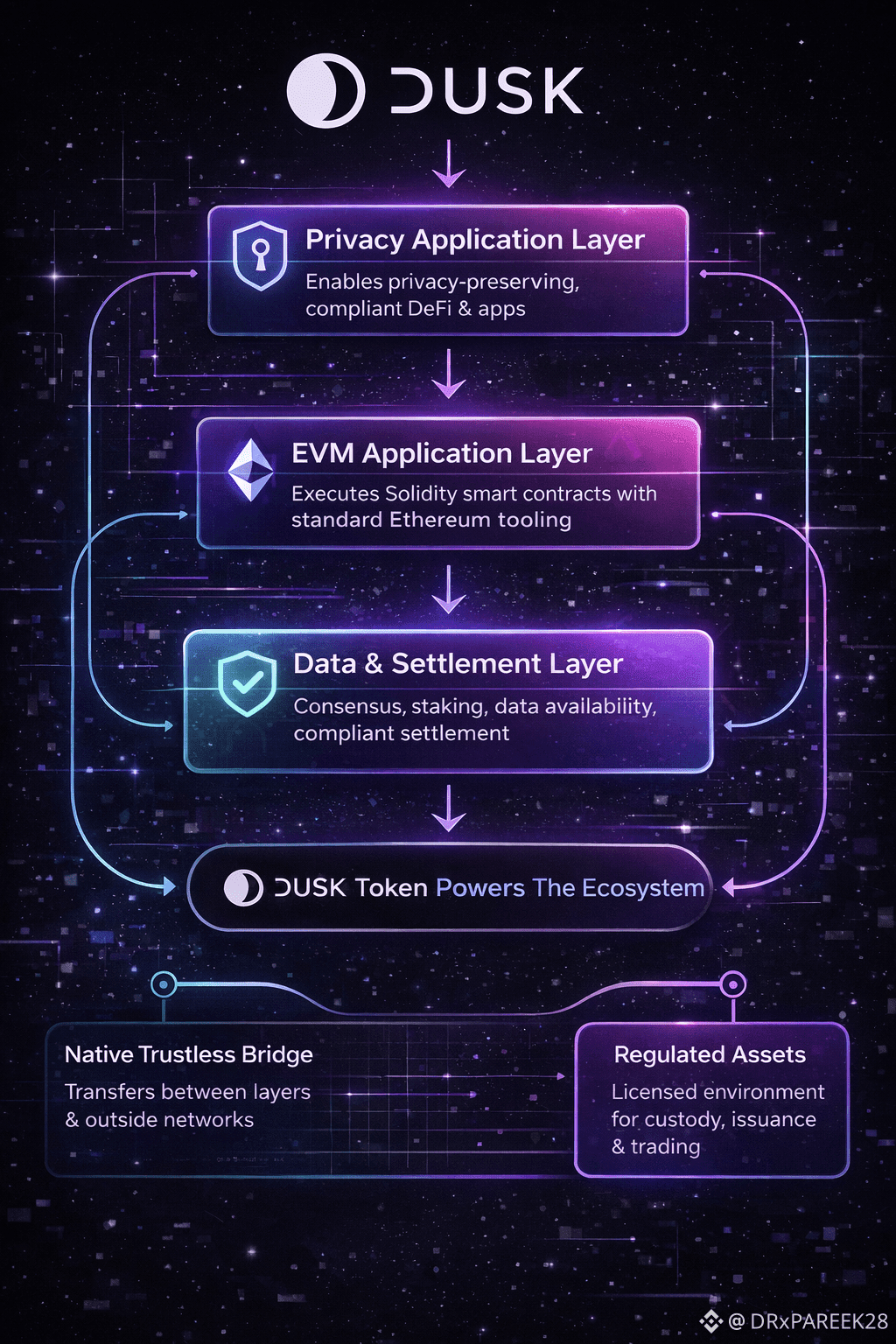
Dusk isn’t only building “another chain.” It’s building a blockchain environment where financial-grade applications can actually live without compromising regulations or user privacy. And the most exciting part is how Dusk is evolving its whole infrastructure into a multilayer architecture, which is basically like giving the network multiple engines — each one optimized for a specific job.
At the base, Dusk focuses on the fundamentals: consensus, security, and settlement. This layer is responsible for making sure the chain stays reliable and scalable, while handling data availability and settlement in a clean, efficient way. Instead of forcing everything into one place, Dusk splits responsibility so the network stays lightweight, faster, and easier to maintain over time.
Above that comes something big: DuskEVM. This is the moment Dusk becomes instantly familiar to the entire Ethereum developer world. DuskEVM runs Solidity smart contracts using the same tooling builders already use daily, like Hardhat and MetaMask. In storytelling terms, this is Dusk opening a massive gateway: developers don’t need to relearn everything or build custom integrations anymore. They can simply bring their apps into Dusk’s ecosystem while gaining native compliance support and access to regulated asset opportunities.
But Dusk isn’t just about being EVM compatible.
The future of finance needs privacy you can audit. That’s why Dusk brings the next layer of its vision: a dedicated privacy application layer that executes privacy-preserving applications. This is where Dusk becomes truly powerful, because it’s not hiding activity for the sake of secrecy — it’s enabling confidentiality while still supporting verifiability. That’s the sweet spot for institutions: transactions can remain confidential while still being provable, traceable in controlled ways, and compatible with the realities of regulated markets.
Now take a step back and think about what this architecture enables. Dusk can support DeFi that isn’t just “degen-style,” but genuinely compliant. It can host tokenized assets in a regulated environment. It can provide privacy-preserving infrastructure for financial instruments, where users and institutions don’t have to choose between transparency and confidentiality. That trade-off is one of the biggest barriers stopping institutional adoption in Web3 — and Dusk is directly attacking it.
One more piece makes this story even stronger: the token system and native bridge.
Rather than splitting the ecosystem with multiple gas tokens, Dusk keeps it simple: one native token serving roles across the layers. It supports staking, governance, and settlement, while also being used as gas in the application layers. This keeps the network unified — not fragmented. Even better, Dusk introduces a native trustless bridge that allows seamless movement between layers without needing external custodians or wrapped assets. That matters because in real finance, trust assumptions are everything. If bridging requires third parties, the whole system becomes weaker. Dusk’s approach is more direct, more secure, and more future-ready.
And this is where the “institutional” focus becomes real, not just marketing.
With its framework, Dusk can onboard assets from regulated venues and offer an environment where custody, issuance, and trading can happen under one structured umbrella. That’s a huge step toward the kind of blockchain adoption people talk about for years — where real-world markets can actually enter Web3 with confidence.
In the end, Dusk feels like a project that isn’t chasing attention. It’s building a route to the future quietly, layer by layer. It’s turning blockchain into a place where compliance and privacy don’t fight each other — they cooperate. And if Dusk succeeds, we won’t just get better dApps. We’ll get a new standard for financial infrastructure.
Because in the next era of Web3, the winning networks won’t be the loudest. They’ll be the ones that can support the real world.