
When people talk about blockchain economics, the conversation usually revolves around transaction fees, token emissions or speculative demand. What rarely gets proper attention is the economics of storage itself. Walrus Coin, in my view, stands out because it treats storage not as a side feature but as an economic system that must remain functional for decades.
Storage is not free in the physical world. It consumes hardware, energy, maintenance and human oversight. Many decentralized projects ignore this reality and promise cheap or unlimited storage, which eventually collapses under its own weight. Walrus approaches the problem differently. It acknowledges that sustainable storage must be priced realistically and incentivized properly.What I find particularly thoughtful is how Walrus ties economic rewards to actual resource contribution. Participants are not rewarded simply for existing in the network but for reliably maintaining data availability. This discourages opportunistic behavior and encourages long-term commitment. From my perspective, this is one of the most important design choices in any decentralized storage system.
Another aspect that resonates with me is predictability. Walrus introduces a model where storage costs can be understood and planned for. This matters not only for developers but also for anyone thinking long-term. Unpredictable costs create fragility, while predictable economics enable planning and stability.
I also see Walrus as a subtle critique of speculative excess. Instead of relying on hype to drive demand, it builds value through utility. Storage demand grows organically as more data needs to be preserved. That demand is grounded in real usage, not narratives. Personally, I trust systems that grow because they are needed, not because they are marketed aggressively.
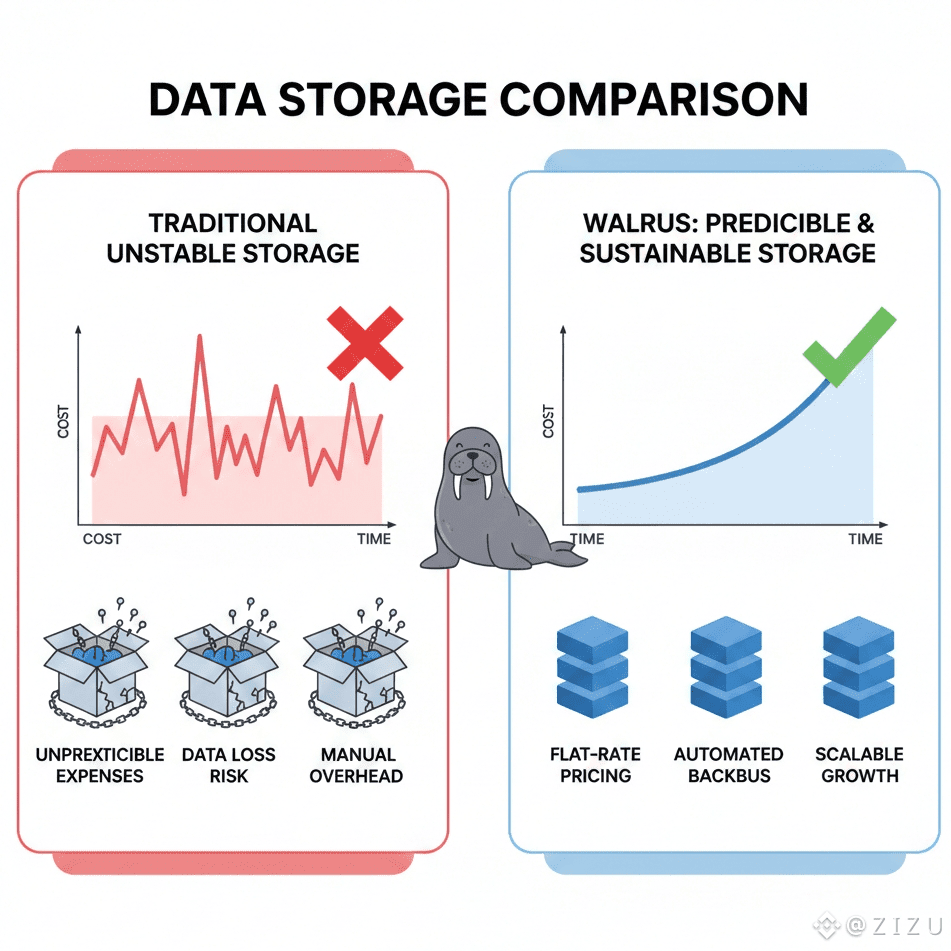
In the long run, I believe storage economics will become one of the defining factors in blockchain survival. Networks that fail to align incentives with physical reality will struggle. Walrus Coin, by contrast, feels like it was designed by people understand that economics is not just about numbers but about behavior over time.

