
Governance is one of the most debated topics in blockchain today. Many projects claim decentralization, yet decision-making is often concentrated among a small group of developers, large holders, or external influencers. Dusk Coin takes a different approach, demonstrating that governance can be both decentralized and practical without sacrificing security or privacy. From my perspective, this approach may signal the next stage in blockchain evolution.
Most decentralized systems rely on full transparency for governance. Voting results, token holdings, and proposal discussions are visible to anyone. While this ensures public accountability, it can also create manipulation. Voters may feel pressured by public opinion, large stakeholders may exert undue influence, and strategic actors can game the system. Dusk Coin recognizes this problem and offers a subtle yet profound solution.
Dusk Coin’s governance model allows for selective transparency. Decisions are still verifiable and enforceable, but participants retain privacy in their voting and strategic intentions. In my view, this is revolutionary because it balances democratic principles with real-world concerns about privacy and strategy. Governance no longer becomes a tool for performative influence; it becomes a genuine mechanism for decision-making.
One of the most fascinating aspects of Dusk Coin governance is how it aligns incentives without exposing participants unnecessarily. Token holders can vote on network upgrades, protocol changes, or treasury allocations while maintaining discretion. This reduces the risk of social or economic coercion and encourages participants to act honestly rather than opportunistically. Personally, I see this as a more ethical and functional form of decentralized decision-making.
Another key element is scalability. Many governance models falter because they assume all decisions must be transparent, which leads to slow participation or voter fatigue. By abstracting sensitive data while retaining verifiability, Dusk Coin enables larger, more engaged participation without compromising integrity. From my perspective, this could redefine how communities organize and execute complex decisions on-chain.
Security is equally important. Traditional governance models often expose weaknesses that can be exploited by malicious actors. In fully transparent systems, voting patterns and proposal intentions can be analyzed to manipulate outcomes. Dusk Coin reduces this risk by protecting participant data, ensuring that strategic attacks are far more difficult. I appreciate this design because it treats participants’ rights and the network’s resilience as equally important.
The philosophical implications are significant. Governance is not just about counting votes, it is about trusting the process. By creating a system where privacy and accountability coexist, Dusk Coin fosters confidence in both individual and collective actions. This, in turn, encourages more thoughtful participation and long-term commitment from the community.
Dusk Coin’s governance approach also opens the door for institutional and regulatory engagement. Many institutions shy away from blockchain governance because of the public exposure of sensitive holdings or decision-making influence. Selective disclosure mechanisms allow these entities to participate responsibly without risking competitive intelligence or regulatory scrutiny. In my opinion, this is a smart bridge between the ideals of decentralization and practical adoption.
Another dimension I find compelling is the encouragement of innovation within governance itself. Proposals can be evaluated and tested with minimal exposure, enabling experimentation without public backlash. Communities can iterate faster, test ideas safely and evolve governance practices organically. This level of adaptive flexibility is rare in existing blockchain ecosystems.
Critically, Dusk Coin’s governance model challenges the assumption that decentralization must always be fully visible to be fair. Transparency and fairness are not synonymous. A system can be private, confidential and selective, yet remain verifiable, accountable and equitable. Recognizing this distinction feels, to me, like the first step toward truly mature decentralized systems.
In my view, Dusk Coin is not only building a network, it is redefining how communities make collective decisions in a digital world. Governance is often messy, politicized and contentious. Dusk Coin’s careful balance of privacy, verification and participation creates a space where decision-making can be both meaningful and secure. I believe that in the years ahead, networks that adopt similar principles will lead the charge toward sustainable, decentralized ecosystems.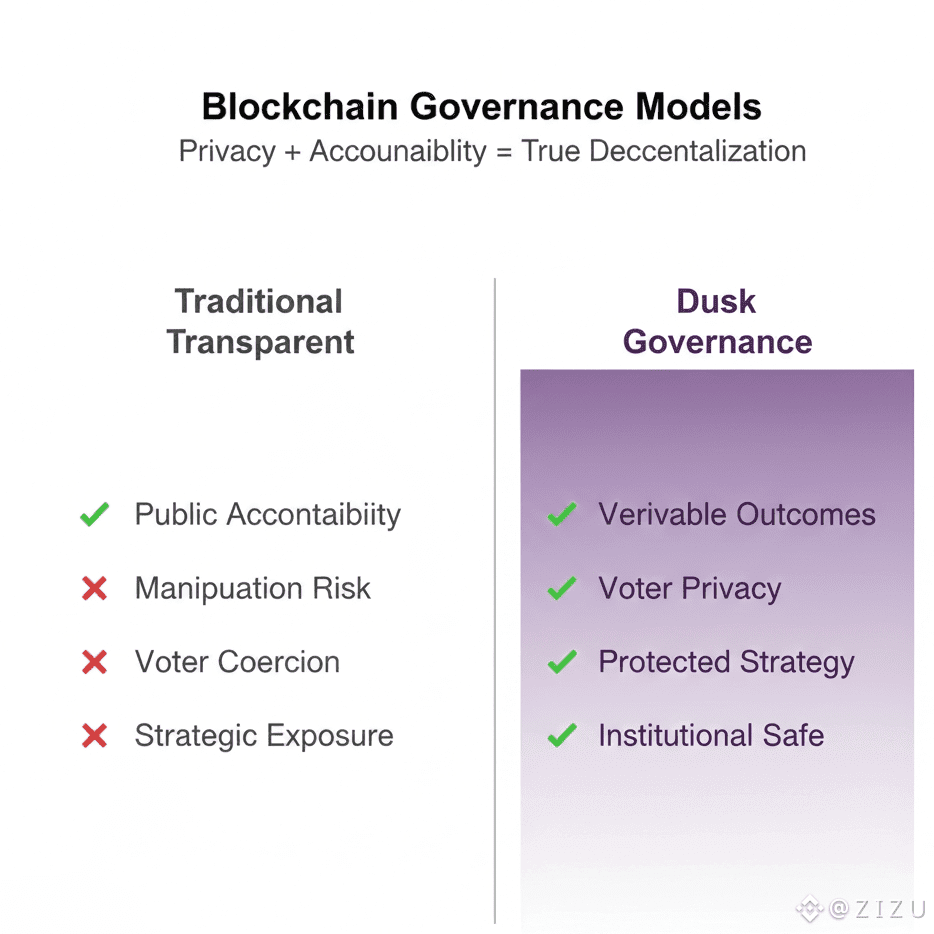
Dusk Coin reminds me that decentralization is not about loud displays of transparency or superficial equality. It’s about designing systems that respect human behavior, protect sensitive choices and still produce fair, verifiable outcomes. For me, this is the essence of next-generation blockchain governance.