
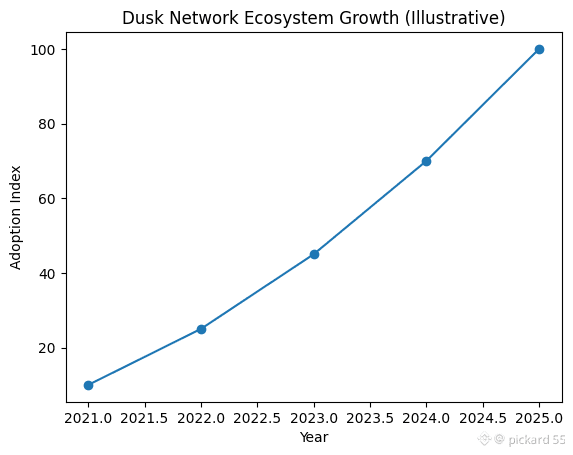
Most blockchains today force users to choose between two extremes. Either everything is fully public, where every transaction and balance can be seen forever, or everything is fully private, which creates trust and regulatory problems. Real financial systems do not work well in either extreme. Institutions, asset issuers, and regulated markets need privacy for sensitive data, but they also need proof, audits, and compliance when required. This is exactly the gap that Dusk Network is trying to solve.
Dusk Network is a Layer-1 blockchain built specifically for regulated finance, real-world assets, and confidential smart contracts. The core idea behind Dusk is privacy by default with selective disclosure. This means transactions and data remain private on-chain, but users or institutions can cryptographically prove ownership, validity, or compliance to authorized parties when needed. This approach is important because the next phase of crypto adoption is not just about speculation. It is about tokenized securities, compliant DeFi, and institutions that cannot operate on fully transparent blockchains.
Technically, Dusk uses advanced cryptography, including zero-knowledge proof systems, to validate transactions without revealing sensitive information. The network is built around a proof-of-stake model using a unique consensus mechanism called Segregated Byzantine Agreement. In this design, block production and validation roles are separated, improving security while maintaining decentralization. Dusk also introduces privacy-preserving leader selection, which helps protect participants in the consensus process and aligns with the network’s privacy-first philosophy.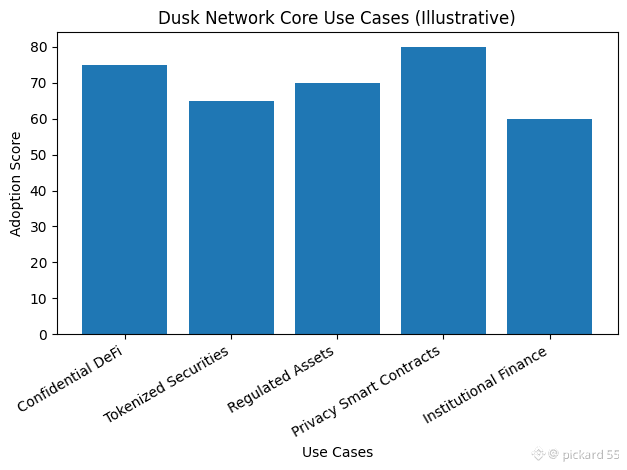
The $DUSK token plays a central role in the network. It is used for staking, securing the network, paying transaction fees, and participating in the ecosystem. The token supply is designed with long-term sustainability in mind, with emissions distributed over many years to reward active network participants. This structure supports long-term security and discourages short-term speculation-driven behavior. Gas fees on the network are efficient, and unused gas is not charged, making the system predictable for developers and institutions.
The Dusk ecosystem is focused on applications where privacy and compliance are critical. This includes tokenized real-world assets, confidential financial contracts, and compliance-friendly DeFi tools. One example from the ecosystem is Citadel, a decentralized licensing protocol that can support privacy-preserving identity and compliance use cases. Instead of exposing personal or financial data publicly, these tools allow verification without unnecessary disclosure, which is a major requirement for institutional adoption.
Looking ahead, Dusk’s roadmap shows a strong focus on mainnet development, ecosystem expansion, and real-world use cases rather than hype-driven growth. The team has consistently communicated that building compliant privacy infrastructure is complex and takes time, but it is necessary for bringing serious financial activity on-chain. This long-term mindset sets Dusk apart from many short-lived trends in the crypto space.
Of course, there are challenges. Privacy-focused technology is harder to build and harder to explain. Adoption by institutions is slow, and competition in the privacy and RWA space is increasing. However, the problem Dusk is solving is real and unavoidable. Finance cannot move fully on-chain without privacy, and privacy cannot scale in finance without compliance. Dusk Network is positioning itself exactly at this intersection.
That is why @dusk_foundation and $DUSK continue to stand out as a project focused on the future of compliant, privacy-preserving blockchain finance rather than short-term narratives. If regulated assets and institutions are truly coming on-chain, solutions like Dusk will be necessary.
