
Stablecoins were supposed to be crypto's killer app. The thing that finally made blockchain useful for regular people. And look, they sort of worked. We've got billions of dollars worth of them floating around now. But here's the awkward truth: using stablecoins still feels like trying to pay for coffee with a wire transfer. The infrastructure we built was designed for speculation, not for actually moving money around. That's the gap @Plasma is trying to fill, and honestly, it's about time someone did.
We spent years building these incredible general purpose blockchains. Universal computers, world computers, call them what you want. They're amazing pieces of technology. But when you try to use them for something as simple as sending USDT to your friend, suddenly you're dealing with complexity that would make a banking lawyer blush. Why do I need to think about gas prices? Why is finality measured in minutes or even hours? Why does every solution feel like a workaround?
Plasma takes a different approach. Instead of building another do-everything blockchain and hoping stablecoin users figure it out, they built a Layer 1 that asks a simple question: what if we optimized for money movement from day one?
The EVM Com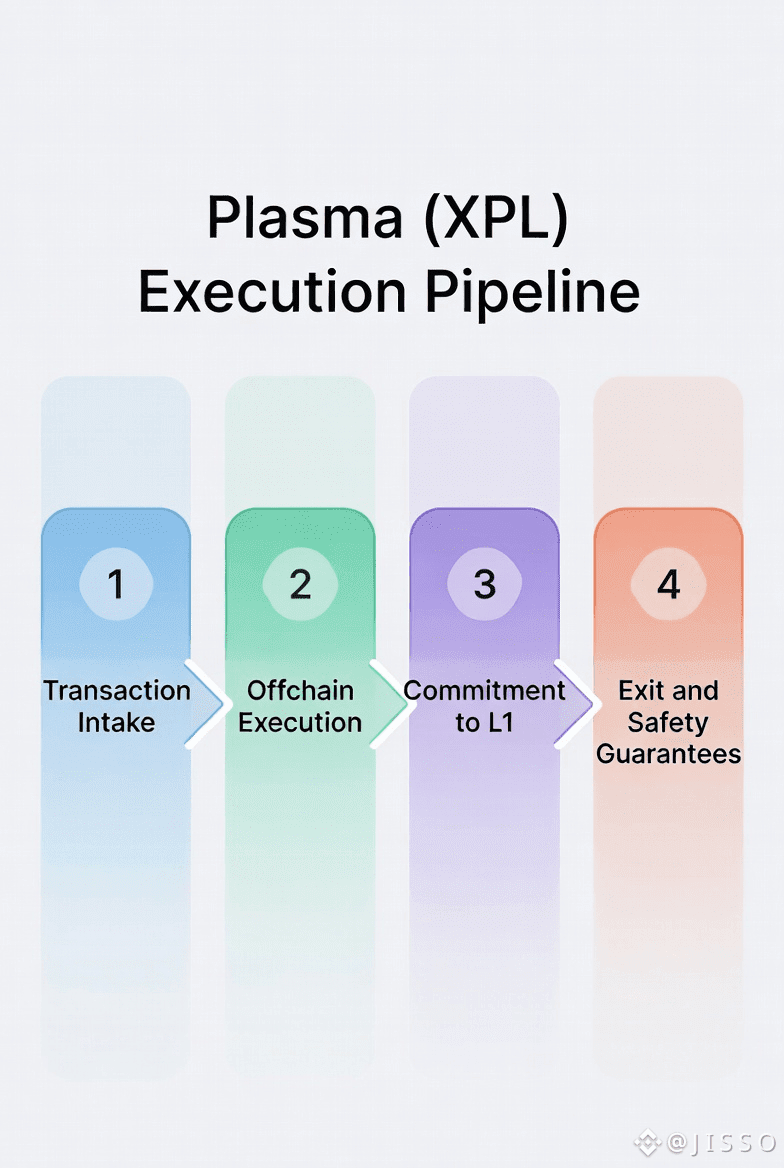 patibility That Actually Matters First things first. Yes, Plasma is EVM compatible, built on Reth. I know, I know, everyone claims EVM compatibility these days. It's become table stakes, like a restaurant advertising that they have plates. But there's a difference between technical compatibility and practical compatibility. Plasma gets this.
The reason EVM compatibility matters for stablecoins isn't about developer familiarity. It's about the massive existing infrastructure of wallets, exchanges, and DeFi protocols. When you're trying to move money, you don't want to ask your users to download a new wallet, learn new patterns, or bridge assets through three different chains. You want to plug into what already exists.
Plasma's implementation means that existing stablecoin integrations, from MetaMask to Ledger to whatever new wallet your cousin is building in his garage, just work. The difference is they work faster, cheaper, and without the usual headaches. This isn't about showing off technical prowess. It's about respecting the reality that stablecoins live in an ecosystem, and breaking that ecosystem is a non-starter.
Speed That Changes The Conversation Let's talk about finality for a second. On most chains, when you send a transaction, you're playing this little waiting game. You send it, you wait for confirmations, you hope the network isn't congested, you maybe grab a coffee. For buying NFTs or voting on governance proposals, this is fine. For paying for something, it's absurd. Imagine waiting ten minutes at a cash register while your payment "confirms."
PlasmaBFT, Plasma's consensus mechanism, delivers sub-second finality. Not "fast," not "pretty quick," but actually sub-second. This changes what you can build. Suddenly you can create payment experiences that feel like, well, payments. Point of sale applications work. Real-time settlement becomes real. You can start competing with Visa on user experience terms, not just on ideological ones.
The technical details of how PlasmaBFT achieves this are interesting if you're into that sort of thing, but what matters is the outcome. When money moves, it moves immediately. For stablecoins, which are supposed to be, you know, currency, this isn't a nice-to-have feature. It's the whole point.Gasless USDT: The Feature That Speaks For Itself
Here's where Plasma's stablecoin-first philosophy gets really obvious. They offer gasless USDT transfers. I'll say that again: you can send USDT without needing to think about gas fees. For anyone who's actually tried to introduce stablecoins to a non-crypto person, this is the moment where the lightbulb goes off.
The current standard experience goes something like this: "Hey, download this wallet. Now buy some ETH to pay for gas. Yes, I know you just want to send USDT, but you need ETH to send it. No, I can't explain why, that's just how it works." It's embarrassing. It's like needing to buy a special token to put a stamp on your envelope before you can mail a check.
Plasma's approach is simple: if you're sending USDT, you pay for the transaction in USDT. The network handles the conversion behind the scenes. Your users never need to touch the native token unless they want to. This single change removes the biggest onboarding barrier in crypto. Not your keys, not your coins, not some philosophical objection to decentralization. Just the pure, practical friction of needing two different tokens to complete one simple transaction.
And for the skeptics who immediately worry about tokenomics, yes, there's still a role for XPL. Validators need incentives, governance needs to happen, network security needs to be paid for. But regular users don't need to see any of that machinery. It's there, it works, and it stays out of the way Stablecoin-First Gas: A Different Way of Thinking
The gasless USDT feature is part of a broader stablecoin-first gas model that rethinks how transaction fees should work. On most chains, gas is this abstract concept tied to computational complexity. On Plasma, it's treated as what it actually is: a cost of moving value.
This means gas fees can be denominated in stablecoins, they're predictable, and they scale with the value being transferred rather than the computational steps. Sending a million USDT costs more than sending ten USDT, which makes intuitive sense. The computational difference is negligible, but the network resources and security implications are real.
For institutions building payment systems, this predictability is gold. They can model costs accurately. They can pass fees to customers in ways that make sense. They can build real business models without worrying that a sudden spike in meme coin trading will make their settlement costs go parabolic Bitcoin-Anchored Security: Why It Matters
Now let's talk about the Bitcoin-anchored security model, because this is where Plasma's design shows its patience. Most new chains bootstrap their security through some variation of Proof of Stake, which works but creates this circular dependency. The chain's security is tied to the value of its native token, which is tied to belief in the chain's security. It's fine until it isn't
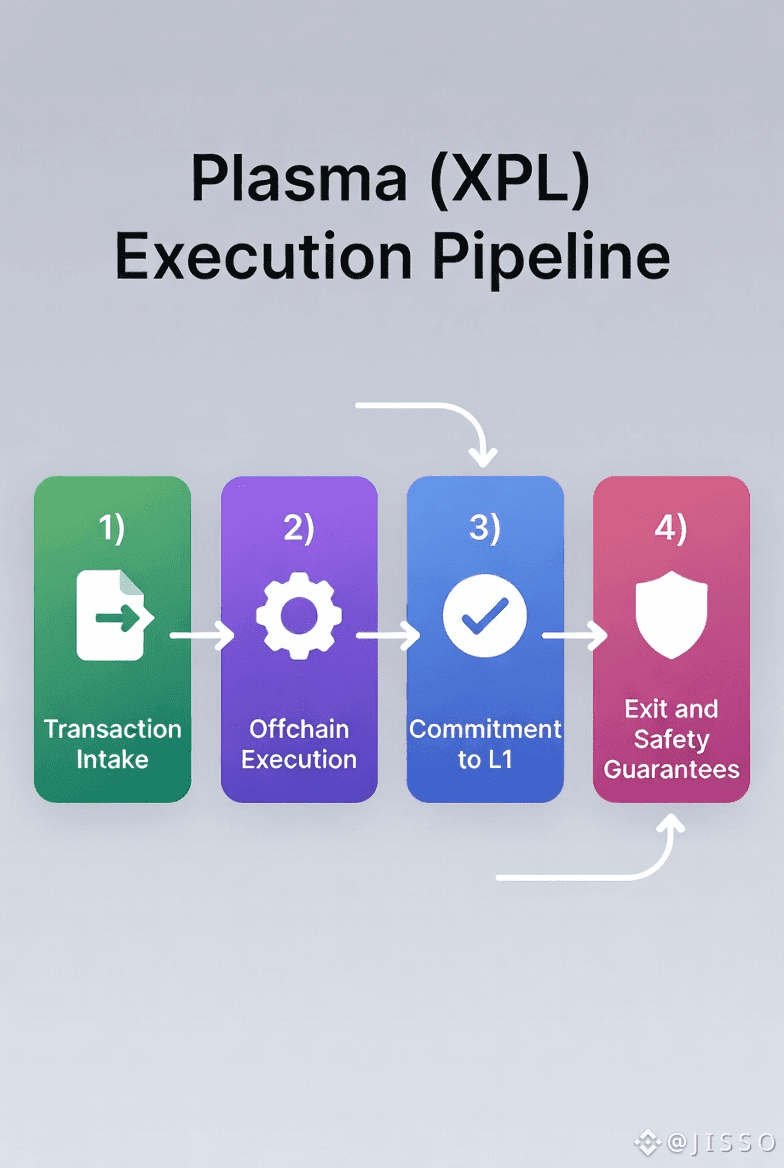
Plasma takes a different approach. They anchor their security to Bitcoin. The details involve checkpointing Plasma's state onto the Bitcoin blockchain, which means that breaking Plasma's security would require breaking Bitcoin's security. Not just theoretically, but actually compromising the Bitcoin network itself.
This serves two purposes. First, it's practical. Bitcoin is the most secure blockchain network in existence by orders of magnitude. Pegging to that security is like building your house on bedrock instead of on whatever the local token's market cap happens to be this week.
Second, and maybe more importantly, it's philosophically sound. Stablecoins need neutrality. They need censorship resistance that doesn't depend on the politics of a particular chain's validator set. By anchoring to Bitcoin, Plasma inherits the credible neutrality that makes Bitcoin valuable in the first place. For institutions moving serious money, this isn't a technical detail. It's a requirement.
Who Actually Uses This? Plasma's target users split into two groups that rarely overlap in crypto: retail users in high-adoption markets and institutional players in payments and finance. This split tells you a lot about their strategy.
The retail focus is on markets where stablecoins are already part of daily life. Places where local currency instability has made USDT the preferred medium of exchange for everything from remittances to small business transactions. In these markets, the current stablecoin experience is a necessary evil. People use it despite the friction, not because they love it. Plasma's improvements, gasless transfers, sub-second finality, predictable fees, solve real, immediate problems for these users.
The institutional focus is more forward-looking. Payments companies, remittance providers, fintech apps looking to integrate stablecoins. These players need reliability, compliance, and cost predictability. They can't tell their customers that a transaction failed because of network congestion. They can't rebuild their entire system every time gas fees spike. Plasma's enterprise-ready features, from the stablecoin-first model to the Bitcoin-anchored security, are designed for their actual requirements.
This dual focus is smart. The retail users provide organic growth and real transaction volume. The institutions provide scale and legitimacy. Each group validates the network for the other. The Bigger Picture
What Plasma is building matters beyond just making stablecoins easier to use. It's a test of whether focused design can beat general purpose complexity. The blockchain space has been obsessed with building universal solutions for years, chains that can do everything from DeFi to NFTs to governance to whatever new trend emerges next month.
There's value in that approach, but there's also cost. When you optimize for everything, you optimize for nothing. Your chain becomes a complex patchwork of compromises. Plasma takes the opposite bet. They're building something that does one thing, moving stablecoins, better than anyone else. They're betting that in a world of increasingly specialized applications, being the best at one critical function is more valuable than being okay at everything.
This is the kind of thinking that comes from real product experience. You don't build successful products by adding every feature possible. You build them by solving specific problems exceptionally well. Plasma's problem is clear: moving money on blockchain is still too hard. Their solution is equally clear: build a chain where that problem is the only thing that matters.
Whether this approach wins out remains to be seen. But in a space that often feels like it's building solutions in search of problems, there's something refreshing about a project that started with a simple question: why is sending stablecoins still so annoying? The answer might just be the infrastructure that finally makes digital money work the way it was supposed to all along.