I watch connections more than launches.
I remember how excited we were in 2021 when everything started connecting to everything. I watched liquidity jump chains in seconds. I also watched confusion rise just as fast. I’ve learned that interoperability sounds like freedom, but without discipline, it turns into fragility. That mindset shapes how I read Plasma’s approach to interoperability with other chains.
At its core, interoperability just means different blockchains can exchange value or data. Simple idea. Hard execution. Every connection adds assumptions. Who verifies the state? Who holds custody during transfer? What happens if one side breaks? Traders usually feel the consequences first, long before the postmortems appear.
Plasma doesn’t treat interoperability as a default good. That’s important. Instead of chasing maximum connectivity, it treats each connection as a risk decision. The Plasma network is designed primarily as a settlement layer, especially for stablecoin flows. That focus changes how and why it connects to other chains.
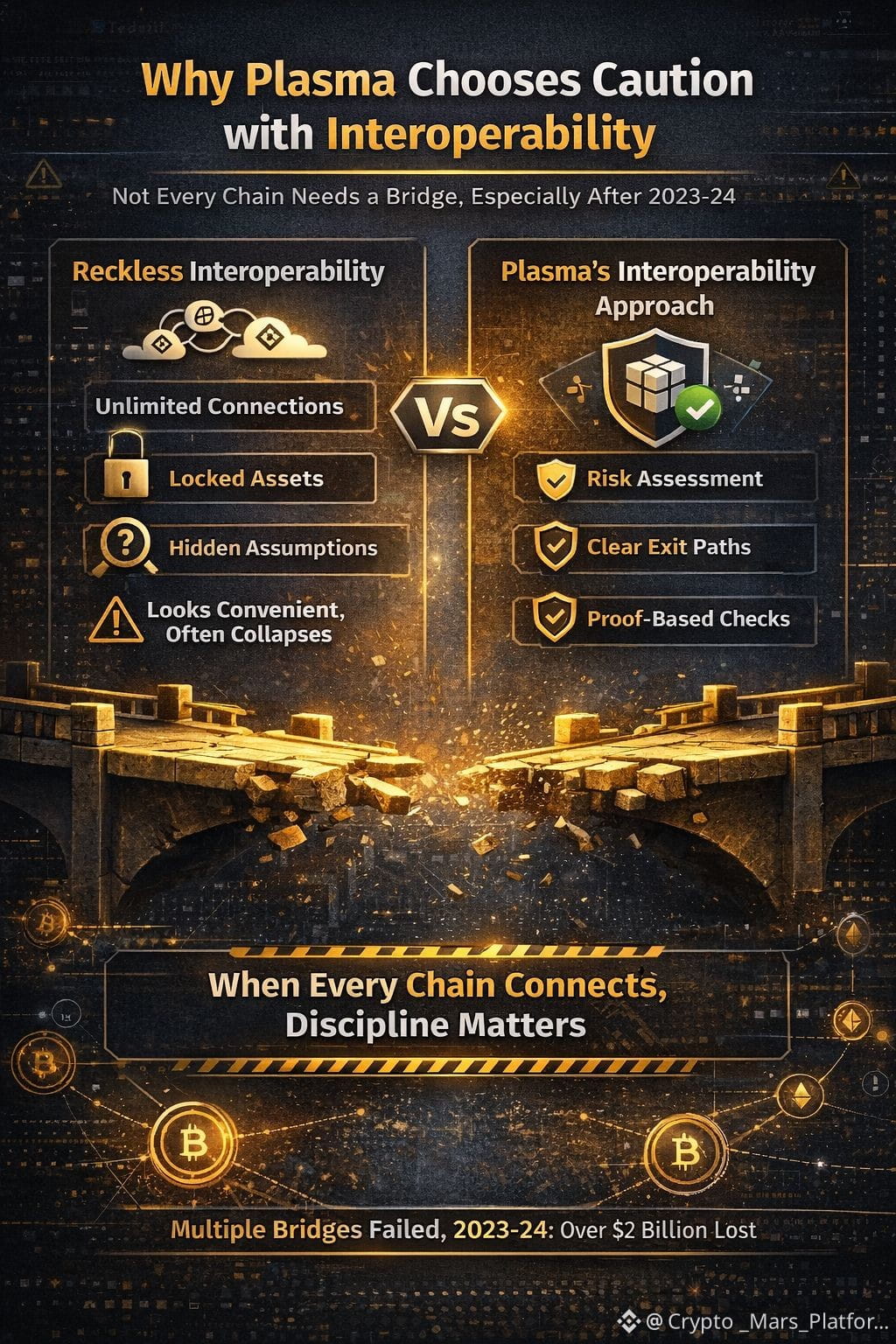
Why is this topic trending in 2024 and early 2025? Because the market learned the cost of careless interoperability. Over the last few years, billions were lost through bridge failures. Traders became cautious. Investors stopped assuming “more connections” meant “more value.” Interoperability moved from growth narrative to risk assessment.
Plasma’s design reflects that shift. It emphasizes verification, clarity, and exit logic over speed. In simple terms, Plasma prefers controlled interoperability. Connections are meant to be explicit, understandable, and reversible. If value moves across chains, the assumptions should be visible. If something fails, users should know how to get out.
Technically, interoperability often relies on locking assets on one chain and representing them on another. The weakest point is always the lock. Plasma’s architecture tries to reduce trust in single operators by focusing on rules, proofs, and defined failure paths. It assumes validators can fail. It assumes data can lag. That assumption isn’t pessimism. It’s experience.
From a trader’s perspective, this matters more than raw convenience. I’ve learned to distrust systems where risk feels hidden behind smooth UX. If a bridge feels too easy, I ask where the complexity went. Plasma doesn’t try to hide that complexity. It surfaces it. That honesty changes how you size positions and manage exposure.
Progress here has been steady, not loud. In 2024, the conversation around interoperability matured. Builders stopped promising “connect everything instantly” and started talking about security boundaries. Plasma aligns with that tone. It doesn’t claim universal composability. It claims safe interaction where it makes sense.
There’s also an economic angle. Liquidity doesn’t like uncertainty. Large capital moves slowly and prefers predictable rules. Interoperability solutions that respect this tend to attract more serious users over time. Plasma’s cautious stance signals that it’s built for capital that values survivability over novelty.
Personally, I’ve learned that not all friction is bad. Some friction protects you. Bitcoin taught us that. Ethereum reinforced it. Plasma seems to carry that lesson forward into how it thinks about cross-chain interaction. Connections are useful, but only when their limits are clear.
Philosophically, this feels like crypto growing more selective. Early cycles celebrated expansion. Mature cycles focus on resilience. Plasma’s interoperability model suggests it understands that transition. It doesn’t see chains as islands, but it also doesn’t pretend borders don’t matter.
I trust systems that say “no” more than systems that say “yes” to everything. Saying no means you’ve measured the cost. Plasma’s approach to interoperability feels measured. It knows what it wants to connect to, and just as importantly, what it doesn’t.
In the end, interoperability isn’t about how many chains you touch. It’s about how you behave when one of them breaks. I’ve watched too many systems fail that test. Plasma’s design suggests it’s asking that question early, not after the damage is done.