
Vanar is often described as an AI first Layer 1, but that label alone does not explain what makes the network different. The real distinction appears when you look at who the system is designed to serve by default.
Vanar is not optimized around user initiated transactions. It is optimized around agent execution.
This is not a narrative choice. It is an architectural one.
Vanar does not assume a human in the loop
Most Layer 1 networks assume a human is present at every critical step. A user decides when to send a transaction. A user waits if fees rise. A user retries if confirmation is delayed.
Vanar does not make that assumption.
Vanar starts from the idea that execution will increasingly be driven by software agents. These agents do not pause, monitor dashboards, or adjust behavior based on changing conditions. They execute based on predefined logic and expected outcomes.
Because of that, Vanar treats settlement predictability as a core requirement, not an optimization target.
Settlement is part of execution on Vanar
On Vanar, value transfer is not treated as a separate event that happens after a decision is made. It is part of the execution loop itself.
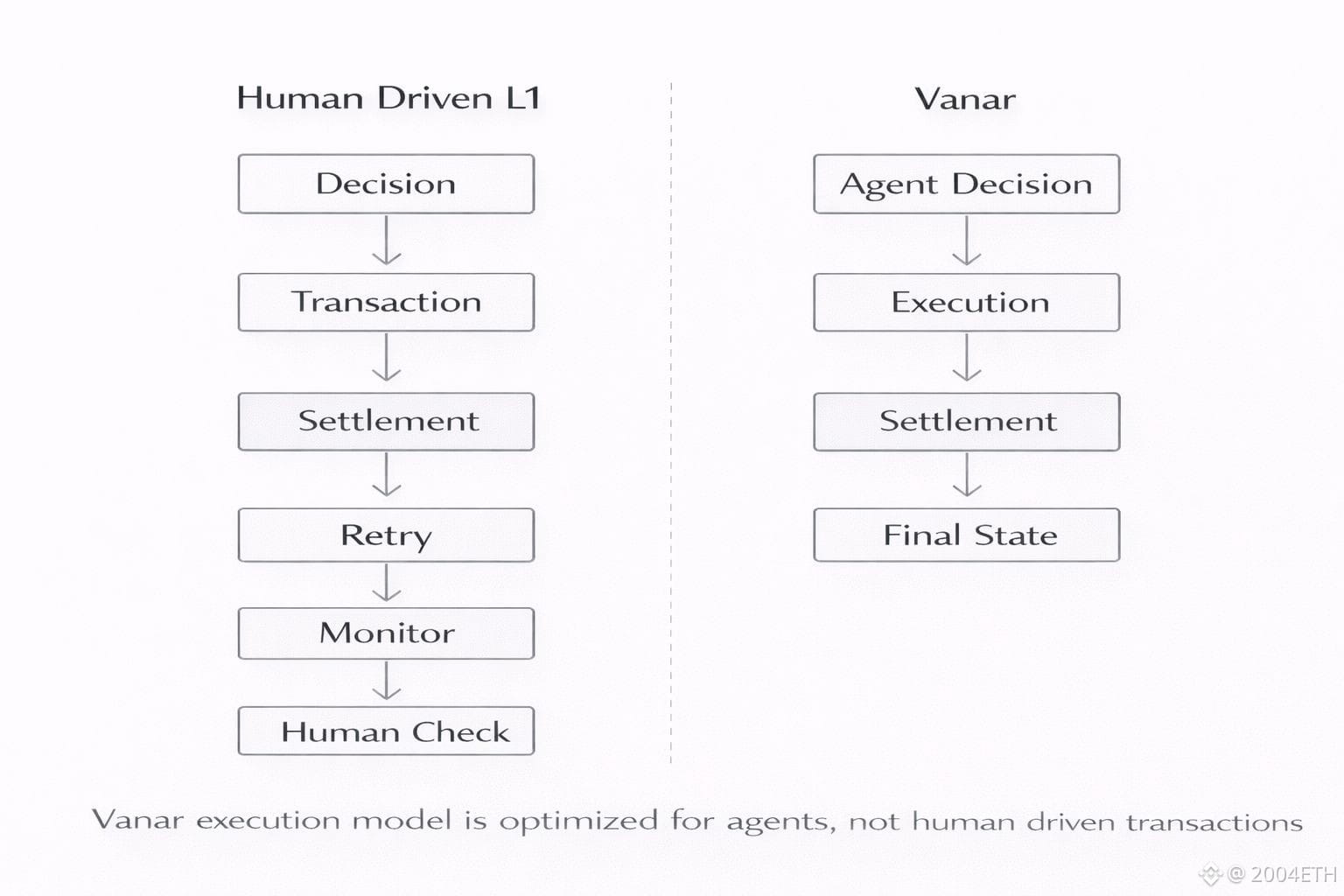
An agent operating on Vanar is expected to:
Observe data
Retain context
Make a decision
Settle value
Continue execution
All without waiting for human confirmation.
This is why Vanar does not frame payments as a feature. Payments are infrastructure. If settlement cannot be assumed to complete reliably, automated execution breaks.
What VANRY actually secures
VANRY is often misunderstood as a simple transaction fee token. That framing misses its actual role inside the system.
VANRY underpins participation in an execution environment where autonomous actions must complete deterministically. It secures the economic layer that allows agents to move value as part of a continuous process.
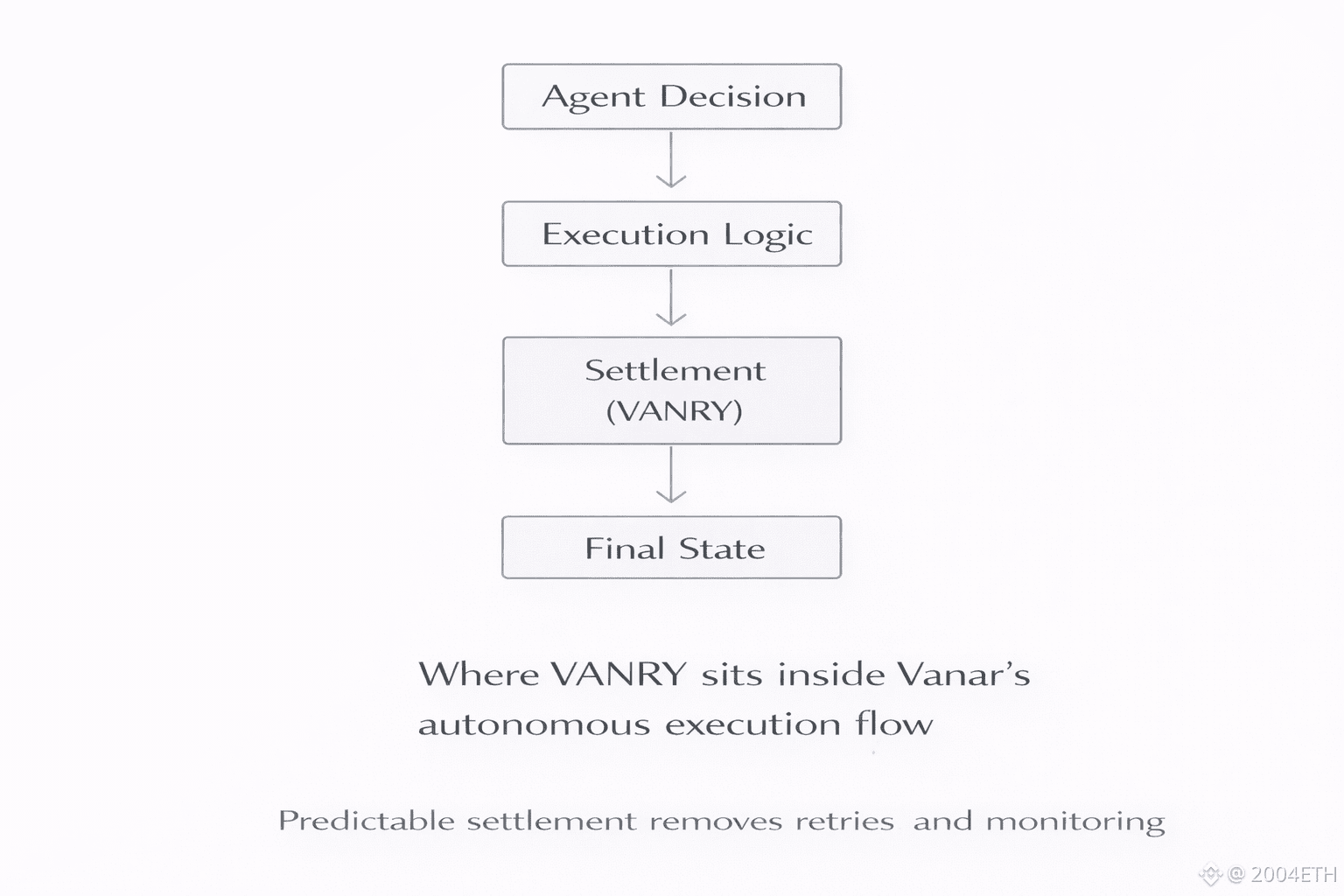
VANRY is not priced on how frequently humans interact with the network. It is positioned around whether automated activity can scale without introducing retries, monitoring logic, or human intervention.
This is a fundamentally different value driver.
Why this matters for AI readiness
AI readiness on Vanar is not about model complexity or feature count. It is about whether an agent can assume that its actions will settle within known bounds.
Unpredictable settlement introduces branching logic. Branching logic introduces coordination cost. Coordination cost reintroduces humans.
Vanar’s design pushes that complexity downward into infrastructure rather than upward into applications. That is the only place it can be standardized.
Live products reinforce the design choice
This execution first philosophy is not theoretical. Vanar’s live components reinforce it.
myNeutron demonstrates persistent context at the infrastructure layer, not at the application edge.
Kayon shows that reasoning and explainability can be embedded into on chain logic.
Flows proves that automated decision making can translate into controlled execution, not just simulation.
These systems rely on predictable settlement to function as intended. Without it, they degrade into supervised workflows.
Why Vanar measures progress differently
Vanar does not measure success by headline throughput or short term activity spikes. It measures progress by how little friction remains in execution.
Every removed retry condition, every eliminated monitoring dependency, reduces the operational cost of autonomy. That reduction compounds as activity scales.
This is why Vanar emphasizes readiness over narratives. Autonomy is binary at scale. Either the system can run without supervision, or it cannot.
The long term implication for VANRY
As agent driven activity increases, networks that assume human behavior will accumulate coordination overhead. Networks that assume autonomous execution will not.
VANRY is aligned with the latter.
Its value is tied to whether Vanar remains a place where machines can act without negotiation, delays, or manual oversight. That is a quieter value proposition, but it is one that becomes more important as automation grows.
Vanar is not trying to win the attention economy. It is building infrastructure for systems that do not need attention at all.