
 Decentralized finance has moved far beyond its experimental phase. What once began as simple peer-to-peer lending has grown into a complex financial ecosystem that demands precision, reliability, and trust. Plasma enters this landscape not as a protocol chasing attention, but as one designed to refine how on-chain lending should function at scale. Its focus is not only on enabling borrowing and lending, but on shaping behavior, reducing systemic stress, and creating an environment where capital can move predictably across market cycles.
Rather than treating growth as an end goal, Plasma treats it as a byproduct of sound structure. This mindset positions the protocol closer to financial infrastructure than speculative experimentation.
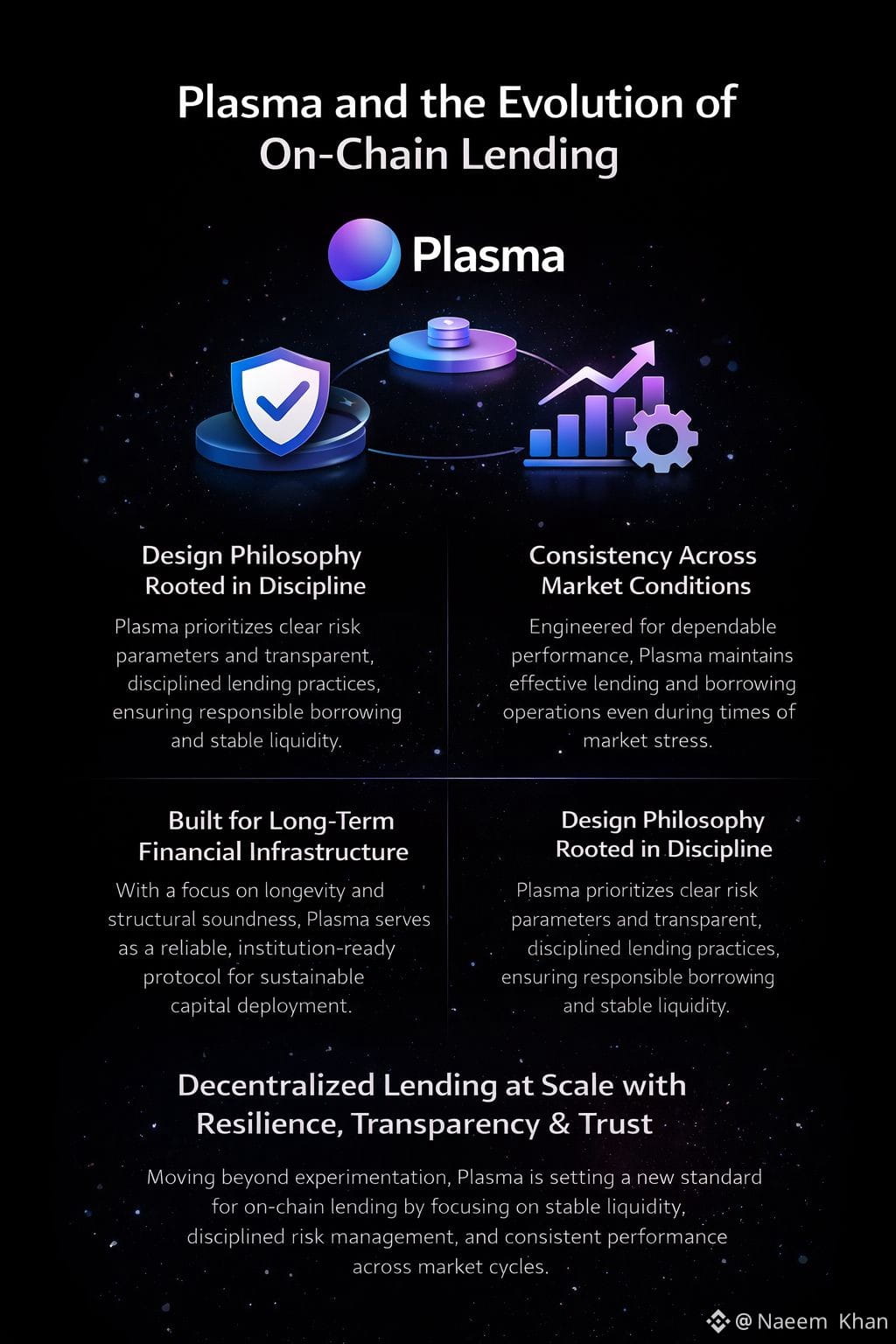
Design Philosophy Rooted in Discipline
At the core of Plasma lies a philosophy of discipline. Every lending system is ultimately defined by how it manages risk, and Plasma approaches this with deliberate restraint. Instead of maximizing leverage or encouraging aggressive borrowing, the protocol emphasizes clearly defined parameters that reward responsible participation. This creates a healthier balance between lenders and borrowers, reducing volatility and improving overall system resilience.
Plasma’s architecture is built to minimize ambiguity. Users are not required to navigate opaque mechanics or unpredictable outcomes. Instead, the protocol prioritizes transparency in how liquidity behaves, how borrowing conditions adjust, and how risk is distributed. This clarity fosters confidence, particularly among users who view DeFi as a long-term financial tool rather than a short-term opportunity.
Consistency Across Market Conditions
One of the defining challenges in decentralized lending is performance under pressure. Market stress often exposes weaknesses in protocol design, from liquidity fragmentation to cascading liquidations. Plasma is engineered with these realities in mind. Its systems are structured to remain composed during periods of heightened demand, ensuring that lending and borrowing continue to function smoothly when they are needed most.
This consistency is not accidental. It is the result of prioritizing predictability over rapid expansion. By focusing on sustainable usage patterns and stable liquidity behavior, Plasma avoids many of the pitfalls that have historically destabilized lending platforms. The result is an environment where participants can make informed decisions without constantly reacting to sudden structural shifts.
In a market defined by cycles, Plasma’s ability to maintain operational stability becomes a defining competitive advantage.
Plasma as Long-Term Financial Infrastructure
As decentralized finance matures, the distinction between protocols that merely operate and those that endure becomes increasingly clear. Plasma positions itself firmly in the latter category. Its emphasis on structural integrity, measured growth, and user trust reflects a broader vision: to serve as a dependable financial layer that can support serious capital over time.
Rather than relying on incentives to attract attention, Plasma builds credibility through performance. This approach aligns with the needs of institutions, advanced users, and developers seeking a lending environment that values longevity over spectacle. In doing so, Plasma contributes to a larger shift within DeFi—one that prioritizes reliability, accountability, and purpose-driven design.
Ultimately, Plasma represents a maturing philosophy of decentralized lending. It demonstrates that the future of DeFi will not be defined by who grows fastest, but by who builds systems strong enough to last.