

Blockchain has spent years promising transformation, yet in practice it has struggled to meet the expectations of real users. High fees appear without warning, transactions slow down during peak demand, and onboarding remains complicated for anyone outside the technical bubble. These issues become even more visible in sectors like gaming and entertainment, where speed, consistency, and smooth interaction are not optional but essential. Vanar Chain enters this space with a clear intent: to remove the structural friction that has kept blockchain from scaling into everyday digital life.
The foundation of Vanar is built around usability at scale. Instead of designing for a small group of crypto-native users, the chain is engineered to support millions and eventually billions of participants without changing how it feels to use. This shift in mindset shapes every technical decision. Vanar does not treat performance as a marketing feature but as a baseline requirement. Transactions are expected to settle quickly, costs are expected to remain stable, and the network is expected to behave predictably regardless of market conditions.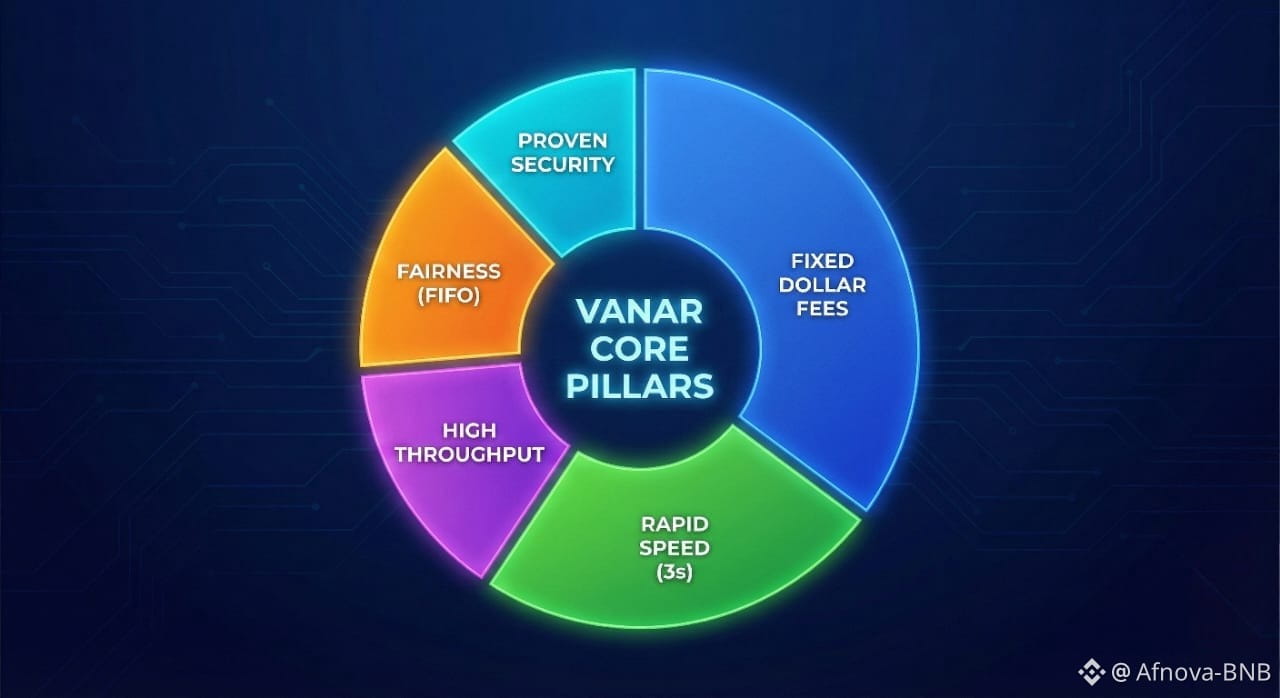
At the heart of this approach lies a simple but powerful commitment: fixed transaction fees denominated in dollar value. Traditional blockchains rely on gas pricing models that fluctuate with network demand and token price movements. This creates uncertainty for users and developers alike. On Vanar, this uncertainty is removed. Standard transactions are processed at a consistent cost of $0.0005, regardless of how the native token performs in the market. Whether the token price rises modestly or surges dramatically, the end user experience remains unchanged. This single design choice transforms how applications can be built, budgeted, and scaled.
Speed is treated with the same level of seriousness. Vanar operates with a maximum block time of three seconds, allowing transactions to reach finality fast enough to support real-time interaction. This matters deeply for gaming environments, digital marketplaces, and interactive applications where delays break immersion and trust. Instead of forcing users to wait for confirmations, Vanar enables a flow where actions and responses feel immediate. The chain does not ask users to adapt to blockchain limitations. It adapts the blockchain to user expectations.
Throughput is another critical layer of this design. By combining rapid block times with a high gas limit per block, Vanar creates an environment capable of handling a large volume of transactions without congestion. This balance allows complex operations to run smoothly alongside simple transfers, even during periods of heavy activity. The network remains responsive, maintaining performance consistency that high-volume platforms depend on to function reliably.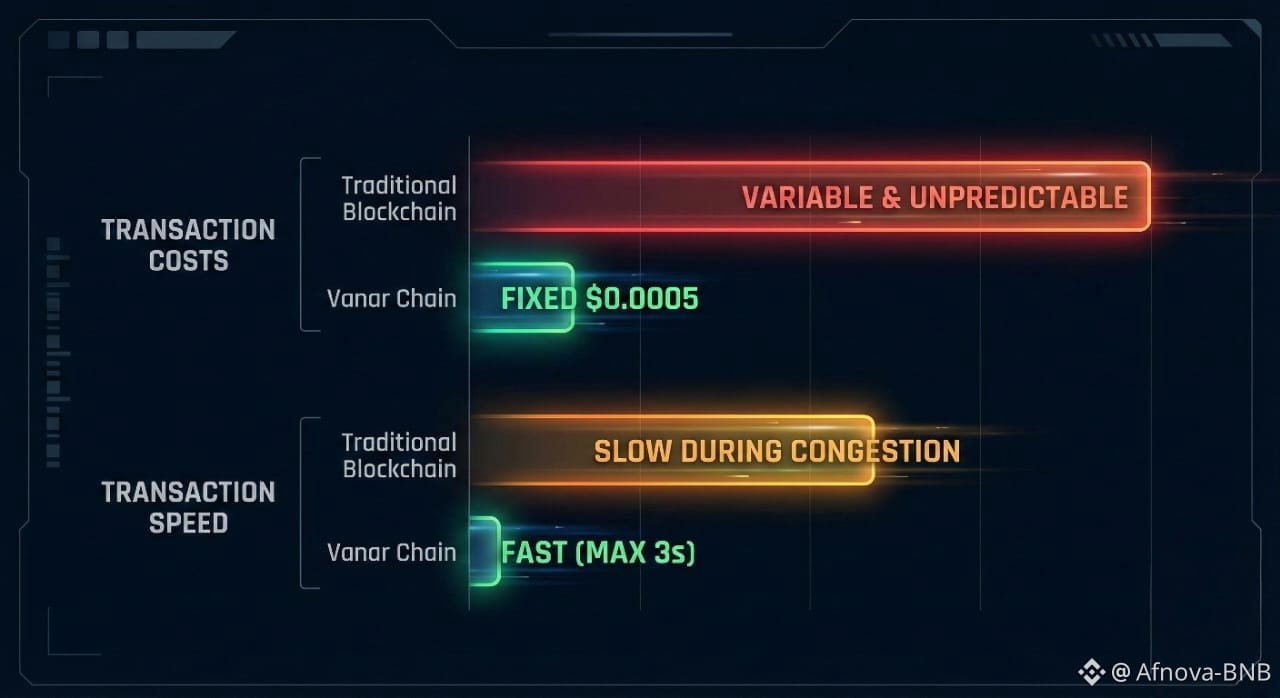
Fairness at the protocol level further reinforces trust in the system. Vanar processes transactions strictly in the order they enter the network. With fixed fees in place, there is no incentive or mechanism for priority bidding. Validators are required to follow a first-in, first-out sequence when sealing blocks. This ensures that all participants, regardless of size or influence, operate on equal terms. Small developers and large enterprises interact with the network under the same rules, without hidden advantages.
Underpinning this infrastructure is a carefully chosen technical foundation. Vanar is built on the Go Ethereum codebase, one of the most tested and trusted blockchain implementations in production. This choice anchors the network in proven security while allowing targeted modifications that align with Vanar’s performance goals. Instead of experimenting with untested systems, Vanar evolves from a base that has already demonstrated resilience at scale.
The native token, VANRY, plays a central role in this ecosystem. It functions as the gas token for transactions while also supporting staking, governance participation, and validator incentives. The supply is capped, and minting follows a controlled structure designed to support long-term stability. An initial supply is introduced at launch to ensure continuity for existing participants, while the remaining issuance is distributed gradually over an extended period through block rewards. This approach avoids sudden supply shocks and aligns incentives across the network.
Security is treated as a continuous priority rather than a final checkbox. Protocol-level changes are subject to rigorous review, and code development follows established best practices. Validators are selected carefully, and governance mechanisms are designed to encourage responsible participation. The aim is to maintain a network that is not only fast and affordable but also resilient and trustworthy over time.
What ultimately sets Vanar apart is not any single feature, but the way its components align around a clear purpose. Speed, cost predictability, fairness, and security are not isolated goals. They reinforce each other to create a blockchain that feels stable, responsive, and ready for mainstream use. Instead of asking users and developers to compromise, Vanar reshapes the infrastructure so compromise is no longer necessary.
This is the direction blockchain has been moving toward but has struggled to reach. Vanar represents a step closer to that destination, where performance is consistent, costs are transparent, and the technology fades into the background, allowing applications and experiences to take center stage.