

Blockchain infrastructure has matured technologically, but economically it remains fragile for real-world applications. Fee volatility, congestion-driven prioritization, and unclear long-term incentives continue to make high-frequency, consumer-facing use cases difficult to sustain. VanarChain approaches this problem from a different angle, designing its Layer 1 around economic predictability rather than reactive fee markets.
At the center of Vanar’s design is a fixed-fee transaction model denominated in dollar value instead of native token price. This directly addresses one of the most persistent pain points in blockchain deployment: the inability to forecast operating costs. On Vanar, common actions such as token transfers, swaps, NFT minting, staking, or bridging are engineered to consistently cost around $0.0005, independent of VANRY’s market valuation.
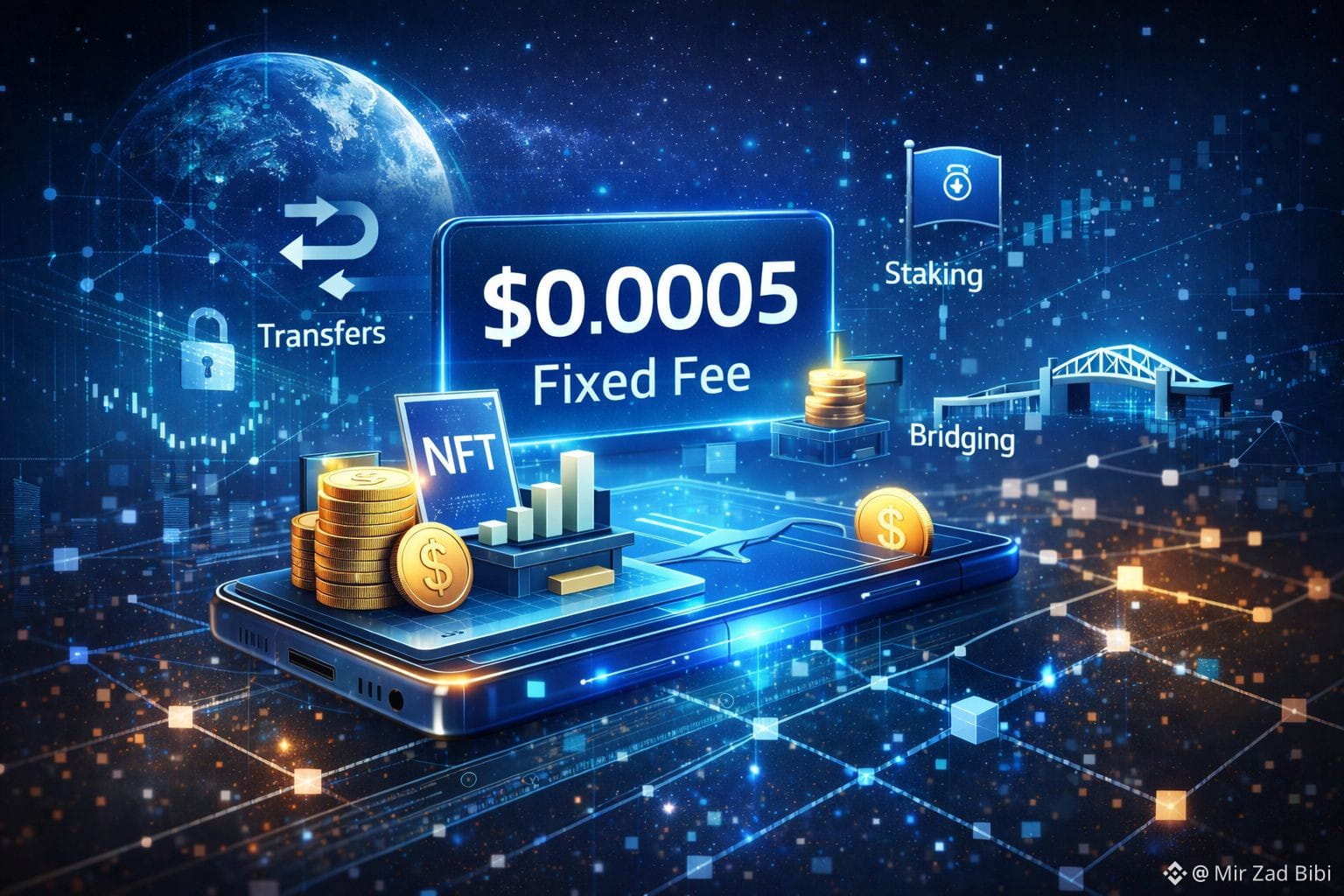
This is a subtle but important shift. When fees scale with speculation rather than usage, applications are forced to optimize around volatility instead of user experience. Vanar’s fixed-fee model restores a sense of infrastructure stability, allowing developers—particularly in gaming and entertainment—to design systems where growth does not make the product economically unusable.
Low fees alone, however, are not enough. History shows that ultra-cheap blockchains are vulnerable to abuse, where attackers can congest the network with large, block-filling transactions at negligible cost. Vanar addresses this through a tiered fee system based on transaction gas consumption. Standard transactions remain extremely cheap, while unusually large transactions move into higher fee brackets.
The rationale is defensive rather than extractive. A large transaction that consumes most of a block becomes progressively more expensive, making denial-of-service style attacks economically irrational. What might cost a few dollars on a flat-fee system could cost thousands under Vanar’s tiered structure. This preserves accessibility for normal users while introducing economic friction precisely where it is needed.
Maintaining dollar-denominated fees in a volatile market requires coordination. Vanar solves this by actively computing the VANRY token price using a mix of on-chain and off-chain data sources. This price is periodically updated at the protocol level—checked every hundred blocks—and used to dynamically adjust the amount of gas token required per transaction. From the user’s perspective, the fee remains stable even as token prices fluctuate.
This introduces a degree of managed economic logic that differs from purely market-driven fee systems. But it reflects Vanar’s broader philosophy: predictability and usability are prioritized over ideological purity. For consumer-scale applications, this trade-off is often practical.
The VANRY token itself is structured to support this long-term model. It has a hard cap of 2.4 billion tokens, with 1.2 billion minted at genesis to enable a 1:1 migration from the existing TVK token. This preserves continuity for the Virtua ecosystem while establishing VANRY as the native gas token for the new chain.
The remaining supply is issued gradually as block rewards over a 20-year period. This long emission curve aligns validator incentives with sustained network usage rather than short-term extraction. Of newly minted tokens, the majority—83%—is allocated to validator rewards, while development incentives and community distributions make up the rest. Notably, no explicit team allocation is defined within the emission schedule, shifting economic weight toward network participants.
Consensus design reinforces this structure. Vanar begins with a Proof of Authority foundation and expands validator participation through a Proof of Reputation mechanism. Validators are selected through community voting, with VANRY stakers delegating tokens to candidates they consider reputable. Block rewards flow not only to validators but also to the community members who supported them, creating a feedback loop between participation, reputation, and economic return.
Interoperability is treated as a baseline requirement rather than a future goal. By building on the Geth codebase and maintaining full EVM compatibility, Vanar follows a simple rule: what works on Ethereum should work on Vanar. This lowers migration friction for existing DeFi protocols, NFT marketplaces, and games, allowing them to retain familiar tooling while operating in a more cost-stable execution environment.
When viewed holistically, VanarChain’s design is internally consistent. Fixed fees reduce uncertainty, tiered pricing protects against abuse, long-term emissions stabilize incentives, and EVM compatibility accelerates ecosystem growth. These are pragmatic choices shaped by application needs rather than abstract optimization.
Whether Vanar succeeds will depend on execution and adoption, not whitepaper intent. But its architecture reflects a clear thesis: if blockchain is to support gaming, entertainment, and mass-market applications, it must behave like dependable infrastructure. In a space still dominated by speculative economics, Vanar’s focus on predictability may prove to be its most meaningful differentiator.
