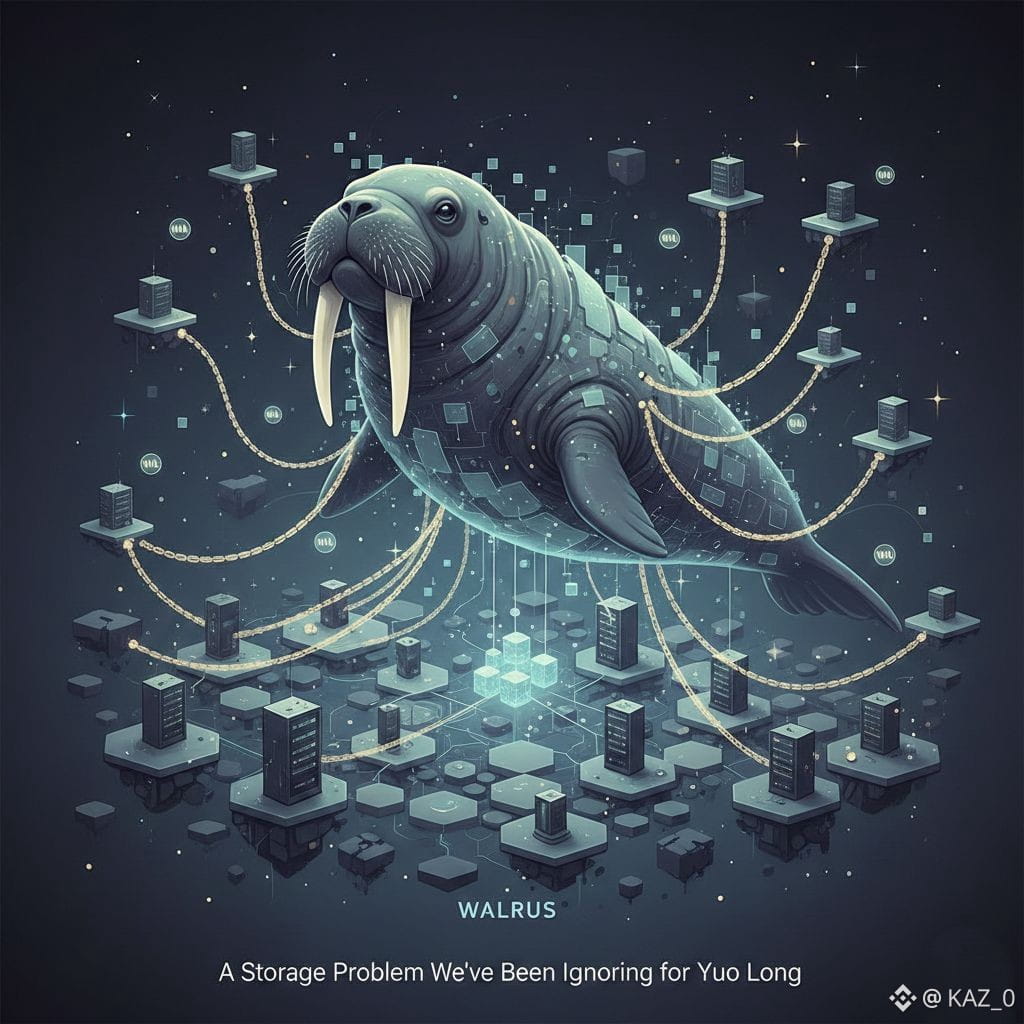
For the past few days, I’ve been trying to properly understand Walrus. Honestly, at the start, I wasn’t very impressed. My first reaction was the same one I’ve had many times before: okay, another decentralized storage project. We’ve seen plenty of those. Big claims, clean diagrams, and a lot of promises that sound great on paper.
But the more time I spent with it, the more I realized Walrus isn’t trying to be exciting. And that’s actually the point.
If you strip everything down, the problem Walrus is dealing with is pretty simple—and also pretty uncomfortable. We talk a lot about decentralization, but most blockchains still depend on centralized storage for their actual data. The apps may be on-chain, the logic may be decentralized, but the heavy files, the history, the real substance? That usually lives somewhere else. Old servers. Someone else’s infrastructure.
That’s a strange contradiction, and we’ve all kind of learned to live with it.
Walrus is built around fixing that exact gap. Not in a flashy way, but in a very practical one. Instead of trying to force large data directly onto a blockchain, it creates a system where data can live off-chain while still being verifiable, distributed, and tied to on-chain rules. The blockchain knows the data exists, who owns it, and how long it should be stored. That alone changes the relationship between applications and their data.
One design choice I found genuinely sensible is how Walrus handles redundancy. Rather than copying entire files again and again across the network, it breaks data into pieces and spreads them out. You don’t need every node to be online. You don’t need perfect conditions. Enough pieces survive, and the data survives. It’s not romantic, but it’s realistic. Storage systems fail all the time in the real world, and pretending otherwise is usually where designs fall apart.
Building on Sui also feels intentional. Walrus treats stored data almost like an object with rules around it—something that can be referenced, paid for, governed, and eventually retired. That matters more than it sounds. Real systems aren’t permanent. Data has a lifecycle. Walrus seems to understand that instead of pretending storage is infinite and free.
The WAL token fits into this in a fairly grounded way. It’s used to pay for storage upfront, for specific periods of time. That mirrors how infrastructure actually works outside crypto. You pay for capacity. You pay for duration. You expect accountability. Staking and governance exist, but they don’t dominate the story. The token feels more like a tool than a centerpiece.
That said, I don’t think Walrus is beyond question. Papers and architecture diagrams are one thing; mainnet conditions are another. The real test will be how this system handles sustained usage, real traffic, and real economic pressure. Adoption is always where good ideas either mature or quietly fade. It’s fair to be a little skeptical until that story plays out.
What I do appreciate is the absence of noise. Walrus isn’t shouting about changing the world. It isn’t trying to convince anyone emotionally. It’s solving a boring problem—and boring problems are usually the ones that matter most. If storage remains centralized, then decentralization always has a ceiling. Walrus is trying to raise that ceiling, slowly and carefully.
It may never be the loudest project in the room. And honestly, that might be its strongest signal.